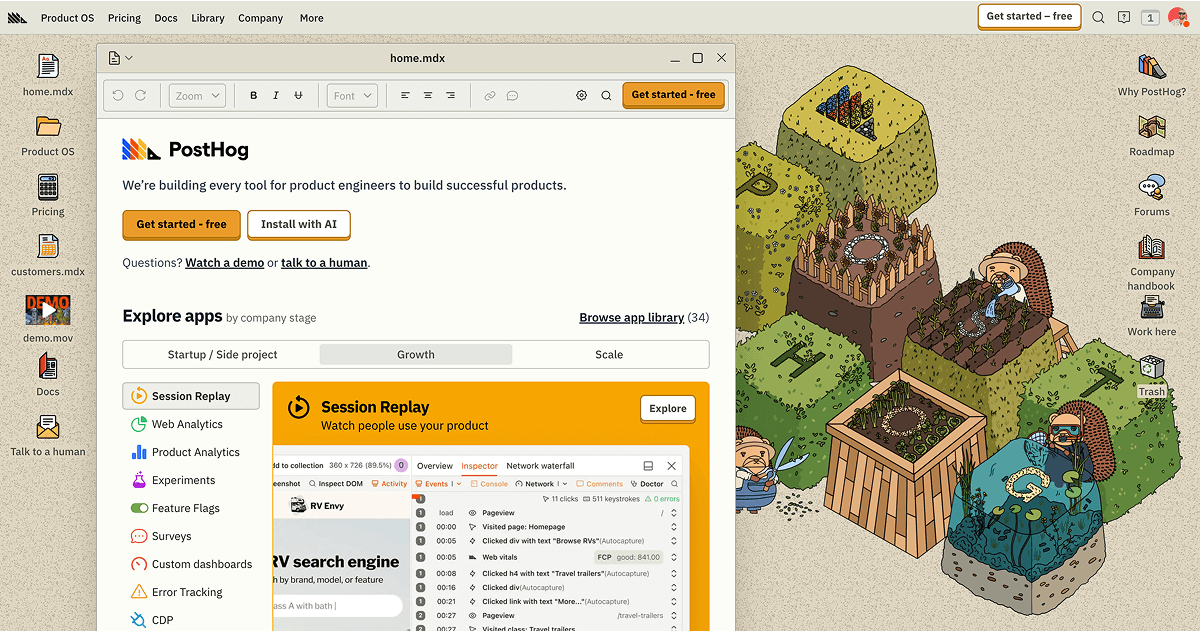
PostHog is an open-source, self-hostable product OS that replaces six separate tools with a single integrated platform. We rate it 85/100 — an outstanding choice for engineering-led teams who want full data ownership, generous free limits, and a product that's built by developers, for developers.
What is PostHog?
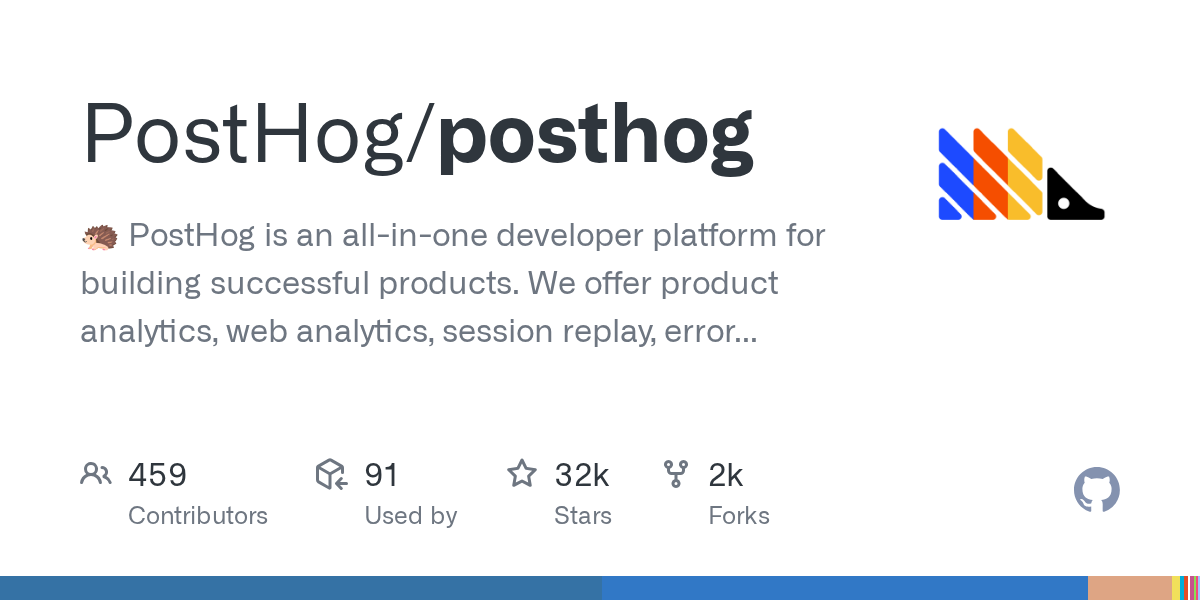
PostHog was founded on by James Hawkins and Tim Glaser, who launched the MVP on Hacker News just four weeks after writing the first line of code. The product immediately resonated with developers tired of sending user data to third-party analytics platforms. Today, PostHog is used by 190,000+ teams worldwide, has 31,900+ GitHub stars, and is MIT-licensed and fully open-source.
Where competitors like Amplitude, Mixpanel, or FullStory each solve one piece of the puzzle, PostHog natively combines product analytics, web analytics, session replay, feature flags, A/B testing, error tracking, surveys, a customer data platform (CDP), and an AI product assistant — all in one stack, with data that never needs to leave your infrastructure if you self-host.
Key Features of PostHog
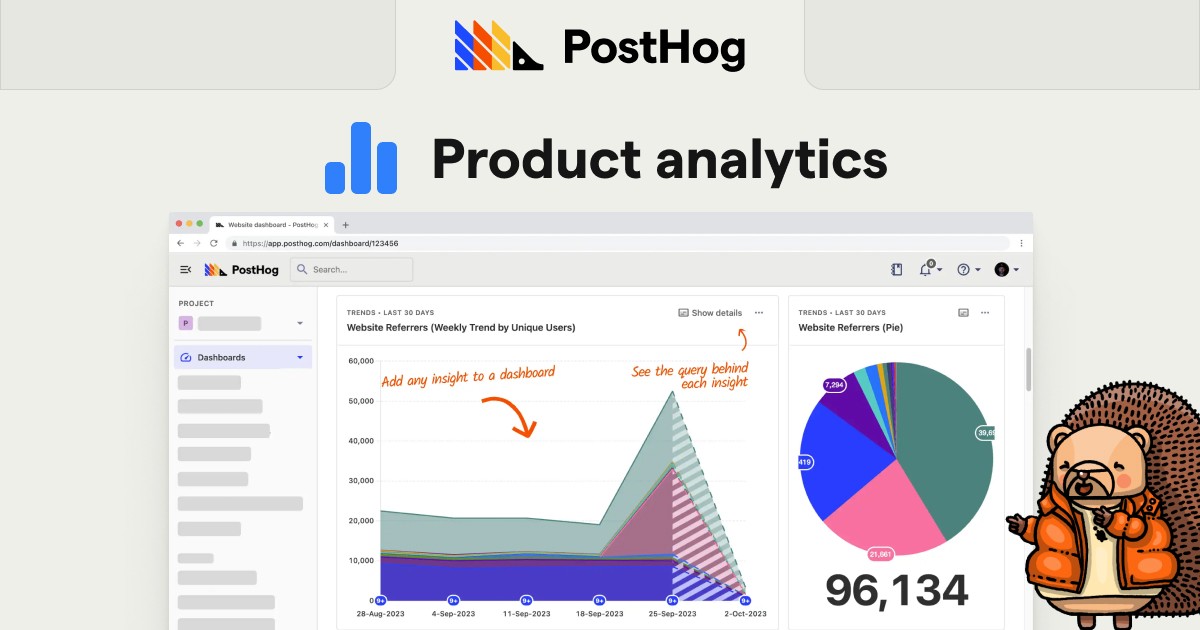
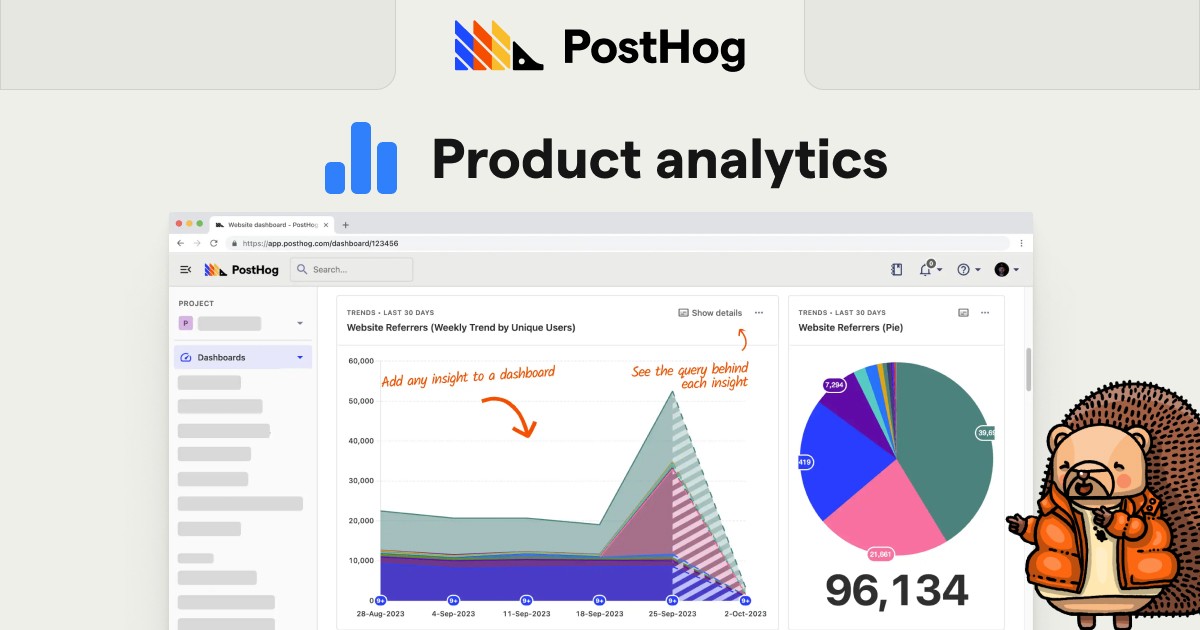
- Product Analytics: Build Trends, Funnels, Retention, User Paths, and Lifecycle reports using autocaptured or manual events. PostHog's autocapture tracks every click and pageview automatically with no manual instrumentation required.
- Session Replay: Watch real user sessions with DOM-level recording to diagnose bugs and understand exactly where users get confused — all data stays on your servers if self-hosted.
- Feature Flags & Experimentation: Roll out features to specific user cohorts, run A/B and multivariate tests, and measure statistically significant results — natively integrated with analytics so you can immediately see the impact.
- Error Tracking: Capture exceptions and stack traces directly from your product. Correlate errors with user sessions and funnels to understand the business impact of bugs.
- Surveys: Launch in-app surveys targeting specific user segments. Tie responses to behavioral data for full context.
- Data Warehouse & CDP: Sync data from your CRM, data warehouse, or payment processor and query it alongside product data using SQL.
- AI Product Assistant (Max): Ask questions in plain English — "Why did signups drop last week?" — and get answers grounded in your actual data.
What Users Say About PostHog
PostHog earns consistently strong reviews across G2, Product Hunt, and Reddit. On G2, users praise the "immensely useful session recordings" and love that you get significant functionality without paying per seat. Reddit's r/webdev and r/SaaS communities frequently cite PostHog as their top recommendation for startups that want to avoid paying Mixpanel's per-event pricing at scale.
However, feedback isn't universally glowing. A recurring complaint across G2 and Hacker News is the steep learning curve — users say PostHog done properly takes a few hours of configuration, and the UI can feel cluttered for teams that only need basic analytics. Some developers also note that webhook control is limited and experiment configurations can feel inflexible for complex statistical setups. PostHog's team is responsive and typically ships fixes quickly, but these are real rough edges to be aware of.
PostHog Pricing
PostHog uses a transparent, usage-based model. Roughly 90% of companies use it completely free. Paid usage typically ranges from $100 to $5,000+ per month depending on scale.
| Product | Free Tier Limit | Paid (per unit above limit) |
|---|---|---|
| Product Analytics | 1,000,000 events/month | ~$0.00005/event |
| Session Replay | 5,000 recordings/month | ~$0.005/recording |
| Feature Flags | 1,000,000 requests/month | ~$0.0001/request |
| Error Tracking | 100,000 exceptions/month | Usage-based |
| Surveys | 1,500 responses/month | Usage-based |
All plans include unlimited team members, unlimited tracked users, 1 year data retention, and no credit card required to start. You can set per-product spending caps to prevent bill shock. PostHog Cloud is hosted by PostHog; for full data ownership, the open-source version can be self-hosted on any infrastructure.
Who Should Use PostHog?
Best for: Engineering-led SaaS companies, product-led growth startups, teams that need to self-host for compliance (GDPR, HIPAA), developers building B2B tools, and anyone tired of paying separate subscriptions for analytics + session replay + feature flags. The generous free tier makes it ideal for early-stage startups.
Not ideal for: Non-technical teams who need a no-code analytics setup without any instrumentation work. Marketing teams who primarily need attribution modeling may find tools like Amplitude more mature. Enterprises needing dedicated SLAs should evaluate PostHog's enterprise tier or managed self-hosting options carefully.
Pros and Cons
Pros:
- Generous free tier: 1M events, 5K session replays, 1M feature flags — no credit card required
- True data ownership: fully open-source (MIT), self-hostable on any cloud or on-premise
- Everything integrated natively: jump from a funnel drop-off directly into the session replay
- No per-seat pricing: unlimited team members on all plans
- Extremely transparent pricing with configurable spending caps
- Active development: the PostHog team ships new features nearly every week
Cons:
- Steep learning curve — proper setup with event instrumentation takes several hours
- UI can feel cluttered when using multiple products simultaneously
- Self-hosting requires infrastructure management and technical expertise
- Some advanced experimentation configurations are less flexible than dedicated A/B testing tools
Alternatives to PostHog
Amplitude — More mature product analytics with stronger behavioral cohorts and predictive features, but significantly more expensive and doesn't include session replay or feature flags natively. Mixpanel — Industry-standard event analytics, also expensive at scale and lacks native feature flagging. Heap — Excellent autocapture but no open-source option and much higher pricing. Plausible Analytics — Great for simple web analytics and privacy-compliance but lacks the depth of product analytics PostHog provides.
Verdict: Is PostHog Worth It?
For engineering-led teams building SaaS products, PostHog is one of the best investments of zero dollars you can make. The free tier alone is genuinely competitive with paid tiers of most alternatives. The integrated platform means fewer vendor relationships, fewer data silos, and faster time-to-insight. The open-source model means no vendor lock-in. The main caveats are real — it takes hours not minutes to set up properly, and the UI complexity grows as you adopt more products — but for teams with a technical product manager or developer willing to invest the initial setup time, PostHog delivers exceptional long-term value. We rate it 85/100.
Frequently Asked Questions
- Is PostHog free?
- Yes. PostHog has a generous free plan that includes 1 million product analytics events, 5,000 session replays, 1 million feature flag requests, 100,000 error tracking events, and 1,500 survey responses per month — with no credit card required. About 90% of companies use PostHog completely free.
- Is PostHog open source?
- Yes. PostHog is fully open-source under the MIT license. The source code is available on GitHub with 31,900+ stars. You can self-host it on any cloud provider or on-premise infrastructure.
- How does PostHog compare to Mixpanel?
- PostHog includes session replay, feature flags, A/B testing, error tracking, and surveys out of the box — features Mixpanel does not offer natively. PostHog is also significantly cheaper at scale due to its free tier and usage-based pricing. Mixpanel has a more polished UI and stronger behavioral cohort capabilities, but lacks PostHog's breadth and data ownership options.
- What platforms does PostHog support?
- PostHog works on web, iOS, Android, React Native, Flutter, and has SDKs for Python, Ruby, Go, Java, Node.js, PHP, and more. The main interface is web-based. PostHog Cloud runs on AWS infrastructure; self-hosted versions run on any Linux-based environment.
- When was PostHog founded?
- PostHog was founded on by James Hawkins and Tim Glaser, and launched publicly in February 2020 as a Y Combinator W20 company.