 Analytics
Rybbit
Open-source, cookieless Google Analytics replacement that's 10× more intuitive — built by an indie founder.
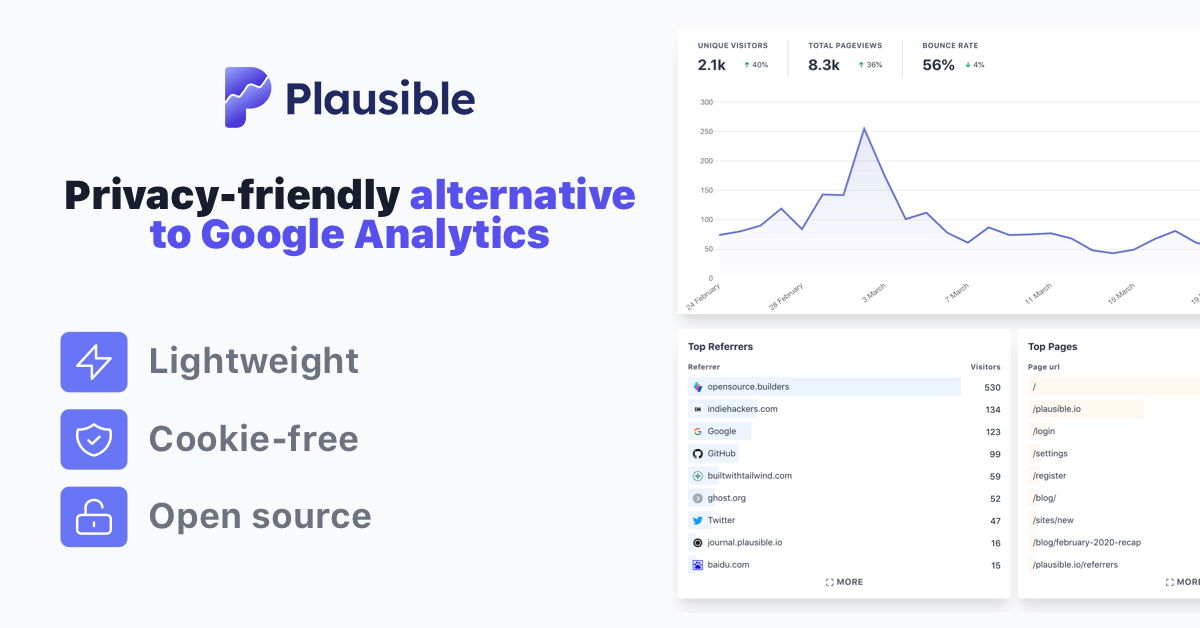
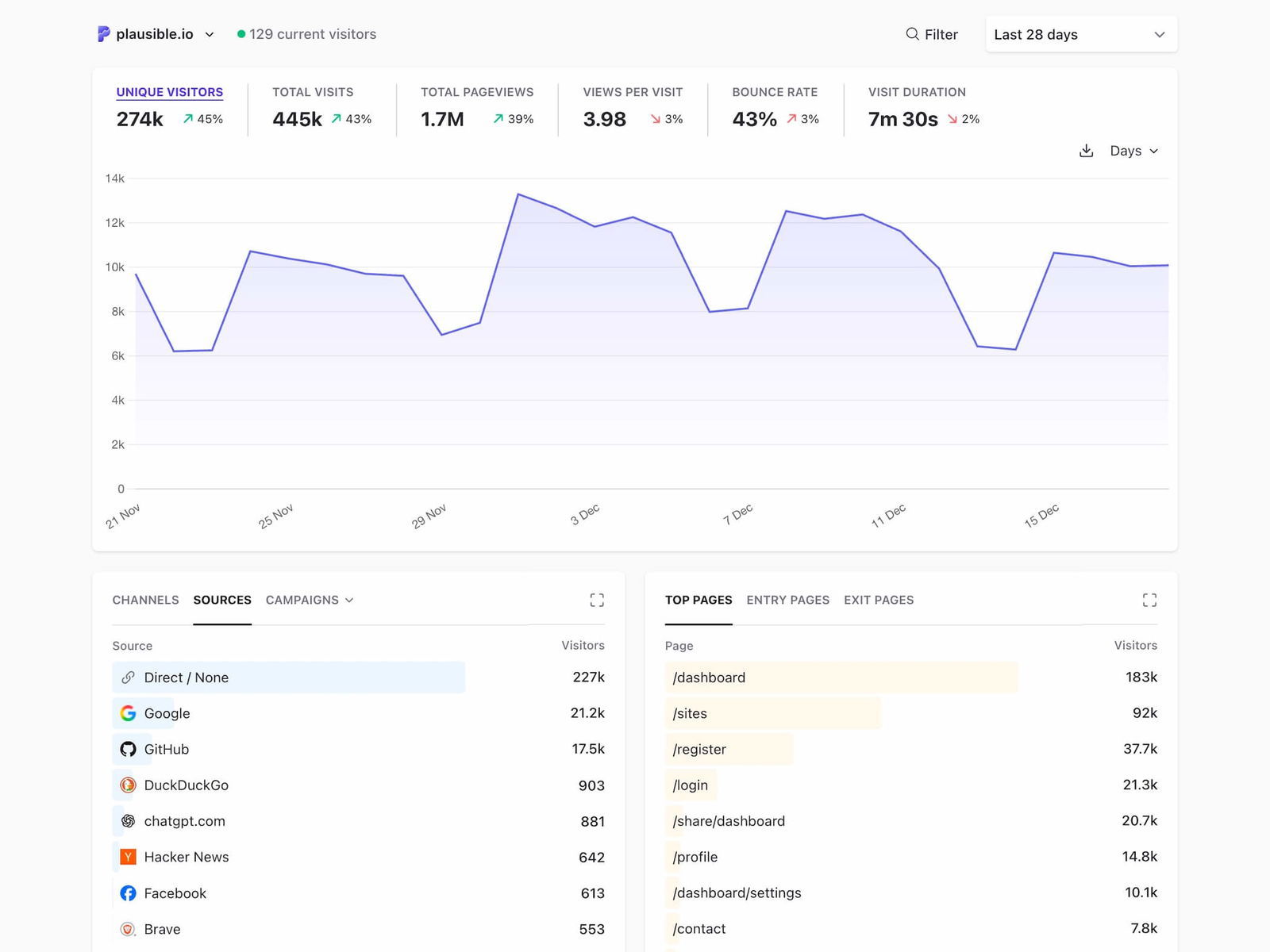
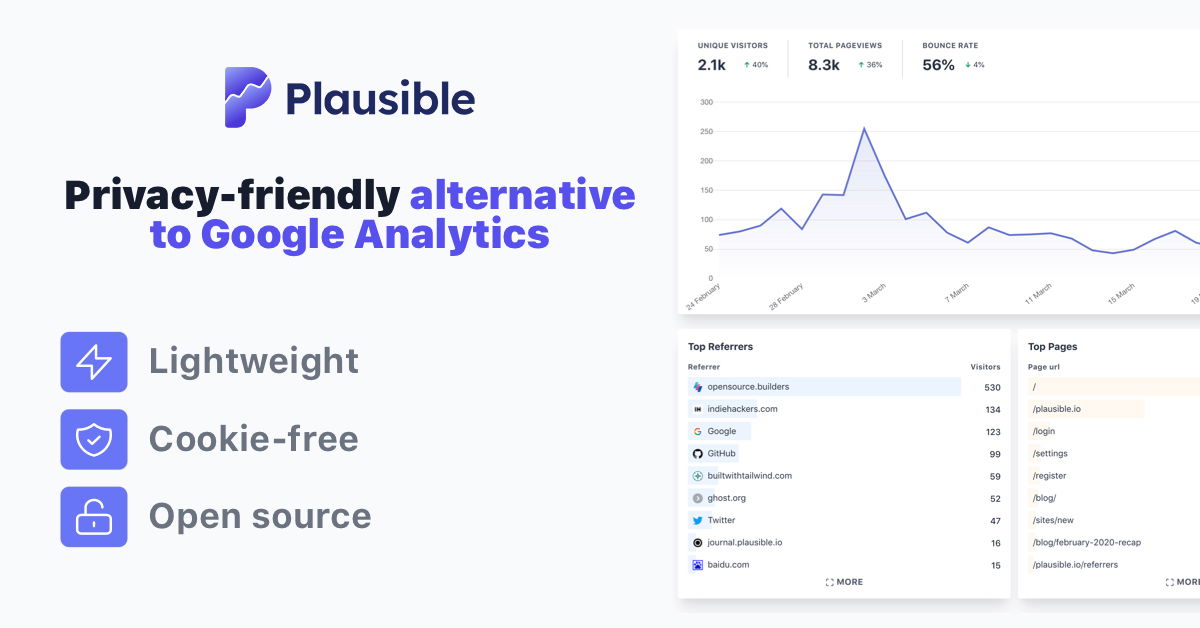
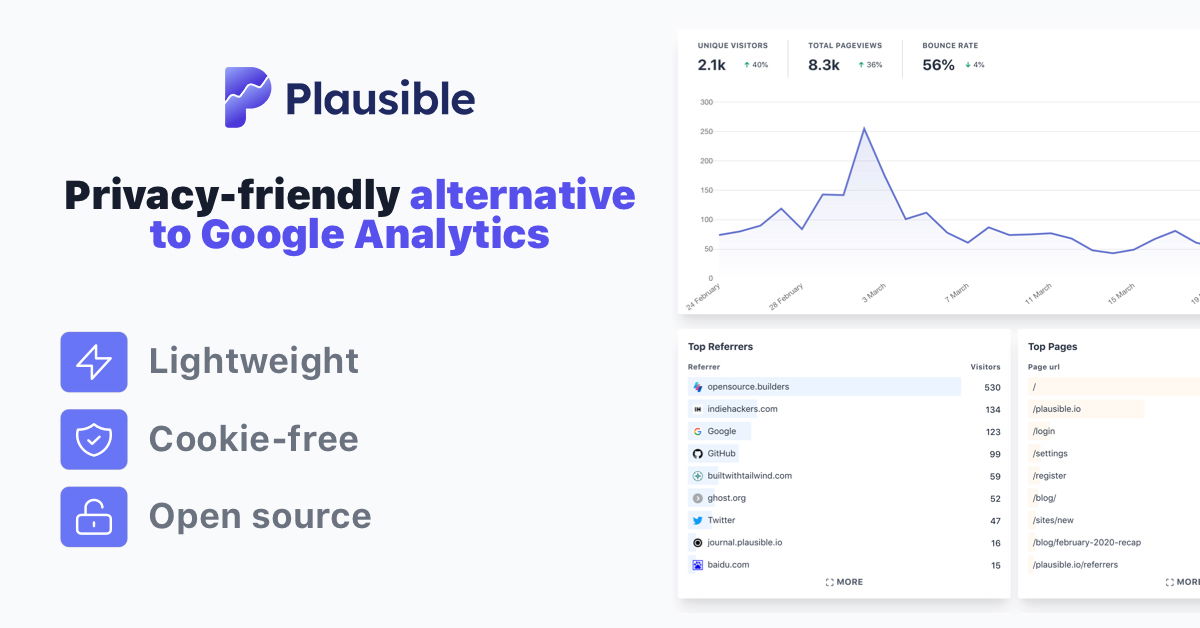
Plausible Analytics is an open source, cookie-free web analytics platform built as a privacy-respecting alternative to Google Analytics. With 24,500+ GitHub stars and 16,000+ paying customers, it delivers the metrics that matter on a single dashboard — no cookie banners, no GDPR headaches, no tracking of personal data.
Plausible Analytics is an open source, cookie-free web analytics platform and the most popular privacy-respecting alternative to Google Analytics. We rate it 80/100 — an excellent choice for indie developers, small businesses, and privacy-conscious teams who want accurate, actionable stats without the compliance overhead of traditional analytics tools.
Plausible was founded by Uku Täht in Estonia and publicly launched on . The premise was refreshingly simple: web analytics should be useful, lightweight, and respectful of user privacy — not a surveillance engine. Plausible is built on Elixir/Phoenix with ClickHouse for its analytics database, making it extremely fast even at scale. By 2026, it has attracted 16,000+ paying subscribers, tracked over 260 billion pageviews, and amassed 24,500+ GitHub stars.
Unlike Google Analytics — which relies on cookies, collects personal data, and requires cookie consent banners — Plausible tracks aggregate metrics only, stores no personal information, and is fully compliant with GDPR, CCPA, and PECR out of the box. Its tracking script is just 1 KB, roughly 75 times smaller than Google Analytics.

Plausible earns a 4.7/5 on G2 and 4.8/5 on Capterra, with praise concentrated on three things: simplicity, privacy compliance, and accurate data. On Reddit's r/webdev and r/selfhosted, the most common sentiment is "set it and forget it" — users appreciate seeing meaningful numbers rather than GA4's complex event-based model. One frequently upvoted comment: "The fact that you can see all your metrics in one page is a breath of fresh air."
The recurring complaints are equally consistent: Plausible lacks heatmaps, session replay, and user-flow visualization — features that tools like Hotjar and PostHog provide. A minority of users have also reported slow or unhelpful customer support responses for edge-case bugs. Additionally, some self-hosters find the Community Edition lagging behind the cloud version in features.
All paid plans include a 30-day free trial (no credit card required). There is no permanent free cloud plan, but the open source Community Edition is free to self-host.
| Plan | Price | Key Limits |
|---|---|---|
| Starter | $9/month | 10,000 pageviews/mo, 1 site |
| Growth | $14/month | 100,000 pageviews/mo, 3 sites, team members |
| Business | $19/month | 500,000 pageviews/mo, all features |
| Enterprise | Custom | Unlimited pageviews, dedicated support, SLA |
| Community Edition | Free | Self-hosted, open source (AGPL), limited features vs cloud |
Annual billing saves approximately 33% across all tiers. Pricing scales up in increments based on monthly pageviews — the $9 Starter plan handles sites up to 10k pageviews, which covers most personal projects and small businesses.
Best for: Indie developers, bloggers, SaaS founders, and small-to-medium businesses that want accurate traffic data without GDPR headaches. Also ideal for developers in the EU where cookie consent law enforcement is strict, and for anyone building on privacy as a product differentiator.
Not ideal for: Enterprise marketing teams requiring deep funnel analysis, cohort tracking, user-level behavioral analytics, heatmaps, or A/B testing. Large e-commerce operations that need granular product analytics will likely outgrow Plausible's feature set and should consider PostHog or Mixpanel instead.
Pros:
Cons:
Umami is the closest open source competitor — fully free to self-host, similar privacy-first approach, but with less polish and fewer integrations. PostHog is significantly more powerful, offering session replay, feature flags, and product analytics, but its complexity and pricing reflect that ambition. Fathom Analytics is the most direct cloud competitor — similar philosophy and pricing, though Plausible has a more active open source community and more frequent updates.
At $9/month, Plausible Analytics is one of the best value analytics tools available for small sites and privacy-conscious developers. The single-page dashboard, zero-cookie architecture, and open source codebase make it the default recommendation for anyone who has ever felt overwhelmed by Google Analytics 4 or concerned about EU privacy law. Its limitations — no heatmaps, no session replay, no free cloud plan — are real but intentional trade-offs. If you need behavioral analytics or enterprise-grade features, look elsewhere. But if you want clean, accurate traffic data with zero compliance overhead, Plausible earns its 80/100 rating.
ServiceNow and Accenture Launch Forward Deployed Engineering Program to Scale Agentic AI in the Enterprise (May 6, 2026)
At Knowledge 2026, ServiceNow and Accenture announced a joint forward deployed engineering program that drops co-located engineer pods into customer environments to ship agentic AI workflows natively on the ServiceNow AI Platform — with access to 300+ pre-built agent skills and the AI Control Tower as the governance backbone.
May 7, 2026
ReFiBuy Raises $13.6M Seed to Help Brands Get Recommended by AI Shopping Agents (May 5, 2026)
ReFiBuy, the Raleigh-based agentic commerce platform from ChannelAdvisor founder Scot Wingo, closed an oversubscribed $13.6M seed led by NewRoad Capital Partners on May 5, 2026 — betting that the next billion-dollar e-commerce moat is being chosen by ChatGPT, Claude and Perplexity.
May 7, 2026
OpenAI Replaces ChatGPT's Default Model With GPT-5.5 Instant — 52.5% Fewer Hallucinations, 30% Shorter Answers (May 5, 2026)
OpenAI on May 5 swapped GPT-5.3 Instant for the new GPT-5.5 Instant as ChatGPT's default model, claiming 52.5% fewer hallucinated claims on high-stakes prompts and 30% more concise answers. The model also rolls into the API as chat-latest and adds personalization from Gmail and past chats for Plus and Pro web users.
May 7, 2026
Is this product worth it?
Built With
Compare with other tools
Open Comparison Tool →