 Marketing
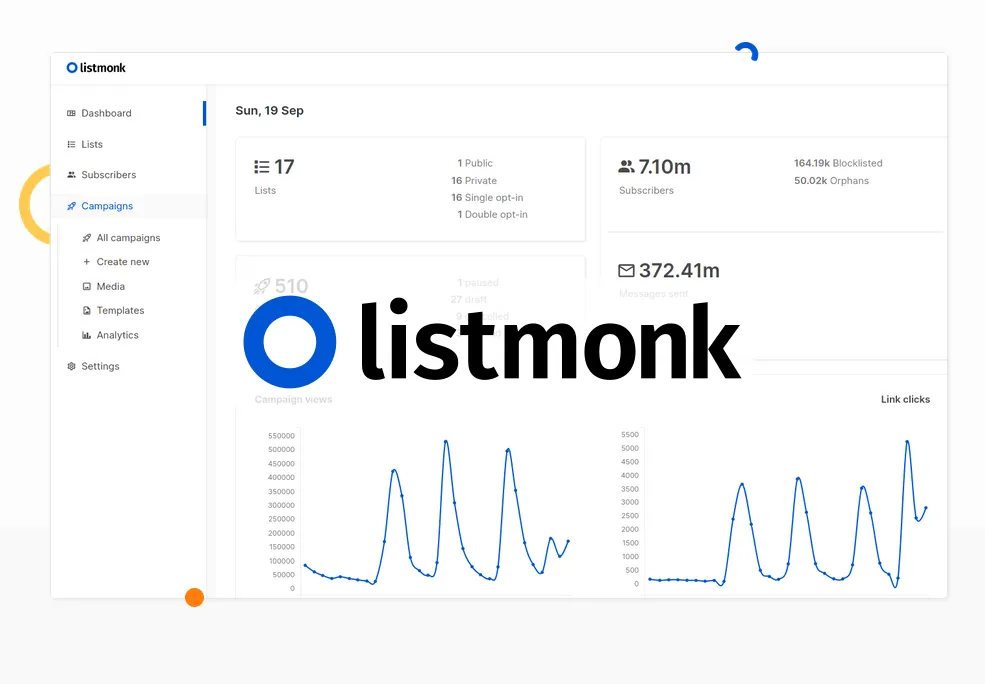
Listmonk
High-performance, self-hosted newsletter and mailing list manager packed into a single Go binary
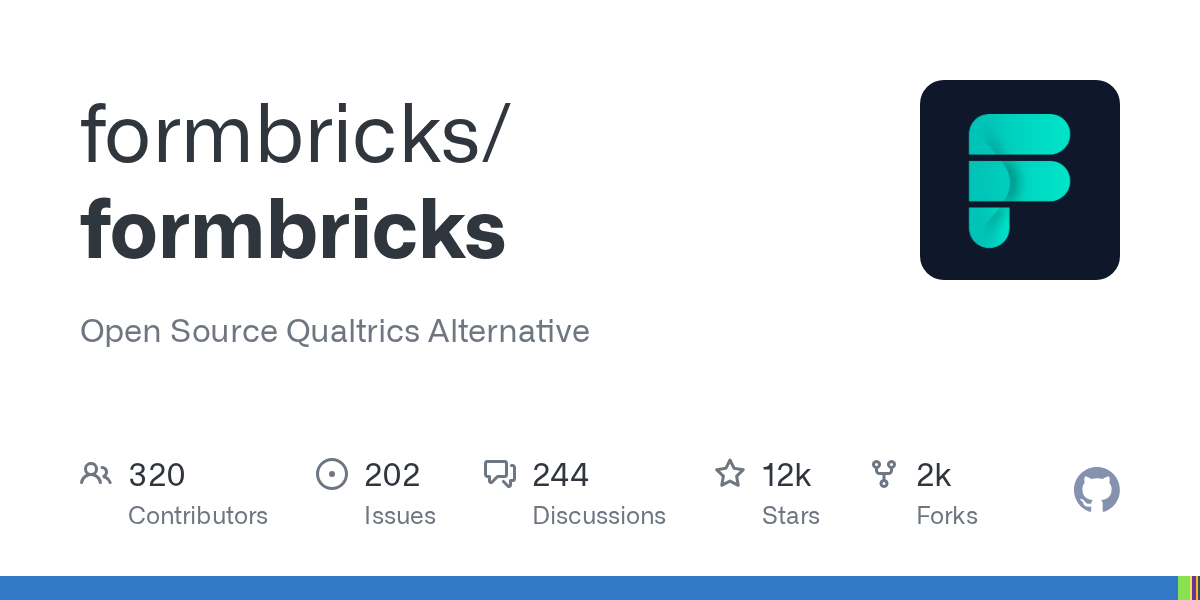
Formbricks is a free, open-source experience management platform for in-app, link, website, and email surveys. With SOC 2 Type II, GDPR compliance, and a self-hosting option, it's the privacy-respecting alternative to Qualtrics and Typeform.
Formbricks is a free, open-source experience management platform built to gather feedback at every step of the customer journey — via in-app micro-surveys, link surveys, email-embedded forms, and website pop-ups. We rate it 82/100 — an outstanding choice for teams that want Qualtrics-level targeting without enterprise contracts, and a strong default for any developer who needs GDPR-compliant surveys with full data ownership.
Formbricks was founded in 2022 by Matti Nannt and Johannes Dancker, who set out to build the open-source alternative to survey platforms like Qualtrics, SurveyMonkey, and Typeform. The platform is headquartered in Germany, making GDPR compliance a founding principle rather than an afterthought. As of March 2026, the project has accumulated over 12,000 GitHub stars and holds SOC 2 Type II and ISO 27001 certifications — rare for an open-source tool of this age. Formbricks is built on Next.js and TypeScript, making it easy for product teams to self-host on their own infrastructure with zero data leaving their servers.
Unlike Typeform, which excels at standalone link surveys, or Qualtrics, which requires enterprise contracts, Formbricks runs inside your own product at the exact moment that matters in the user journey. Its no-code segment targeting lets you show a churn survey only to users who have not logged in for 30 days, or an NPS survey to users who just completed onboarding — without writing backend code.

On G2 and Product Hunt, Formbricks earns consistent praise for two things: behavioral targeting quality and setup ease. One Product Hunt reviewer wrote: "We replaced a $12,000/year Qualtrics contract with Formbricks in a single sprint. The targeting alone is worth it — I have never been able to fire surveys based on specific user actions this easily." On Trustpilot, the platform holds strong ratings, with the most recurring compliment being the maintainer team's 24-hour GitHub issue response time.
The main friction comes from self-hosted deployments. A recurring complaint is that the Docker install script forcefully reinstalls packages without user warning. More significantly, the Community edition gates branding removal entirely — even users running Formbricks on their own servers must pay $790/month Enterprise to remove the "Powered by Formbricks" badge. Hacker News threads show this as a polarizing design decision: some accept it as a fair open-core sustainability model; others see it as restrictive for a self-hosted tool.
Formbricks follows an open-core model: the Community Edition is entirely free and self-hosted, while the managed Enterprise tier starts at $790/month.
| Plan | Price | Key Details |
|---|---|---|
| Community (Self-Hosted) | $0/month | Unlimited seats, surveys, and responses. All question types, advanced logic, webhooks, API, file uploads. Requires self-hosting on your own infrastructure. |
| Enterprise | Starts at $790/month | Everything in Community plus branding removal, contact management, team roles, white-label email, multi-language surveys, SAML/OIDC SSO, 2FA, spam protection, white-glove onboarding, and SLA support. |
A free Enterprise trial is available on request. There is currently no mid-tier between free and $790/month, which may be a barrier for growing startups not yet at enterprise scale.
Best for: Product teams at B2B SaaS companies needing in-app NPS, churn surveys, and feature validation tied to real user behavior. Engineering-led teams wanting full control over survey data and infrastructure. Companies in regulated industries where data sovereignty is mandatory. Any team paying for Qualtrics, Typeform, or Delighted who is open to self-hosting.
Not ideal for: Non-technical teams needing a fully managed cloud solution with all features from day one — the free plan requires self-hosting. Teams needing conjoint analysis, MaxDiff, or advanced quantitative research methodologies will still need Qualtrics or Alchemer.
Pros:
Cons:
Typeform offers a more polished standalone survey experience starting at $25/month but lacks in-app behavioral targeting. Qualtrics is the enterprise gold standard for advanced research but costs $15,000–$50,000/year and requires dedicated admin resources. Tally is a simpler, free-tier form builder but does not support SDK-based in-app surveys.
For product teams who want to move beyond vanity NPS scores and understand what specific users think at specific moments in their journey, Formbricks is the best free tool available in 2026. The behavioral targeting — firing surveys based on real user actions rather than random time intervals — was previously available only through six-figure Qualtrics contracts. We rate Formbricks 82/100: highly recommended for engineering-led teams comfortable self-hosting, with a note that the $790/month jump for branding removal and SSO is steep for early-stage companies.
ServiceNow and Accenture Launch Forward Deployed Engineering Program to Scale Agentic AI in the Enterprise (May 6, 2026)
At Knowledge 2026, ServiceNow and Accenture announced a joint forward deployed engineering program that drops co-located engineer pods into customer environments to ship agentic AI workflows natively on the ServiceNow AI Platform — with access to 300+ pre-built agent skills and the AI Control Tower as the governance backbone.
May 7, 2026
ReFiBuy Raises $13.6M Seed to Help Brands Get Recommended by AI Shopping Agents (May 5, 2026)
ReFiBuy, the Raleigh-based agentic commerce platform from ChannelAdvisor founder Scot Wingo, closed an oversubscribed $13.6M seed led by NewRoad Capital Partners on May 5, 2026 — betting that the next billion-dollar e-commerce moat is being chosen by ChatGPT, Claude and Perplexity.
May 7, 2026
OpenAI Replaces ChatGPT's Default Model With GPT-5.5 Instant — 52.5% Fewer Hallucinations, 30% Shorter Answers (May 5, 2026)
OpenAI on May 5 swapped GPT-5.3 Instant for the new GPT-5.5 Instant as ChatGPT's default model, claiming 52.5% fewer hallucinated claims on high-stakes prompts and 30% more concise answers. The model also rolls into the API as chat-latest and adds personalization from Gmail and past chats for Plus and Pro web users.
May 7, 2026
Is this product worth it?
Built With
Compare with other tools
Open Comparison Tool →