 Analytics
Rybbit
Open-source, cookieless Google Analytics replacement that's 10× more intuitive — built by an indie founder.
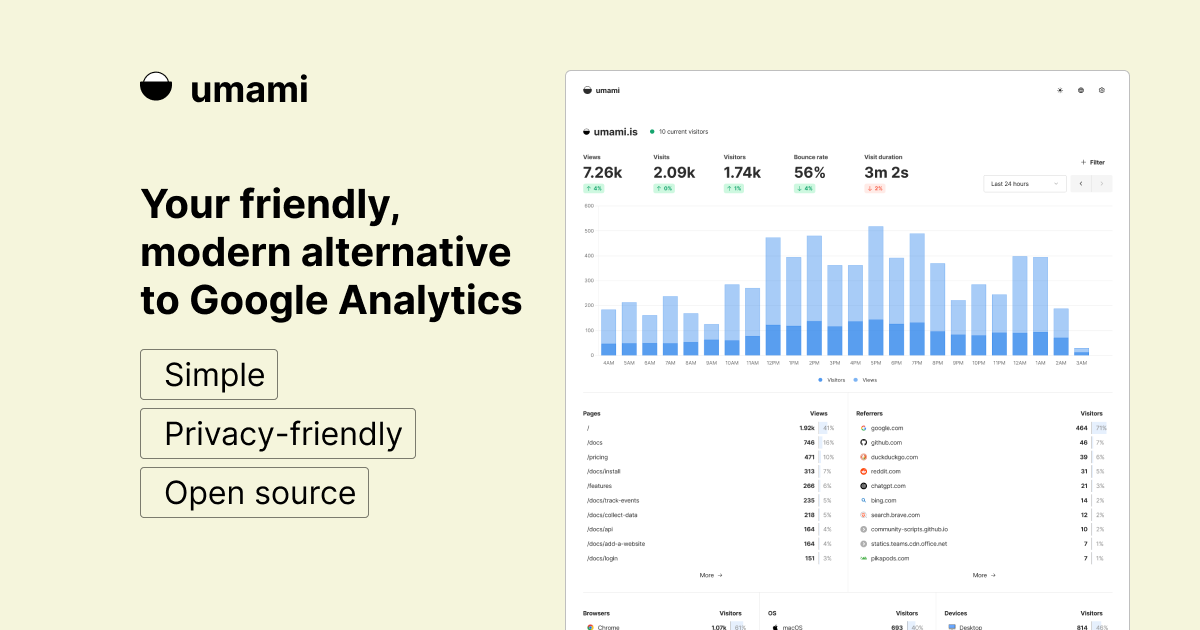
Umami is a self-hostable, cookie-free web analytics platform and the most-starred open-source Google Analytics alternative on GitHub. It runs on a $5 VPS, weighs 2KB on the client, and is GDPR/CCPA compliant out of the box.
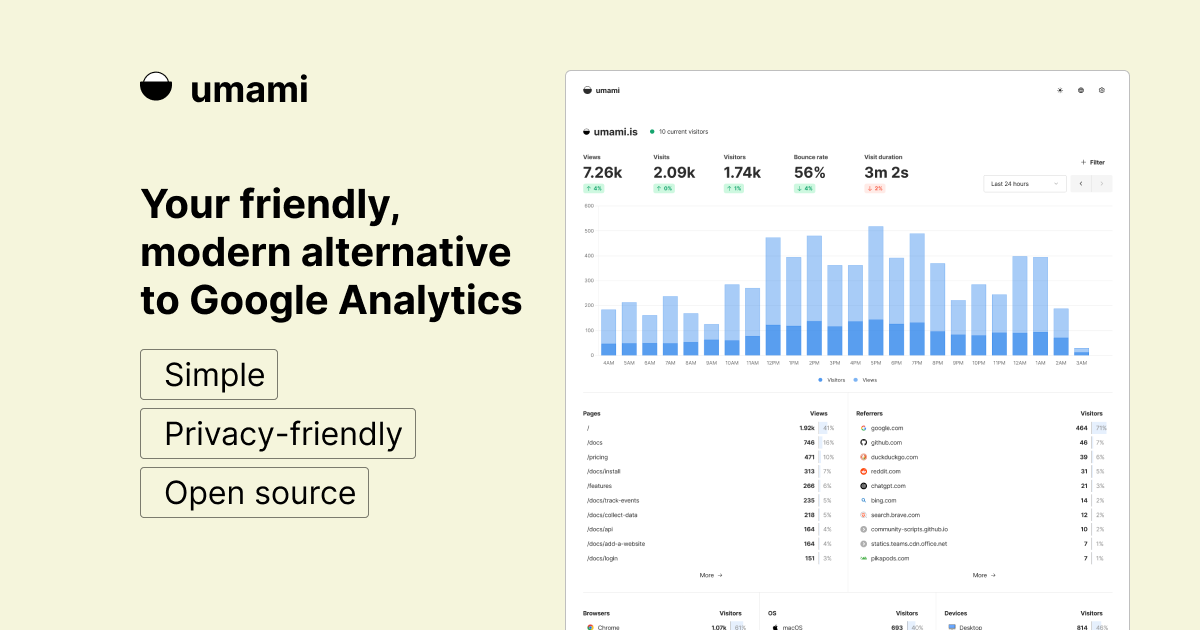
Umami is a modern, privacy-focused web analytics platform and the leading open-source alternative to Google Analytics. We rate it 88/100 — the best choice for founders, indie hackers, and small teams who want real dashboards on their own VPS without cookies, consent banners, or a monthly bill, though power users chasing funnels, session replay, and deep product analytics will still want PostHog or Matomo.
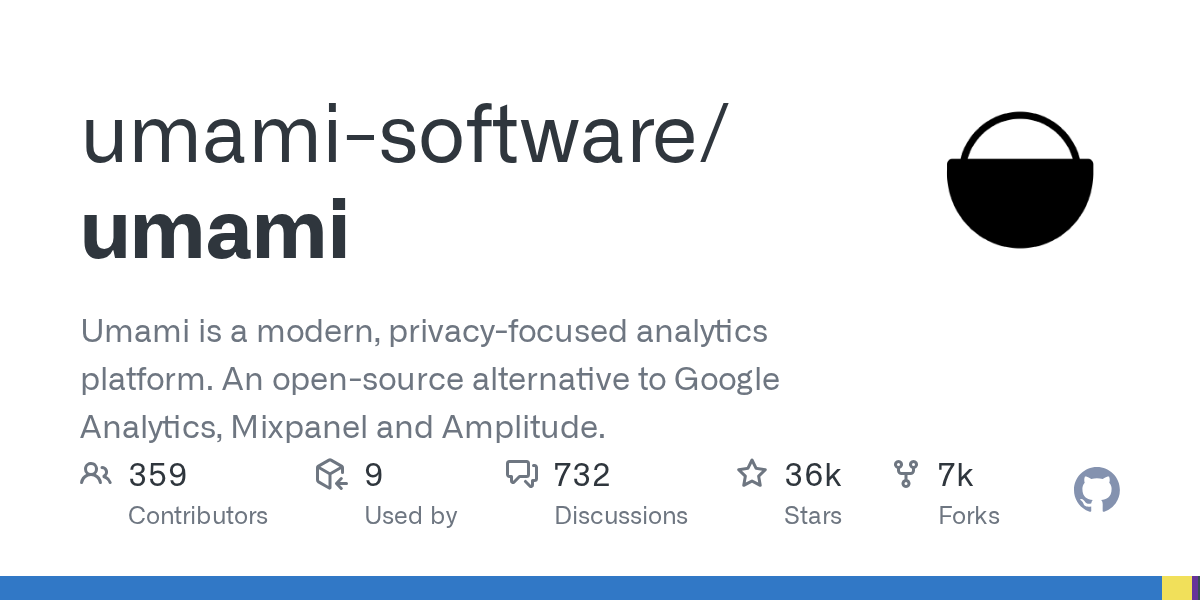
Umami is an open-source web analytics platform released under the MIT license by Mike Cao and the Umami Software team. The project went public on GitHub in 2020, crossed the 15,000-star mark in 2022, and as of the v3.1.0 release sits at 36.2k GitHub stars — more than any other self-hostable analytics project. Umami Software, the company behind it, runs a managed version called Umami Cloud with a free tier and paid plans that start around $20/month for 1 million events.
The product sits in the same lane as Plausible Analytics, Fathom, and Matomo: a lightweight dashboard that answers "who visited my site, from where, on what device, and what did they do" — without the cookie consent bureaucracy of Google Analytics 4. What sets Umami apart is that it is genuinely free (MIT, no commercial restrictions, white-label allowed), runs on a single Node process with PostgreSQL or MySQL, and ships a tracker that is roughly 22× smaller than the GA4 script — 2KB versus 45KB — which is a measurable Core Web Vitals win.
pnpm build && pnpm start, and you have analytics running. Official Docker image and compose file are maintained at docker.umami.is/umami-software/umami.umami.track('event-name', {}) captures anything — button clicks, form submits, A/B variants — with arbitrary JSON payloads for later querying.Umami has one of the most consistently positive reputations of any self-hosted tool we've reviewed — Product Hunt shows a clean 5.0/5 with 8 reviews, and recurring praise across Reddit's r/selfhosted and r/webdev centres on three things: "it just works on a $5 VPS", "the script is tiny", and "I replaced GA4 in an afternoon." Hacker News threads consistently call out the clean TypeScript codebase and the fact that the company has not pushed aggressive upsells into the self-hosted build.
The honest criticism is equally consistent. On r/selfhosted and the GitHub discussions tab, the most upvoted complaints are: no session replay in the open-source build (Cloud-only today), CSV-only export with no scheduled reports, no built-in heatmaps or funnels at PostHog's depth, and MySQL support that is noticeably less polished than PostgreSQL — several issues about slow queries at >1M events/day on MySQL remain open at the time of writing.
Self-hosted Umami is free forever under the MIT license — the only cost is the VPS you run it on. Umami Cloud layers a managed tier on top with a generous free plan and simple, usage-based paid tiers. Exact numbers are refreshed periodically on the official pricing page; the current structure is:
| Plan | Price | Key Limits |
|---|---|---|
| Self-hosted | $0 forever | Unlimited websites, events, team members. You pay only for infrastructure. |
| Hobby (Cloud) | $0/month | Up to 3 websites, ~10K events/month, 6-month data retention. |
| Pro (Cloud) | From ~$20/month | 1M events included, unlimited websites, extended retention, team seats. |
| Enterprise | Custom | Higher event volumes, custom retention, SSO, dedicated support. |
Best for: indie hackers, bootstrapped SaaS founders, agencies running client sites, privacy-conscious teams in the EU, and anyone who has ever been scared by their GA4 data-retention dialog. If you can run Docker Compose, you can run Umami.
Not ideal for: product teams that live in funnels, session replays, and cohort retention curves — PostHog is still the better tool there. Also not ideal for non-technical marketers who need scheduled PDF reports or deep attribution out of the box.
Pros:
Cons:
The nearest competitors are Plausible (AGPL, more polished cloud UX, paid-only for self-hosters in commercial settings), PostHog (heavier but far more powerful — funnels, replays, feature flags), and Matomo (GA4-feature-parity but slower and much heavier). For most self-hosters, Umami wins on simplicity; for paid SaaS users, Plausible often wins on polish; for product teams, PostHog wins on depth.
Yes — for the right use case, emphatically. Umami is the clearest example of a side project that grew into an industry standard without selling out its open-source roots. If you want privacy-first web analytics on your own infrastructure, there is no better starting point in 2026. Our 88/100 rating reflects that near-perfect fit for the self-hosted use case, with a small deduction for the feature gap against PostHog on session replay and funnels. Marketers who need scheduled reports and advanced attribution should look elsewhere; everyone else should install it this afternoon.
ServiceNow and Accenture Launch Forward Deployed Engineering Program to Scale Agentic AI in the Enterprise (May 6, 2026)
At Knowledge 2026, ServiceNow and Accenture announced a joint forward deployed engineering program that drops co-located engineer pods into customer environments to ship agentic AI workflows natively on the ServiceNow AI Platform — with access to 300+ pre-built agent skills and the AI Control Tower as the governance backbone.
May 7, 2026
ReFiBuy Raises $13.6M Seed to Help Brands Get Recommended by AI Shopping Agents (May 5, 2026)
ReFiBuy, the Raleigh-based agentic commerce platform from ChannelAdvisor founder Scot Wingo, closed an oversubscribed $13.6M seed led by NewRoad Capital Partners on May 5, 2026 — betting that the next billion-dollar e-commerce moat is being chosen by ChatGPT, Claude and Perplexity.
May 7, 2026
OpenAI Replaces ChatGPT's Default Model With GPT-5.5 Instant — 52.5% Fewer Hallucinations, 30% Shorter Answers (May 5, 2026)
OpenAI on May 5 swapped GPT-5.3 Instant for the new GPT-5.5 Instant as ChatGPT's default model, claiming 52.5% fewer hallucinated claims on high-stakes prompts and 30% more concise answers. The model also rolls into the API as chat-latest and adds personalization from Gmail and past chats for Plus and Pro web users.
May 7, 2026
Is this product worth it?
Built With
Compare with other tools
Open Comparison Tool →