 Databases
DuckDB
The in-process SQL OLAP database — SQLite-style embedding, columnar speed, and 1.5.2 ships DuckLake 1.0 GA.
TinyBase is a 6.2 kB reactive data store and sync engine for local-first apps, with native CRDTs, persisters from IndexedDB to PostgreSQL, and React/Svelte components in one MIT-licensed package.
TinyBase is a reactive data store and sync engine for local-first apps that fits in 6.2 kB and ships with native CRDTs, schemas, indexes and ready-made React and Svelte components. We rate it 87/100 — if you are building an offline-first or local-first JavaScript app and don't want to bolt together SQLite, a sync layer and a state library yourself, TinyBase is the most batteries-included option in the entire local-first ecosystem.
TinyBase is an open-source JavaScript library, MIT-licensed, written by James Pearce (formerly of Meta and Facebook) under the tinyplex organisation. The first commit landed on , and the project just shipped version 8.2 on — "the one with Svelte components." It now sits at over 5,000 stars on GitHub with the test suite at 100% coverage, which is unusual for a library this ambitious.
Where competing local-first stacks make you assemble pieces — a database, a reactive query layer, a CRDT engine, a sync server, UI bindings — TinyBase ships all of that as one library. You start with a 6.2 kB key-value store, layer on tabular data when you need it, snap on schemas, indexes, relationships, an undo stack, and finally turn the whole thing into a CRDT-backed multi-device sync engine without touching another package.
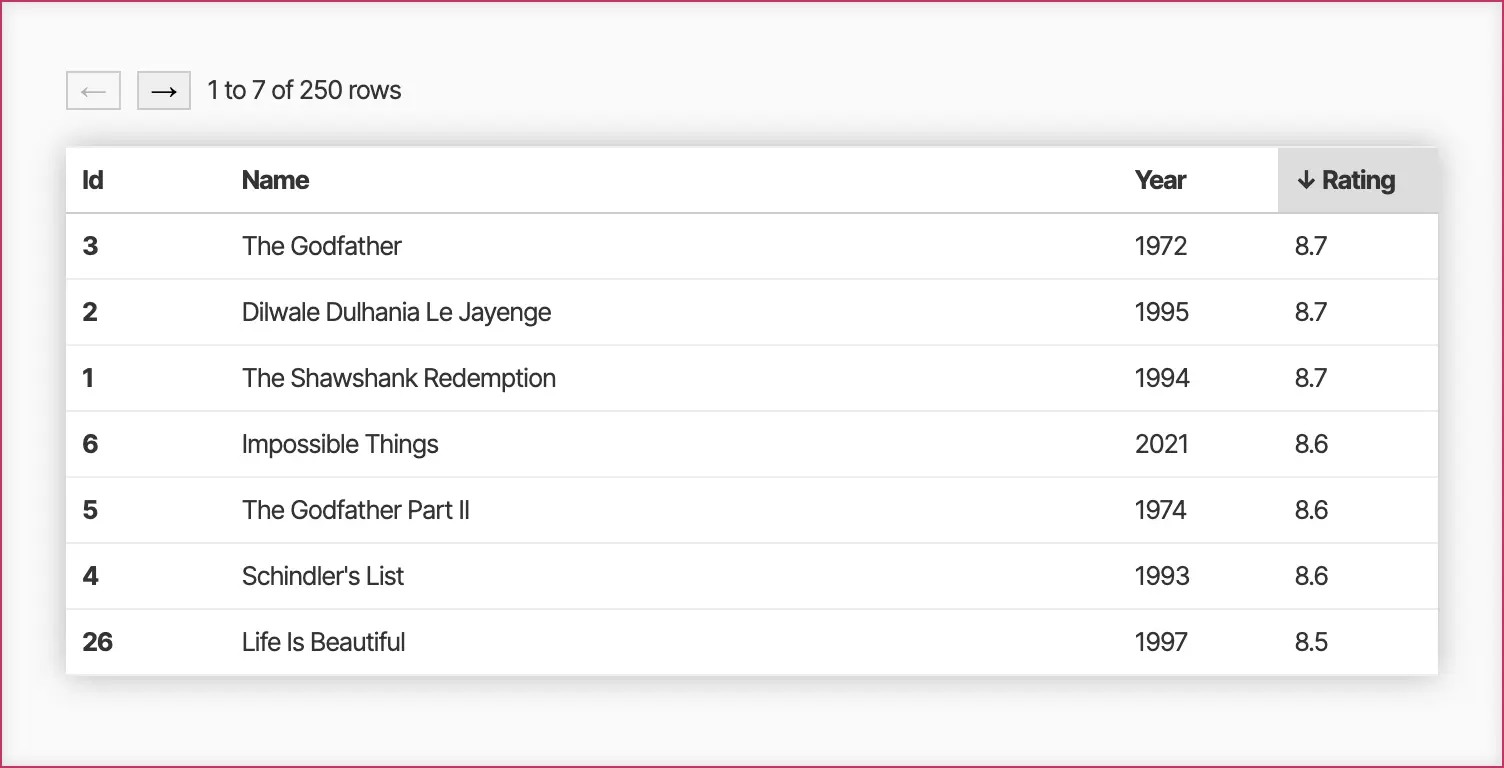
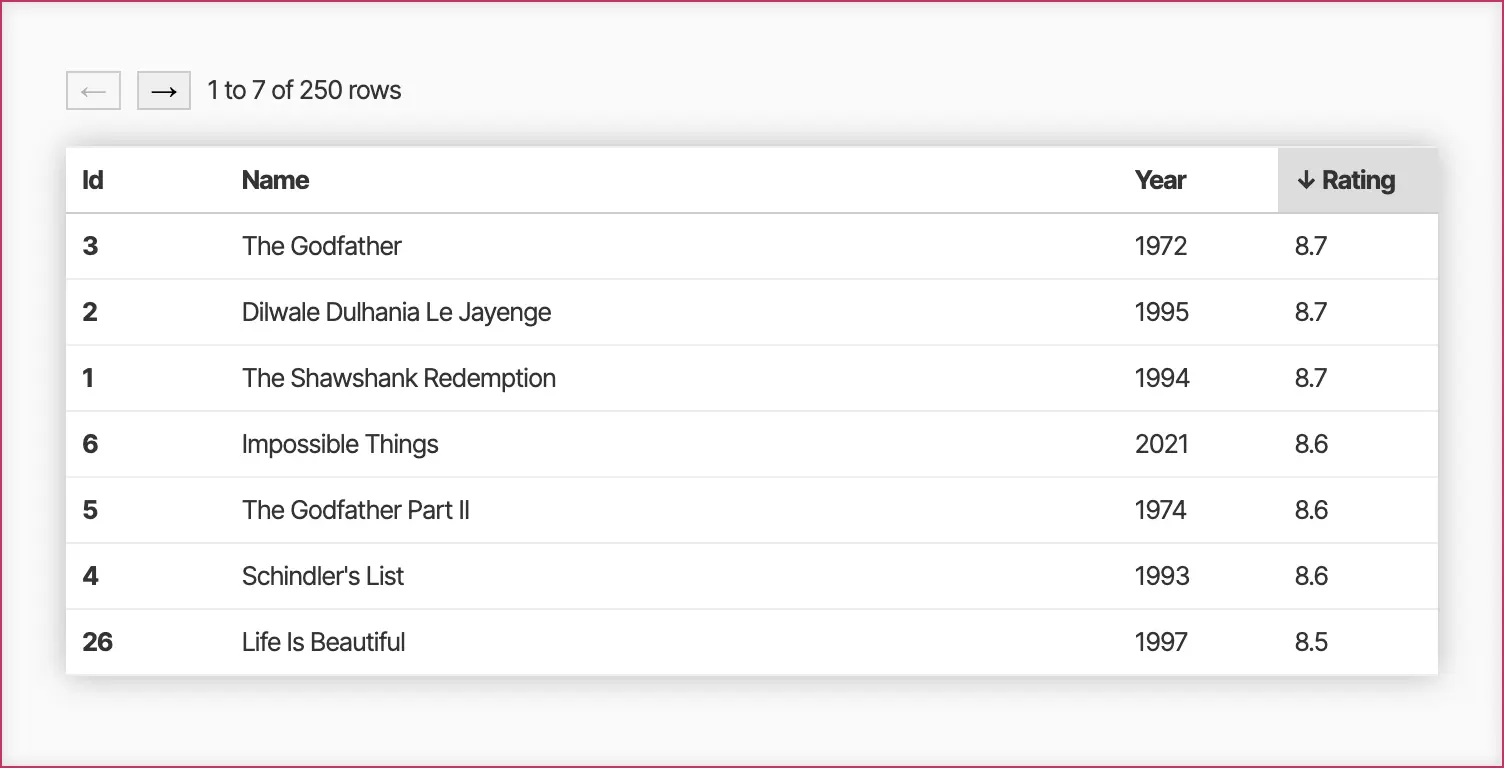
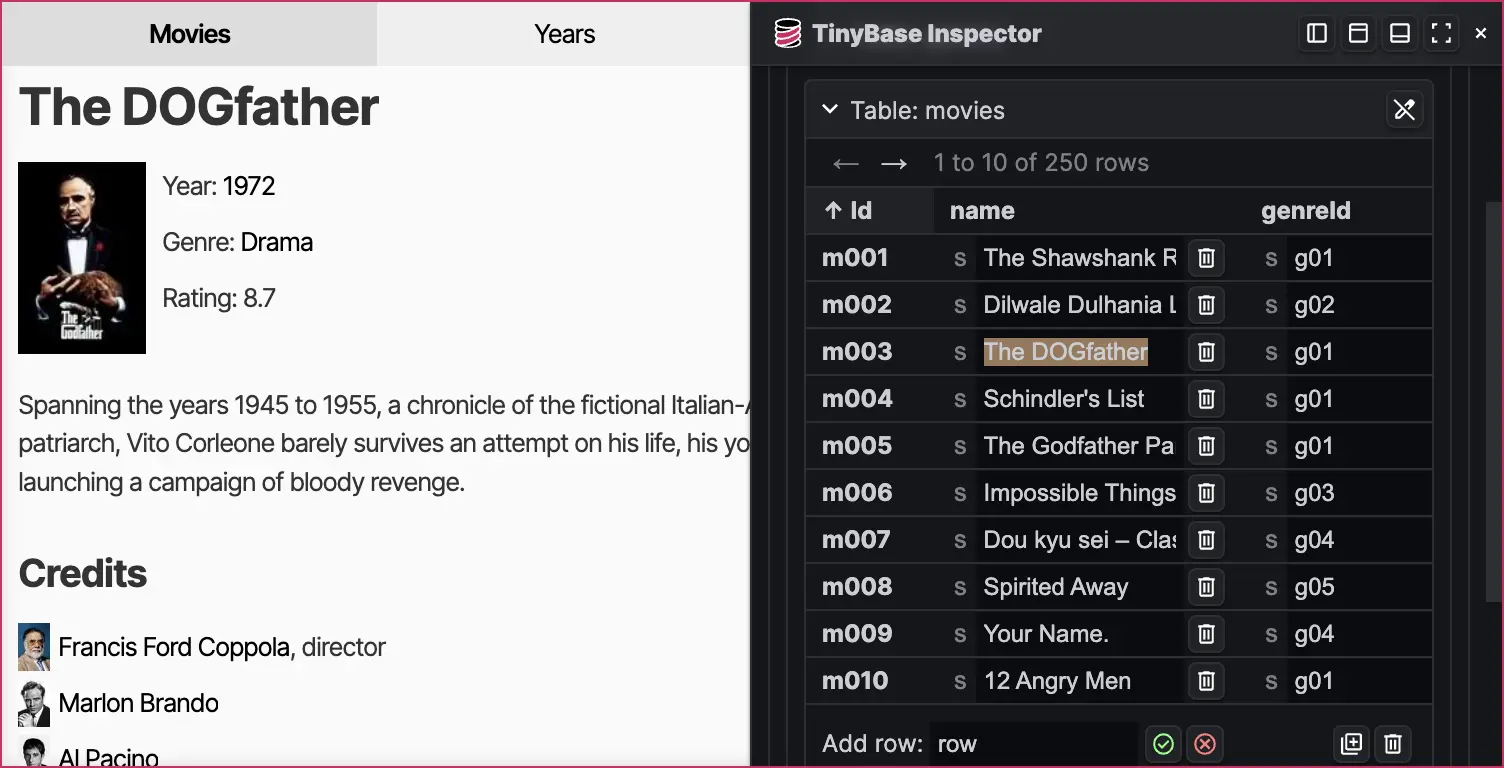
Store or a tabular Tables model with row/column-level listeners — only the components touching changed cells re-render.MergeableStore type is a built-in CRDT. Merge clients deterministically over WebSockets, the browser BroadcastChannel, or a custom transport — no Yjs or Automerge required, but you can plug them in if you prefer.tinybase/ui-react hooks plus ui-react-dom drop-in components (table viewers, inspectors), and as of v8.2 a full Svelte components package.Checkpoints module turns any store into an undoable timeline with one line of setup.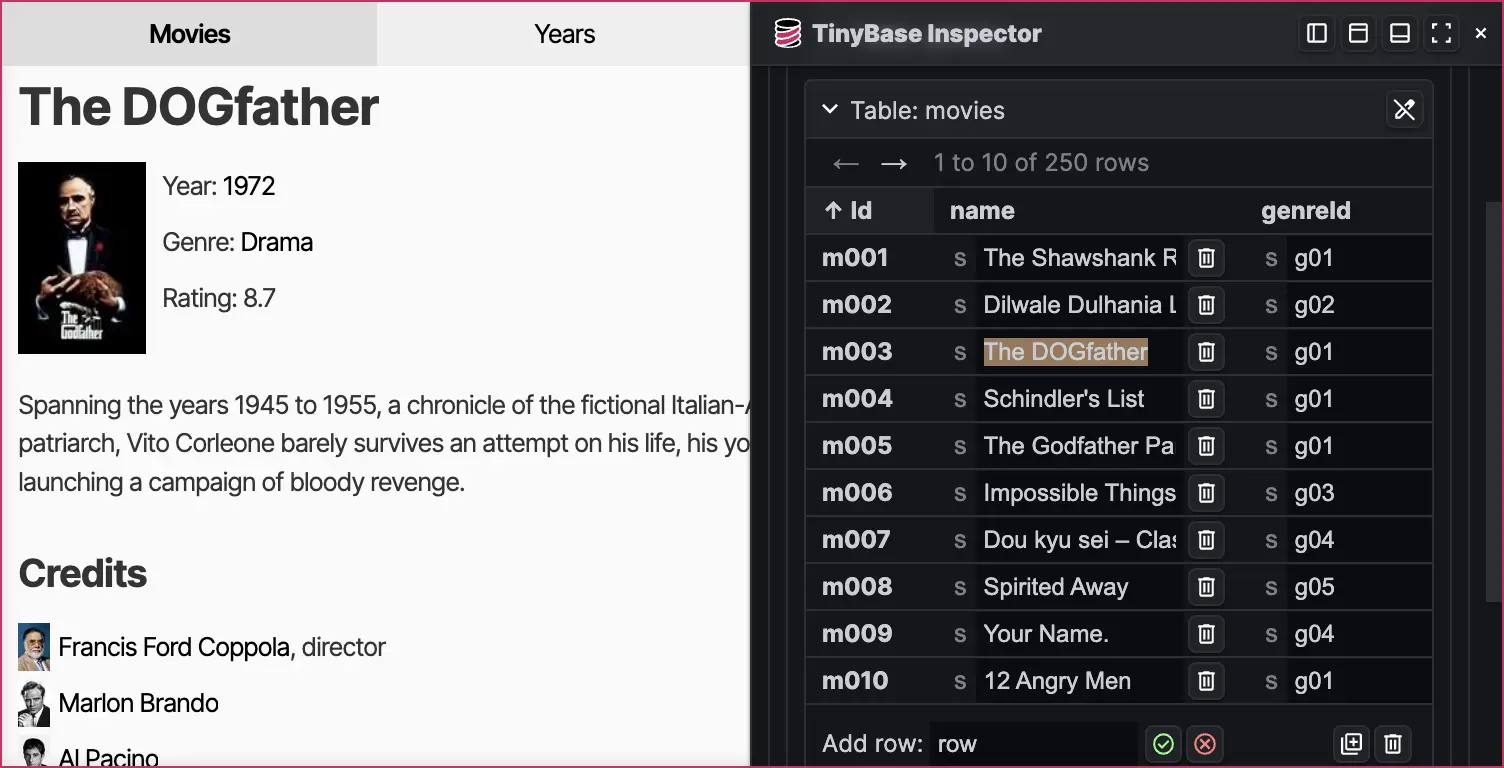
Sentiment on Hacker News across the v2, v5 and v8 release threads is consistently positive but with one recurring caveat. The most-upvoted comments call out two things: that TinyBase is one of the few local-first libraries with proper relational semantics (schemas, indexes, foreign keys) instead of the schemaless key-value approach taken by Yjs and Automerge, and that the bundle-size discipline is unusual — people repeatedly note the whole library is smaller than a single Lottie animation. The recurring complaint is that the surface area is now genuinely large: between Stores, MergeableStores, dozens of persisters, multiple UI binding packages and the new Synclets project, the docs are deep enough that newcomers say it took "a weekend" to internalise the mental model. A second, smaller complaint is that the API uses positional get(tableId, rowId, cellId) calls rather than chainable accessors — readable but verbose.
On the Local-First Landscape directory and in James Pearce's own talks, TinyBase is now treated as one of the canonical references in the space alongside ElectricSQL and Replicache. Adopters listed publicly include Expo, Primodium and Learn Anything.
TinyBase is fully free and open source under the MIT license. There is no hosted product, no paid tier, no telemetry and no sign-up. You install it from npm and you own everything — including the storage and sync infrastructure you point it at.
| Plan | Price | What's Included |
|---|---|---|
| Open Source (MIT) | $0 | Every module: Store, MergeableStore, persisters, UI bindings, Inspector, schemas, indexes, metrics, queries, checkpoints, sync. |
Best for: JavaScript and TypeScript developers building local-first apps — offline-capable note-takers, drawing tools, todo apps, side-project games, Expo and React Native apps that need a real database with sync. Solo devs and small teams will get the most leverage because TinyBase replaces three or four packages with one.
Not ideal for: Backends that need a server-side relational database with concurrent writes from many tenants — pick PostgreSQL or ClickHouse for that. Also overkill for trivial UI state where tRPC + Zustand or Jotai already do the job.
Pros:
Cons:
setCell('pets', 'fido', 'species', 'dog')) reads cleanly but takes effort to type.The closest alternatives are Yjs (mature CRDT but schemaless, requires you to build the data model yourself), Automerge (similar trade-off, document-oriented), Replicache (commercial, server-required), and ElectricSQL (Postgres-backed sync, heavier to deploy). TinyBase is the only one that gives you a relational data model, a CRDT, persistence, and React/Svelte components in a single MIT package.
If you are shipping a local-first app in 2026 and you have ever found yourself stitching Dexie + Yjs + a custom sync server + a state library together, TinyBase deletes most of that diagram. It earns 87/100 because the engineering quality is exceptional — full type safety, 100% test coverage, 6.2 kB, MIT — but the learning curve and verbose API keep it from a higher score. For solo developers and small teams building offline-capable apps, it is the most pragmatic choice in the local-first landscape today.
MergeableStore) plus a relational data model, indexes, metrics, UI bindings and persisters. You can also use Yjs or Automerge as a persister inside TinyBase if you want both worlds.ServiceNow and Accenture Launch Forward Deployed Engineering Program to Scale Agentic AI in the Enterprise (May 6, 2026)
At Knowledge 2026, ServiceNow and Accenture announced a joint forward deployed engineering program that drops co-located engineer pods into customer environments to ship agentic AI workflows natively on the ServiceNow AI Platform — with access to 300+ pre-built agent skills and the AI Control Tower as the governance backbone.
May 7, 2026
ReFiBuy Raises $13.6M Seed to Help Brands Get Recommended by AI Shopping Agents (May 5, 2026)
ReFiBuy, the Raleigh-based agentic commerce platform from ChannelAdvisor founder Scot Wingo, closed an oversubscribed $13.6M seed led by NewRoad Capital Partners on May 5, 2026 — betting that the next billion-dollar e-commerce moat is being chosen by ChatGPT, Claude and Perplexity.
May 7, 2026
OpenAI Replaces ChatGPT's Default Model With GPT-5.5 Instant — 52.5% Fewer Hallucinations, 30% Shorter Answers (May 5, 2026)
OpenAI on May 5 swapped GPT-5.3 Instant for the new GPT-5.5 Instant as ChatGPT's default model, claiming 52.5% fewer hallucinated claims on high-stakes prompts and 30% more concise answers. The model also rolls into the API as chat-latest and adds personalization from Gmail and past chats for Plus and Pro web users.
May 7, 2026
Is this product worth it?
Built With
Compare with other tools
Open Comparison Tool →