
 Security
Bitwarden
Open-source password manager — unlimited free vault on every device, AES-256 encryption, audited annually.
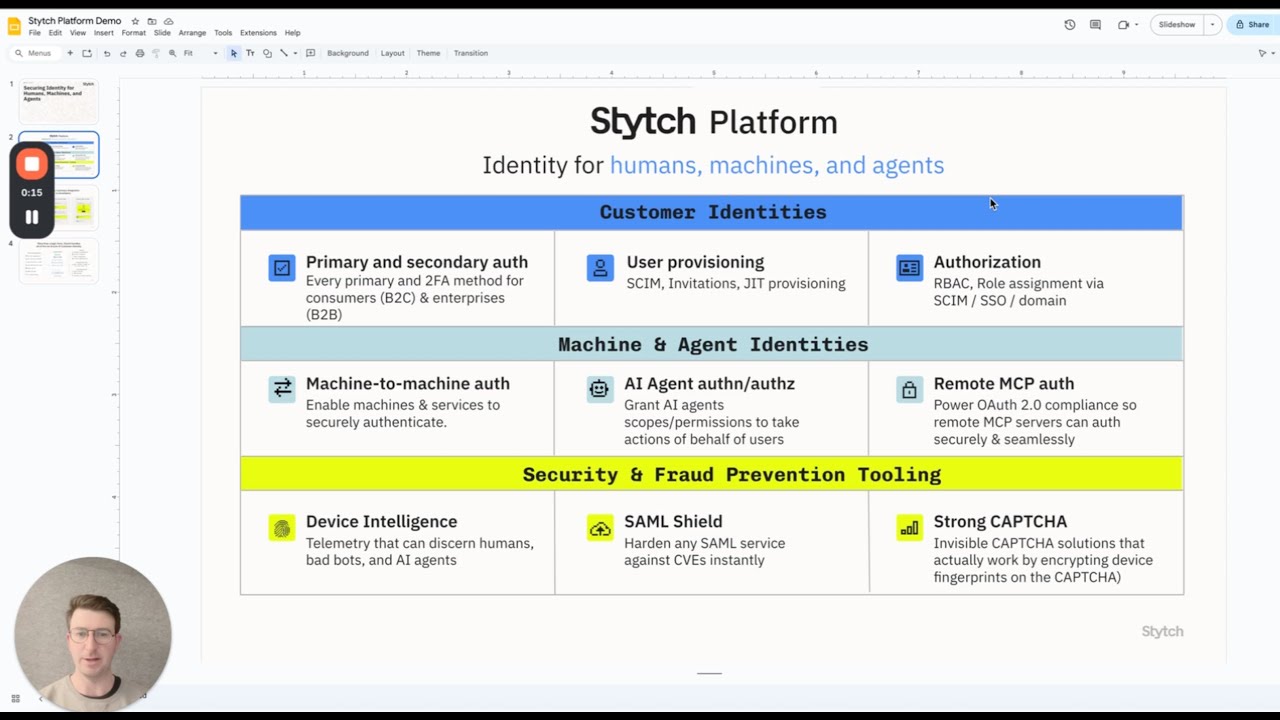
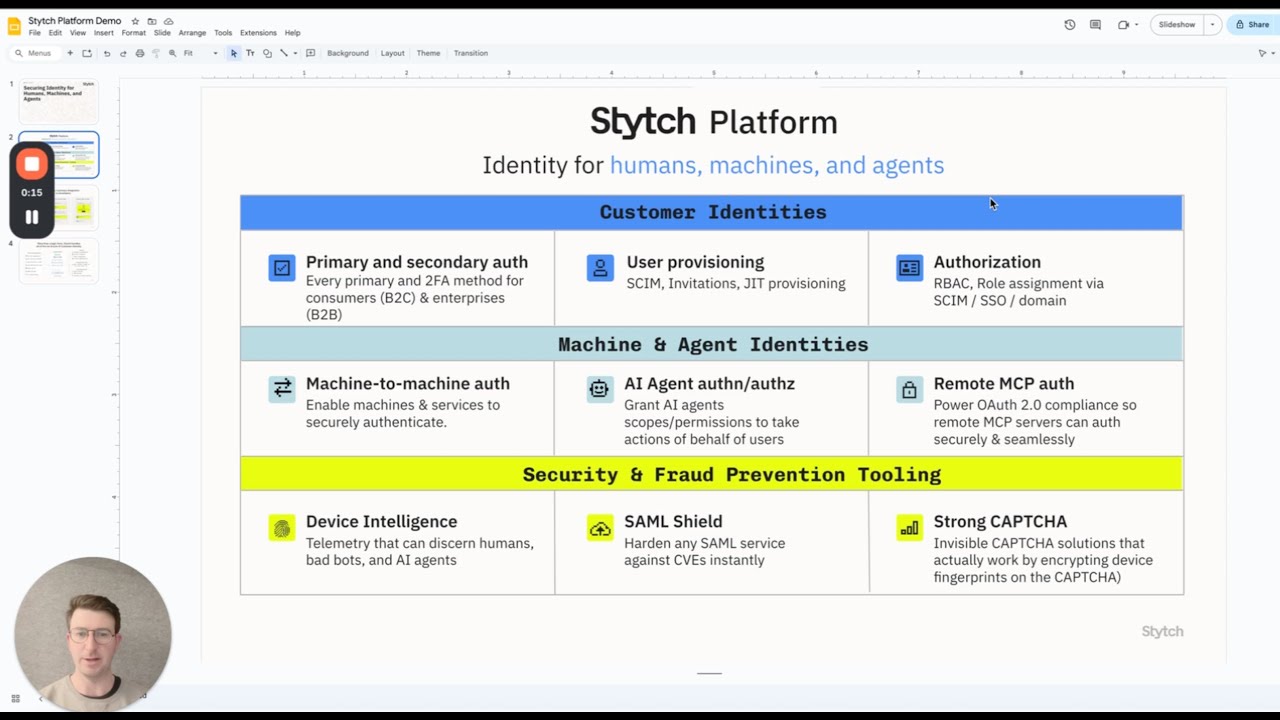
Stytch is a developer-first identity platform unifying passwordless auth, passkeys, SSO, multi-tenant B2B and AI-agent identity behind one API. Free up to 10,000 MAU; built for teams who want Auth0's surface area without Auth0's bill.
Stytch is a developer-first identity platform that bundles passwordless auth, passkeys, SSO, multi-tenant B2B controls, fraud prevention and AI-agent identity behind a single API. We rate it 84/100 — for product teams who want Auth0's enterprise surface area with cleaner APIs and dramatically lower MAU pricing, Stytch is the most credible challenger in 2026, especially now that every feature is unlocked from day one and the free tier covers 10,000 MAU.
Stytch is an identity infrastructure company building auth as a developer API. The company was founded in by Reed McGinley-Stempel (CEO) and Julianna Lamb (CTO), both early Plaid employees who saw firsthand how broken consumer authentication was when integrating with thousands of bank login flows. Stytch has raised roughly $126 million across Seeds A, B and C, including a $90 million Series B in 2022 led by Coatue at a $1 billion valuation, with Benchmark, Index Ventures and Thrive Capital also on the cap table.
The pitch is simple: most teams either roll their own auth (and ship security bugs for years), bolt on Auth0 (and watch the bill explode at scale), or stitch together five separate services (magic links, OAuth, MFA, SSO, fraud) and pray they stay in sync. Stytch collapses all of that into one API plus an SDK for every modern stack, with the same primitives powering both consumer (B2C) and B2B SaaS multi-tenant flows. As of , Stytch has also become one of the first major identity providers to ship purpose-built primitives for AI-agent identity — issuing scoped, revocable credentials so agents can act on a user's behalf without sharing the user's session.
Sentiment on Stytch is unusually warm for an auth provider — a category where developers tend to be loud and unhappy. On G2, the highest-upvoted reviews praise three things in roughly this order: the quality of the documentation, the coherence of the API design, and the responsiveness of Stytch's developer-relations team (multiple reviewers mention same-day Slack responses from the founding engineers themselves). On the SuperTokens vs. Stytch comparison threads, Stytch is consistently called out as the cleanest hosted alternative to Auth0 for teams that don't want to self-host.
The recurring complaints are honest ones: custom email templating is described as "adequate but not great" — you can swap colors and copy, but full design control still requires going headless. Several reviewers note that figuring out which features are à la carte versus bundled in your tier is harder than it should be from the public website (Stytch's self-serve pricing rework fixed most of this, but not all). And on Reddit's r/webdev, a few teams migrating from Auth0 mentioned that Stytch's legacy-IdP integration story (older SAML implementations, on-prem AD) is thinner than Okta's, though good enough for the vast majority of greenfield B2B SaaS.
Stytch moved to a flat MAU-based model in and removed every feature gate. You get MFA, SSO, RBAC, SCIM, social logins, OTPs, passwordless and the AI-agent primitives on day one — you only pay once you cross the free MAU threshold.
| Plan | Price | Key Limits |
|---|---|---|
| Free | $0/month | 10,000 MAU, all features unlocked, community support |
| Essentials (Consumer) | $0.01 per MAU | Above 10k MAU; full passwordless, OAuth, MFA, fraud — typical SaaS B2C pricing |
| Growth (B2B) | $0.05 per MAU | Above 10k MAU; adds org-scoped auth, SCIM, RBAC, SSO connections — equivalent of Auth0's B2B Pro at a fraction of the cost |
| Enterprise | Contact sales | Custom MAU pricing, dedicated support, SLAs, HIPAA BAAs, advanced fraud |
For comparison, Auth0's B2B "Professional" plan starts at $1,500/month for 7,500 MAU before SSO connections are added, and SSO is metered separately — Stytch's Growth tier is roughly 5–10× cheaper for comparable coverage at typical SaaS scale.
Best for: Seed-to-Series-C SaaS teams shipping multi-tenant B2B products who want SSO, SCIM and RBAC without negotiating a six-figure Auth0 contract; consumer products that need passwordless + passkeys + OAuth in days, not sprints; AI-agent or agentic-SaaS startups who need scoped credentials and consent flows out of the box.
Not ideal for: Enterprises locked into legacy on-prem AD or older SAML stacks where Okta and Microsoft Entra still have a decade head start; teams who explicitly want to self-host their identity provider (look at Keycloak, Authentik or Ory instead); developers building tiny side projects where Better-Auth or NextAuth is free and good enough.
Pros:
Cons:
The most credible competitors in 2026 are Auth0 (still the safe enterprise pick, but expensive and feature-gated), WorkOS (laser-focused on B2B SSO/SCIM, less consumer breadth), Clerk (better drop-in UI for Next.js, narrower B2B story) and Better Auth (open source, self-hostable, requires more glue code). Stytch sits between WorkOS's enterprise focus and Clerk's UI-first approach — most useful if you need both consumer and B2B in one provider.
Yes, with a clear caveat. If you're shipping a B2B or B2C SaaS product in 2026 and don't already have an Okta contract, Stytch is the lowest-risk, highest-leverage choice in the auth-as-a-service category — the API is clean, the free tier is generous, every feature is unlocked from day one, and the AI-agent primitives put it ahead of Auth0 and WorkOS on the most important new auth surface of the next two years. The caveat is data residency: if your compliance team requires self-hosted identity, look at Keycloak or Authentik instead. Otherwise, this is what Auth0 should have been if it were rebuilt in 2026 — and that's why we rate it 84/100.
ServiceNow and Accenture Launch Forward Deployed Engineering Program to Scale Agentic AI in the Enterprise (May 6, 2026)
At Knowledge 2026, ServiceNow and Accenture announced a joint forward deployed engineering program that drops co-located engineer pods into customer environments to ship agentic AI workflows natively on the ServiceNow AI Platform — with access to 300+ pre-built agent skills and the AI Control Tower as the governance backbone.
May 7, 2026
ReFiBuy Raises $13.6M Seed to Help Brands Get Recommended by AI Shopping Agents (May 5, 2026)
ReFiBuy, the Raleigh-based agentic commerce platform from ChannelAdvisor founder Scot Wingo, closed an oversubscribed $13.6M seed led by NewRoad Capital Partners on May 5, 2026 — betting that the next billion-dollar e-commerce moat is being chosen by ChatGPT, Claude and Perplexity.
May 7, 2026
OpenAI Replaces ChatGPT's Default Model With GPT-5.5 Instant — 52.5% Fewer Hallucinations, 30% Shorter Answers (May 5, 2026)
OpenAI on May 5 swapped GPT-5.3 Instant for the new GPT-5.5 Instant as ChatGPT's default model, claiming 52.5% fewer hallucinated claims on high-stakes prompts and 30% more concise answers. The model also rolls into the API as chat-latest and adds personalization from Gmail and past chats for Plus and Pro web users.
May 7, 2026
Is this product worth it?
Built With
Compare with other tools
Open Comparison Tool →