 Developer Tools
Templ
Type-safe HTML templating language for Go with compile-time safety
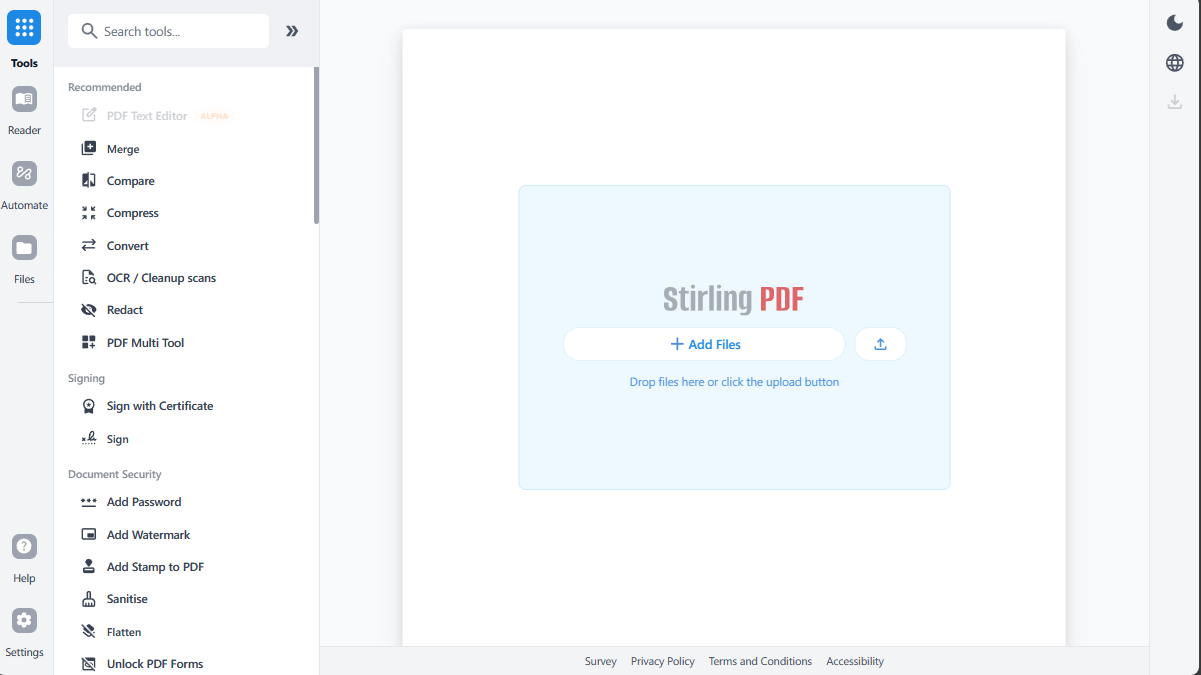
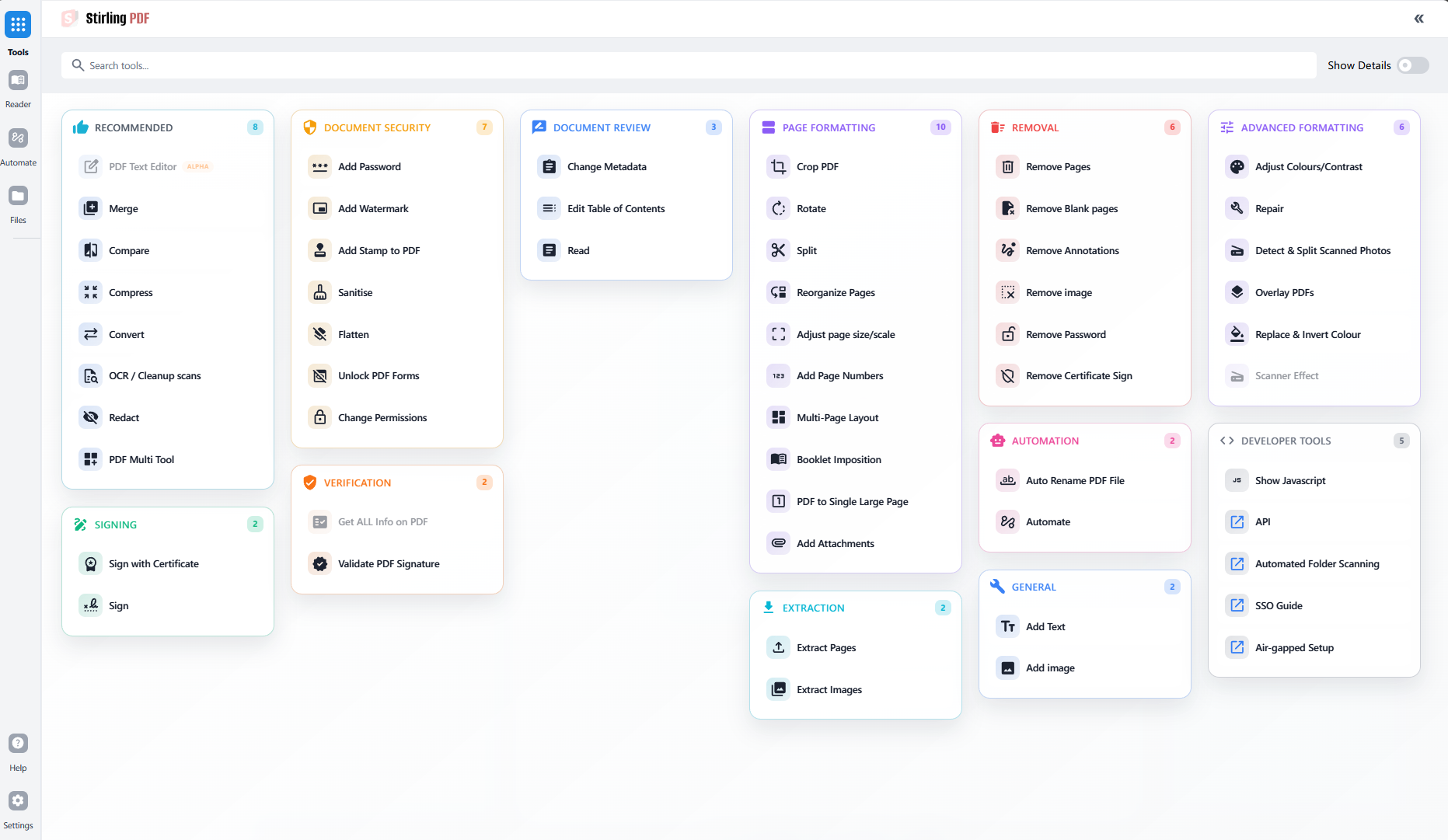
Stirling PDF is a self-hostable, open-source PDF platform with 50+ tools that runs completely offline via Docker. With 77k+ GitHub stars and 25M+ downloads, it is the most credible open-source alternative to Adobe Acrobat in 2026.
Stirling PDF is a self-hostable, open-source PDF platform that bundles more than 50 document tools — merge, split, OCR, sign, redact, compress, convert, edit — behind a clean browser UI that runs entirely on your own server. We rate it 86/100 — the most credible open-source alternative to Adobe Acrobat in 2026 if you are willing to run a container, with an enterprise tier that finally justifies a paid plan for teams that need SSO and audit logs.
Stirling PDF is a browser-based PDF toolkit built by Anthony Stirling, a UK developer who started the project in January 2023 after refusing to pay Adobe to sign a single document. The project lives at github.com/Stirling-Tools/Stirling-PDF, has crossed 77,100+ GitHub stars, 6,700 forks, and 25 million downloads, and raised a $2M pre-seed round led by Open Core Ventures to turn a side project into an open-core company. The latest release at time of writing is v2.9.2, published on , on top of the 2.0 rewrite that landed in late 2025.
The pitch is simple: deploy one Docker container on your own server, point a browser at it, and get an office-grade PDF editor that never ships your documents to a third-party SaaS. For regulated industries — legal, healthcare, defense, finance — that local-only guarantee is the entire product.
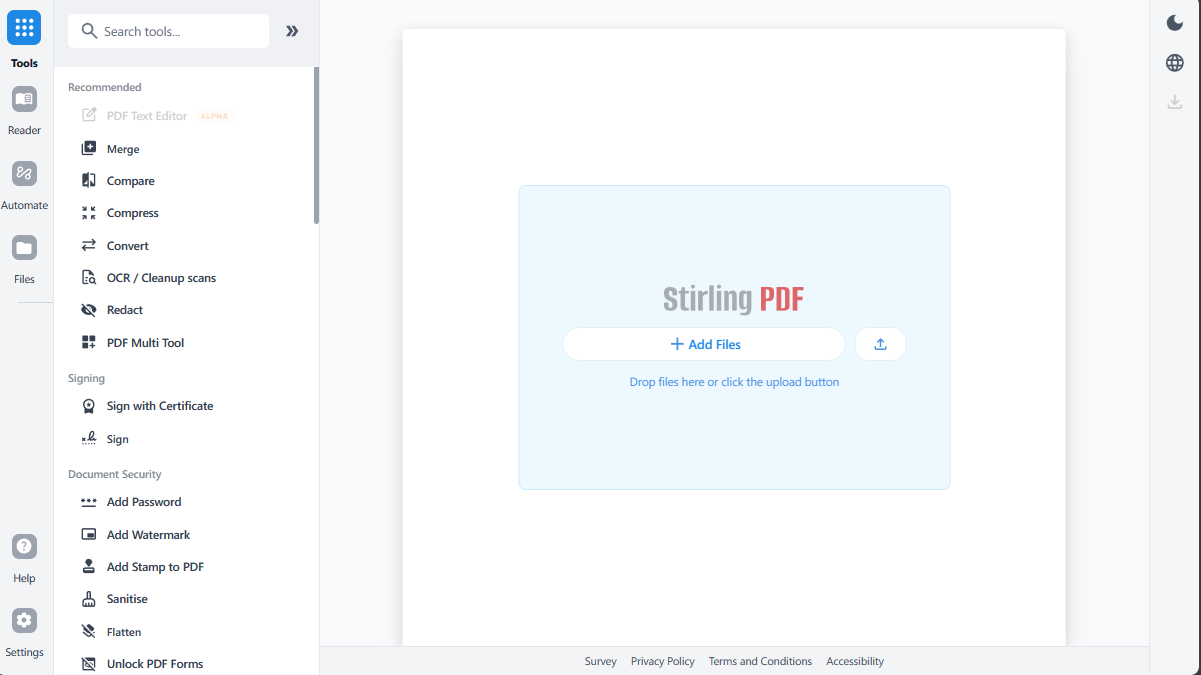
docker run or docker compose up brings up the whole stack with zero outbound network required. HIPAA, ITAR and FedRAMP-style environments can actually use it.curl. Published on the Scalar API registry.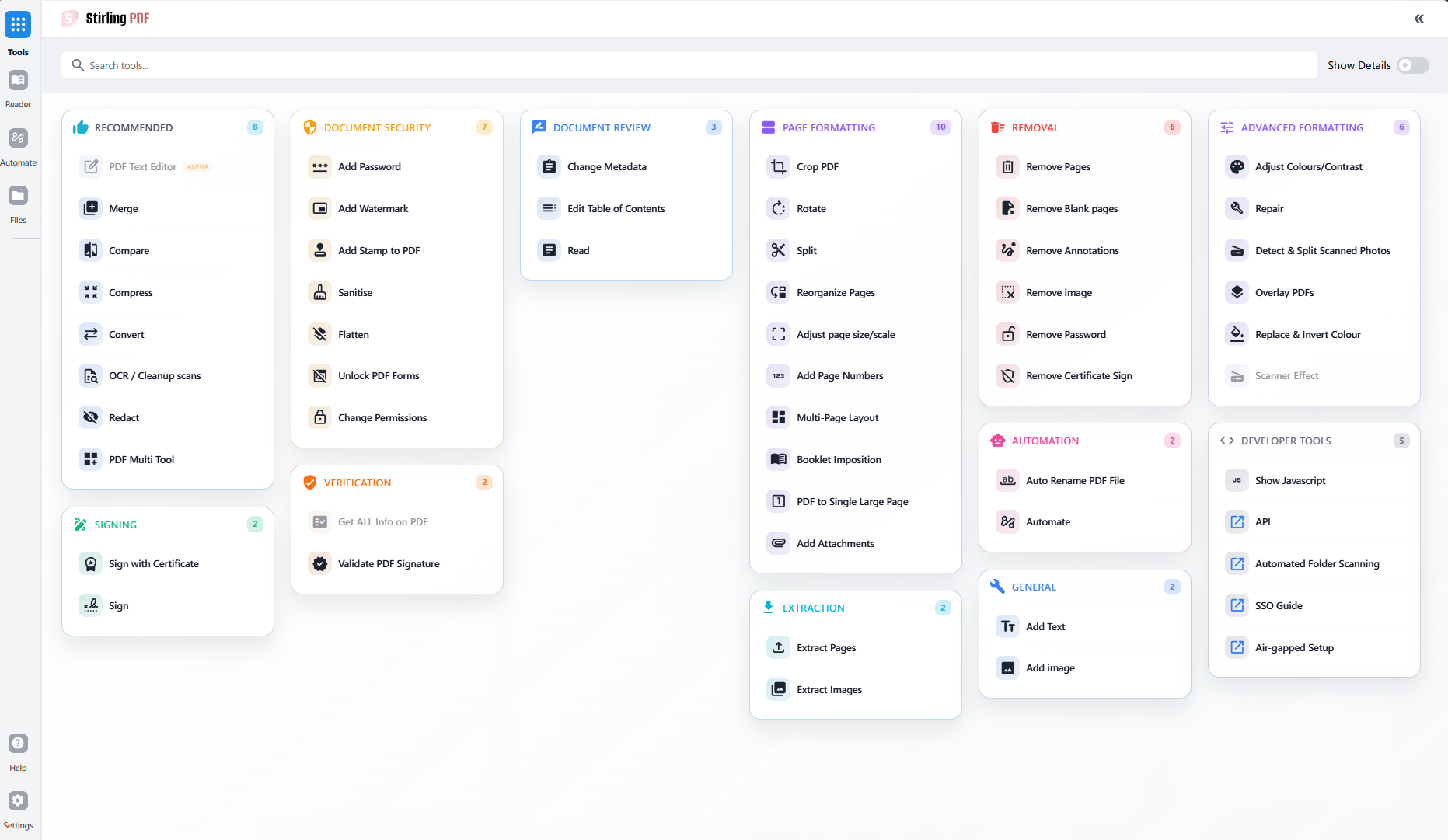
Across r/selfhosted, r/homelab and r/opensource, Stirling PDF is the default recommendation whenever someone asks "open-source Adobe Acrobat replacement." The most-upvoted praise points are consistent: fast Docker deployment, genuinely useful tool surface, and a responsive maintainer who ships weekly. Multiple users on Hacker News mention that Stirling PDF is the first self-hosted PDF tool they have not abandoned after a weekend.
The recurring complaints are honest ones. In late 2024 the project added a cookie banner and an analytics/telemetry flag to the hosted demo, and the self-hosted community pushed back hard — the dev team responded by making telemetry opt-in and documenting a clean disable path, but some users on XDA Developers still recommend forks and alternatives. The other common critique: the Java/Spring + TypeScript stack is heavier than pure-Rust competitors, so the container image is ~1.6 GB and memory use sits around 512 MB at idle.
| Plan | Price | Key Limits |
|---|---|---|
| Free | $0 | Full 50+ tool suite, self-hosted, 50 monthly AI credits, standard AI models, API sandbox, community support |
| Server | $99/server/month | Everything in Free, plus local AI models, basic SSO, advanced server controls, self-hosted API access, security alerts |
| Enterprise | Custom (from ~$12/seat/month) | SAML / OIDC / SCIM, audit logs, RAG and fine-tuning, compliance controls, managed self-hosting, custom SLAs |
The entire 50+ tool suite is free forever for self-hosters — the paid plans only unlock AI models, SSO, audit and enterprise provisioning. That makes Stirling PDF one of the rare open-core products where the free tier is genuinely usable for small teams.
Best for: sysadmins and small engineering teams who need a local PDF editor for sensitive documents; law firms, clinics and government offices that cannot send files to SmallPDF or iLovePDF; homelab enthusiasts replacing a $239/year Adobe Acrobat seat; and enterprises that want an on-prem PDF platform with SSO and audit trails.
Not ideal for: consumers who just need to sign one PDF and don't want to run Docker — a browser-only tool like BentoPDF is a faster fit. Also not ideal for teams that care about native mobile apps; Stirling PDF is strictly a web UI.
Pros:
Cons:
BentoPDF is the most-cited alternative after the 2024 telemetry episode — 100% browser-based, no server required, but a much smaller tool surface. PDF Arranger is a classic open-source desktop app for page-level editing on Linux. Gotenberg is a containerised PDF API for document conversion, better if you only need programmatic generation. Adobe Acrobat Pro remains the incumbent at $239/year per seat but ships your files through Adobe's cloud by default. For self-hosting enthusiasts also looking at workflow automation, see our review of n8n.
Yes — for almost anyone who runs their own servers, Stirling PDF is a clear win. The free tier gives you an Acrobat-class editor for $0, and the $99/month Server tier pays for itself the first time you would have shipped a client contract through a third-party SaaS. The 1.6 GB image and Java backend are real downsides, and the telemetry misstep is worth reading the docs about before you deploy. Everything else — velocity, feature coverage, open governance, enterprise controls — is better than any competing open-source PDF project in 2026. Our rating: 86/100.
Developer ToolsType-safe HTML templating language for Go with compile-time safety
 Developer Tools
Open-source API key management and rate limiting platform for modern developers
 Developer Tools
Open-source low-code platform for building internal business applications
 Developer Tools
Git-friendly open-source API client for REST, GraphQL, and gRPC
ServiceNow and Accenture Launch Forward Deployed Engineering Program to Scale Agentic AI in the Enterprise (May 6, 2026)
At Knowledge 2026, ServiceNow and Accenture announced a joint forward deployed engineering program that drops co-located engineer pods into customer environments to ship agentic AI workflows natively on the ServiceNow AI Platform — with access to 300+ pre-built agent skills and the AI Control Tower as the governance backbone.
May 7, 2026
ReFiBuy Raises $13.6M Seed to Help Brands Get Recommended by AI Shopping Agents (May 5, 2026)
ReFiBuy, the Raleigh-based agentic commerce platform from ChannelAdvisor founder Scot Wingo, closed an oversubscribed $13.6M seed led by NewRoad Capital Partners on May 5, 2026 — betting that the next billion-dollar e-commerce moat is being chosen by ChatGPT, Claude and Perplexity.
May 7, 2026
OpenAI Replaces ChatGPT's Default Model With GPT-5.5 Instant — 52.5% Fewer Hallucinations, 30% Shorter Answers (May 5, 2026)
OpenAI on May 5 swapped GPT-5.3 Instant for the new GPT-5.5 Instant as ChatGPT's default model, claiming 52.5% fewer hallucinated claims on high-stakes prompts and 30% more concise answers. The model also rolls into the API as chat-latest and adds personalization from Gmail and past chats for Plus and Pro web users.
May 7, 2026
Is this product worth it?
Built With
Compare with other tools
Open Comparison Tool →