 Developer Tools
Templ
Type-safe HTML templating language for Go with compile-time safety
Ruff is the Rust-powered linter and formatter from Astral that has effectively replaced Flake8, Black, isort and a dozen more tools across the Python ecosystem. With 47K+ GitHub stars, 800+ rules, and 10–100x speedups, it has become the default for Apache Airflow, FastAPI, Pandas, SciPy and Hugging Face.
Ruff is an extremely fast Python linter and code formatter from Astral — the same team behind uv — written in Rust and designed to replace Flake8, Black, isort, pydocstyle, pyupgrade, autoflake and a dozen related tools behind a single binary. We rate it 95/100 — it is the clearest, simplest, and fastest way to lint and format Python code in 2026, and at this point not adopting it is the unusual choice.
Ruff is an Apache 2.0 / MIT-licensed open-source linter and formatter authored by Charlie Marsh and first released on . Just three and a half years later it has accumulated 47,330 GitHub stars and 2,036 forks, and is now the standard linting and formatting toolchain for projects including Apache Airflow, FastAPI, Pandas, SciPy, Hugging Face Transformers, and Apache Superset.
Where the legacy Python tooling stack required gluing together Flake8, Black, isort, pydocstyle and pyupgrade — each with its own configuration, plugin system, and CI hook — Ruff ships 800+ built-in rules, a Black-compatible formatter, and an LSP server in a single zero-dependency binary that installs in milliseconds via pip install ruff, uv tool install ruff, or brew install ruff. The current stable line is the 0.15.x series, with v0.15.0 shipping on and bringing the new 2026 style guide, block-level suppression comments, and an expanded preview rule set of 412 default rules.
pyproject.toml.except clauses and keeps lambda parameters on a single line for readability.ruff server LSP shipped inside the main binary.pyproject.toml / ruff.toml discovery means a 200-package monorepo can share defaults at the root and override per-package — a common pain point with Flake8.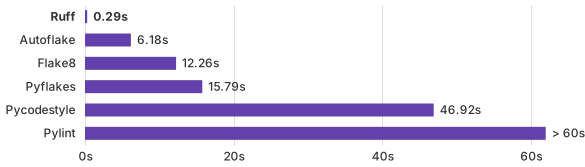
Sentiment across Reddit's r/Python and r/learnpython, Hacker News, and the Python Discord is overwhelmingly positive — to the point that several maintainers have publicly joked that Ruff is so fast they had to add intentional bugs to verify it was actually running. Sebastián Ramírez, creator of FastAPI, said exactly that: Ruff is so fast that sometimes I add an intentional bug in the code just to confirm it's actually running and checking the code.
Tim Abbott, lead developer of Zulip, summarized it bluntly: This is just ridiculously fast.
Recurring complaints, where they exist, are honest and worth knowing. Ruff covers a meaningful subset of Pylint's rules but not all of them — projects that depend on Pylint's deepest type-aware checks (especially those without separate static-typing tooling) still need it alongside Ruff. Some teams also note that the rapid release cadence (the 0.15 series alone has shipped seven point releases) occasionally introduces new lint warnings on stable code, which can be friction in CI without pinned versions. Astral's response has been to ship preview mode as the staging ground for new rules and to keep the stable rule set deliberately conservative.
Ruff is completely free and open source under a dual MIT / Apache 2.0 license. There is no paywall, no tiered SaaS plan, no usage cap, and no telemetry — you install the binary and run it. Astral monetizes the broader stack (uv, ty, the planned managed services) rather than Ruff itself.
| Plan | Price | Includes |
|---|---|---|
| Open Source | $0 | Linter, formatter, LSP server, all 800+ rules — unlimited use |
Best for: Every Python team that currently runs Flake8, Black, isort, pyupgrade or any combination of those tools. Solo developers, library maintainers, monorepo owners, and CI-conscious enterprises all benefit immediately — the migration is a one-line install plus a small pyproject.toml section.
Not ideal for: Codebases that depend specifically on Pylint's deepest dataflow rules, projects whose CI culture cannot tolerate any rule-set churn between minor releases, or strict-licensing environments that have policies against pulling in new Apache 2.0 dependencies (rare).
Pros:
Cons:
Direct competitors are essentially the legacy stack: Flake8 (slower, plugin-based, much more permissive about config sprawl), Black (formatter only, but Ruff's formatter is Black-compatible), Pylint (deeper static analysis, multiple times slower), and Meta's Pyrefly (newer, type-checker-focused, narrower scope). For teams that want a similarly fast all-in-one approach but in JavaScript-land, see our Biome review.
Ruff is the clearest "yes" we have written this year. It is genuinely 10–100x faster than the legacy Python tooling stack, replaces five to ten separate tools with one binary, costs nothing, has zero telemetry, and is already the default in essentially every major open-source Python project. If you are still running Flake8 + Black + isort + pyupgrade in CI, switching to Ruff will save you minutes per build, dozens of lines of configuration, and one or two CI containers — at the cost of a single afternoon's migration work. The 95/100 rating reflects exactly that: it is the rare tool that is both objectively the fastest option and the simplest one.
ruff server LSP.ServiceNow and Accenture Launch Forward Deployed Engineering Program to Scale Agentic AI in the Enterprise (May 6, 2026)
At Knowledge 2026, ServiceNow and Accenture announced a joint forward deployed engineering program that drops co-located engineer pods into customer environments to ship agentic AI workflows natively on the ServiceNow AI Platform — with access to 300+ pre-built agent skills and the AI Control Tower as the governance backbone.
May 7, 2026
ReFiBuy Raises $13.6M Seed to Help Brands Get Recommended by AI Shopping Agents (May 5, 2026)
ReFiBuy, the Raleigh-based agentic commerce platform from ChannelAdvisor founder Scot Wingo, closed an oversubscribed $13.6M seed led by NewRoad Capital Partners on May 5, 2026 — betting that the next billion-dollar e-commerce moat is being chosen by ChatGPT, Claude and Perplexity.
May 7, 2026
OpenAI Replaces ChatGPT's Default Model With GPT-5.5 Instant — 52.5% Fewer Hallucinations, 30% Shorter Answers (May 5, 2026)
OpenAI on May 5 swapped GPT-5.3 Instant for the new GPT-5.5 Instant as ChatGPT's default model, claiming 52.5% fewer hallucinated claims on high-stakes prompts and 30% more concise answers. The model also rolls into the API as chat-latest and adds personalization from Gmail and past chats for Plus and Pro web users.
May 7, 2026