 Design
Screen Studio
Professional macOS screen recorder with automatic zoom and cursor smoothing
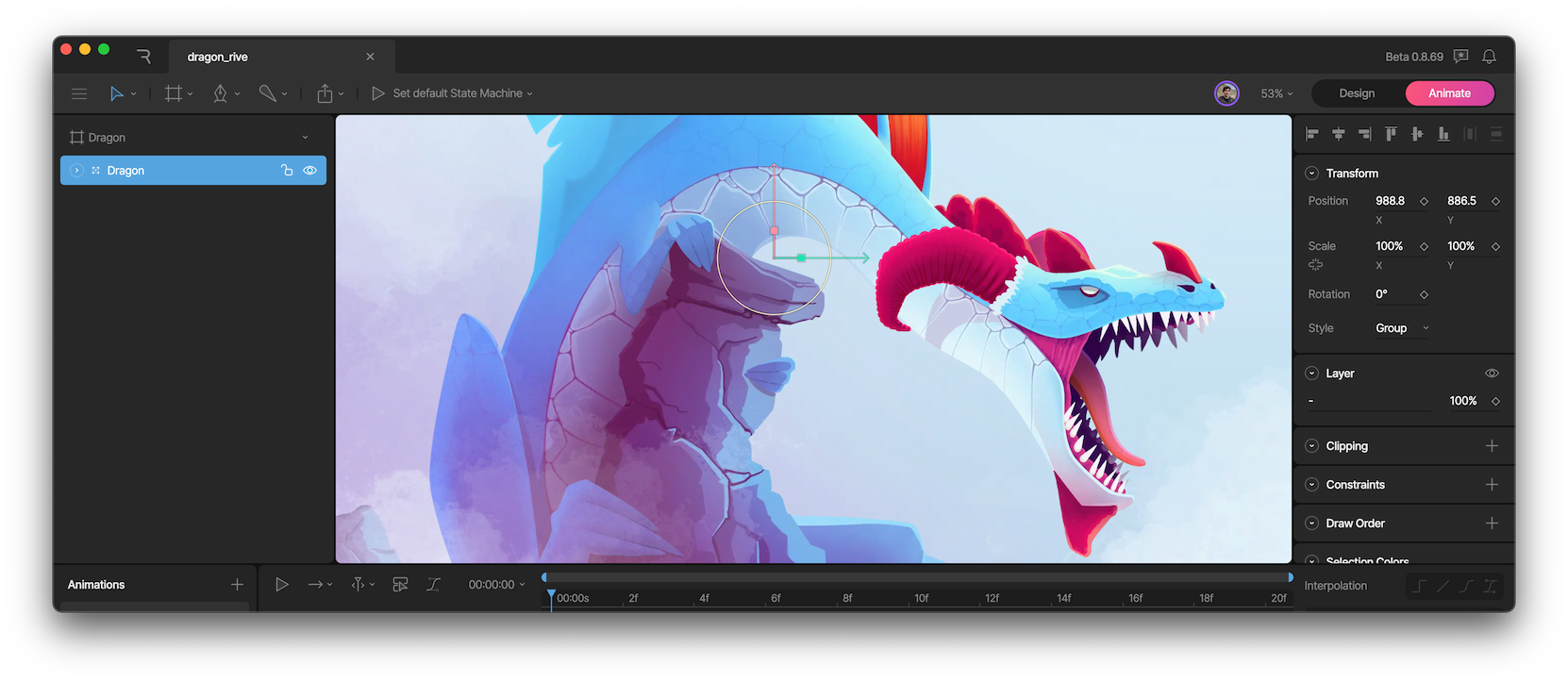
Rive is a real-time interactive animation tool that powers Spotify Wrapped and Duolingo's character system. Build a state machine once, ship it natively to iOS, Android, Flutter, React, web, Unity, and Unreal.
Rive is a real-time interactive design and animation tool that lets designers, animators, and developers build vector animations once and ship them natively across iOS, Android, Flutter, React, React Native, web, and game engines like Unity and Unreal. We rate it 89/100 — the most production-ready interactive animation engine in 2026, and the obvious choice for any product team that wants animations to be more than decoration.
Rive was founded by Guido Rosso (formerly of Adobe) in 2018 and rebranded from "Flare" to Rive in February 2020. The San Francisco company has raised roughly $68 million across a Series A led by Spark Capital and a 2021 Series B led by IVP. Today Rive powers Spotify Wrapped 2025, the lip-synced characters in Duolingo, products at ESPN, LinkedIn, Google, Disney, and dozens of Fortune 500 automakers — reaching, by Rive's own count, over two billion end users.
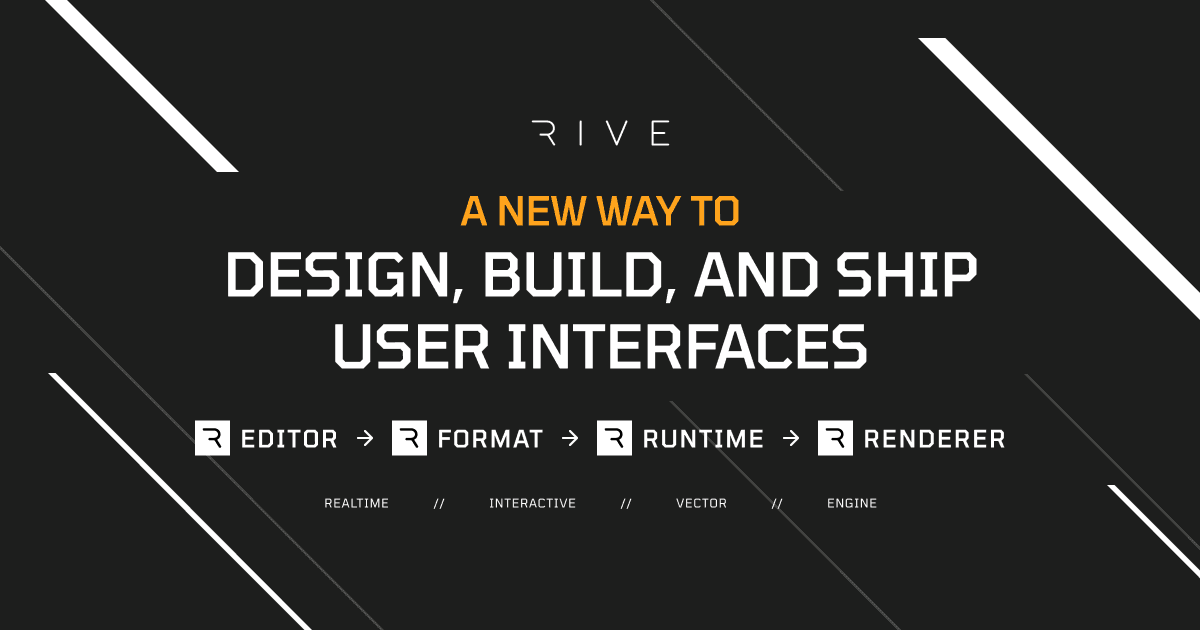
The pitch is simple: workflows built on After Effects, Lottie, Figma export, and hand-rolled CSS keyframes were never designed for interactivity. Lottie animations play forward, then stop. Rive treats animation as a state machine where any input — a tap, a hover, a stream of live data — can drive smooth blends between timelines. Files compile to a tiny .riv binary that the open-source Rive Renderer (a GPU-accelerated vector engine running at 120fps, open-sourced in March 2024) plays natively on every supported runtime. Teams report up to 4× faster animation production, files up to 90% smaller than equivalent Lottie or video, and measurably higher engagement when interactive Rive replaces static art.

Designer reaction across r/MotionDesign, the 2023 Hacker News thread, and the 2024 renderer open-source announcement is overwhelmingly positive. Recurring praise: file sizes "10× smaller than Lottie," genuine multiplatform parity, and a state-machine model that designers can author without engineering help. A frequently-quoted r/MotionDesign comment captures the workflow: "If I need to ship fast, I'll go straight to Rive. But if I want total control, AE is still my finisher." Rive holds a 4.6/5 on G2 across small-to-mid-team reviewers.
The honest complaints are also consistent. The single biggest is the learning curve — one frequently-upvoted G2 review reads "Rive has a bit steep learning curve but it is a game changer." After Effects veterans regularly report a few weeks of friction before Rive's vector-only, constraint-driven model clicks. The second is asset import: Rive doesn't accept After Effects projects directly, so existing AE keyframe libraries have to be rebuilt rather than imported. The third is seat-cap pricing: the Cadet tier is capped at 3 seats and Voyager at 25, forcing larger teams onto Enterprise (custom contracts, $120/seat/mo) earlier than some would like.
Rive moved to a four-tier "spaceflight"-themed model in 2025. The free tier is meaningfully usable for learning and personal work, but exports and unlimited files unlock at the paid tiers.
| Plan | Price | Key Limits |
|---|---|---|
| Free | $0/seat/mo | 3 collaborative files, full editor (state machines, data binding, scripting), no runtime exports |
| Cadet | $9/seat/mo | 3-seat max, unlimited files, runtime exports, $5/seat monthly Rive AI agent credits |
| Voyager | $32/seat/mo | 25-seat max, Libraries, CDN asset hosting, embed links, $16/seat AI credits, prioritized support |
| Enterprise | $120/seat/mo | Subteam workspaces, custom S3 bucket, SSO, SOC 2 Type II, $40/seat AI credits, custom runtime support |
The Cadet and Voyager prices above are the monthly billing; annual billing knocks roughly 25% off. Enterprise is gated to organizations with $10M+ annual revenue.
Best for: Mobile and product teams that want interactive UI animations — gamified onboarding, animated state transitions, character mascots that respond to user actions, live-data visualizations — without writing per-platform animation code. Particularly compelling for Flutter and React Native shops, mobile games that want vector-quality UI, and any team already running Lottie that has hit its performance or interactivity ceiling.
Not ideal for: Teams that just need fire-and-forget motion graphics for a marketing video (After Effects + Lottie is still cheaper), studios with deep AE pipelines and no need for interactivity, and pure 3D workflows (Spline or Blender are the right tools there).
Pros:
Cons:
The closest alternatives are Lottie / LottieFiles (free, ubiquitous, but non-interactive playback only and notably heavier on mobile), After Effects + Bodymovin (the legacy pipeline Rive is targeting — far better for cinematic motion graphics, far worse for interactive UI), Excalidraw and Cavalry (different problem space — sketch-style and motion-design respectively), and emerging tools like Jitter for marketing-focused motion. For 3D, Spline is the right pick. For game-engine UI specifically, Rive GameKit is the only product that lets the same designer-built file power both an app's onboarding screen and an in-game interaction.
Yes — with one caveat. If your team is already shipping Lottie and ever found yourselves wishing the animation could react to a tap, a scroll, or live data, Rive is the upgrade and you should be on it. The free tier is enough to evaluate; the $9/seat Cadet tier covers indie and small-team production; and the Voyager tier is fairly priced for the multiplayer collaboration most product teams will actually use. The caveat: budget two to three weeks of designer ramp time before you'll feel productive, and rebuild — don't migrate — from any deep After Effects asset library. Our final score is 89/100 — very good, in the same tier as Figma was around its 2018 inflection point, with the same kind of design-tool-as-runtime ambition.
ServiceNow and Accenture Launch Forward Deployed Engineering Program to Scale Agentic AI in the Enterprise (May 6, 2026)
At Knowledge 2026, ServiceNow and Accenture announced a joint forward deployed engineering program that drops co-located engineer pods into customer environments to ship agentic AI workflows natively on the ServiceNow AI Platform — with access to 300+ pre-built agent skills and the AI Control Tower as the governance backbone.
May 7, 2026
ReFiBuy Raises $13.6M Seed to Help Brands Get Recommended by AI Shopping Agents (May 5, 2026)
ReFiBuy, the Raleigh-based agentic commerce platform from ChannelAdvisor founder Scot Wingo, closed an oversubscribed $13.6M seed led by NewRoad Capital Partners on May 5, 2026 — betting that the next billion-dollar e-commerce moat is being chosen by ChatGPT, Claude and Perplexity.
May 7, 2026
OpenAI Replaces ChatGPT's Default Model With GPT-5.5 Instant — 52.5% Fewer Hallucinations, 30% Shorter Answers (May 5, 2026)
OpenAI on May 5 swapped GPT-5.3 Instant for the new GPT-5.5 Instant as ChatGPT's default model, claiming 52.5% fewer hallucinated claims on high-stakes prompts and 30% more concise answers. The model also rolls into the API as chat-latest and adds personalization from Gmail and past chats for Plus and Pro web users.
May 7, 2026
Is this product worth it?
Built With
Compare with other tools
Open Comparison Tool →