 Developer Tools
Templ
Type-safe HTML templating language for Go with compile-time safety
Reflex is an open-source, MIT-style Apache 2.0 framework that compiles pure Python into a Next.js + FastAPI full-stack app — and Reflex Cloud and Reflex Build now wrap it in AI generation and one-command hosting. We rate it 84/100.
Reflex is an open-source, Apache-2.0 framework that compiles pure Python code into a Next.js + React frontend wired to a FastAPI backend — letting a Python developer ship a real, reactive full-stack web app without ever touching JavaScript. We rate it 84/100 — for Python teams building internal tools, AI dashboards, or data-heavy apps in 2026, Reflex is the most polished "no-JS" framework on the market, and the new Reflex Build AI generator plus Reflex Cloud hosting make it credible for production work, not just prototypes.
Reflex is a free, Apache-2.0 open-source Python web framework, originally launched as Pynecone in and rebranded to Reflex in early 2024. It was founded by Nikhil Rao (CEO) and Alek Petuskey, both ex-MIT, and the company raised a $5M seed round led by Lux Capital with participation from Y Combinator, Box Group, Abstract Ventures and Picus Capital.
What makes it different from Flask, Django or FastAPI is that Reflex doesn't stop at the API layer — it compiles your Python components into a full Next.js + React frontend and a FastAPI backend, so a single reflex run command gives you a reactive single-page app with WebSocket-driven state, type-checked event handlers, and zero JavaScript on your side of the stack. As of the main repo has crossed 28,385 GitHub stars, the framework is at v0.9.2 (released ), and the company has expanded the platform with three commercial layers on top of the open-source framework.
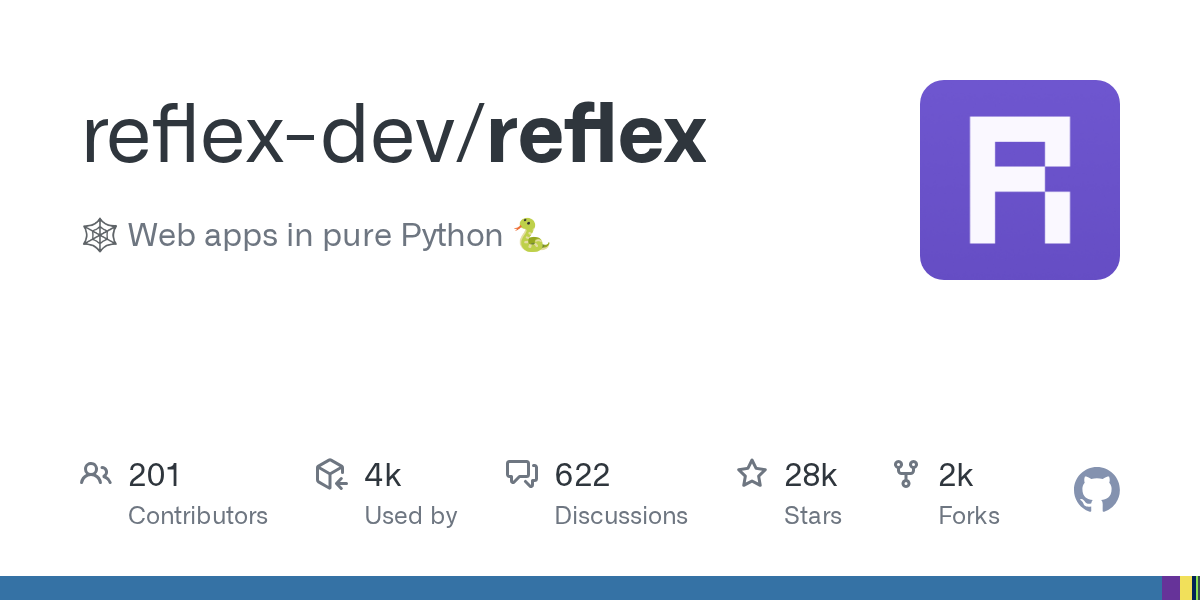
reflex-dev/reflex repository: 28k+ stars, 1.7k forks, actively maintained with weekly releases.rx.hstack, rx.button, rx.data_table) — over 60 Radix-themed primitives ship out of the box, plus a CSS-prop system that exposes the full Tailwind palette.State class holds your variables and event handlers; Reflex compiles state mutations into typed WebSocket messages, so the same Python type hints validate both the UI and the server.reflex deploy ships your app to managed infrastructure billed per-minute of compute (from 0.008 credits/min on c1m.5 up to 0.080 credits/min on c4m8) — no Dockerfile required.reflex export producing a static frontend bundle plus a standard Python ASGI app — no lock-in to Reflex Cloud.
Sentiment among Python developers in 2026 is broadly positive but not unconditional. On Hacker News, the most common praise is that Reflex finally delivers what tools like Streamlit and Dash hinted at — a single Python codebase that can produce a real, customizable SPA — without forcing the developer to learn React's mental model. The most consistent complaint is that the compiled frontend bundle is heavier than a hand-written Next.js app, that hot reload can stall on very large component trees, and that the documentation, while extensive, still has gaps around advanced state patterns and authentication. r/Python users frequently compare Reflex favorably to NiceGUI and Rio for production internal tools, while noting that for purely server-rendered content sites, Django or FastHTML are leaner choices. The Reflex Build AI generator has split opinion: power users appreciate that the output is real Reflex code they own, but several Reddit threads flag that the credit pricing on the Pro plan (1,000 credits/month) can be eaten quickly by anyone leaning hard on the Custom Agent.
The framework is free and Apache-2.0; pricing only applies to Reflex Build (AI generation) and Reflex Cloud (hosting):
| Plan | Price | Key Limits |
|---|---|---|
| Hobby | $0 | 50 Build credits/day (~150/month), public apps only with "Built with Reflex" attribution, 1 app, shared compute |
| Pro | $50 / month | 1,000 Build credits/month, private projects, browser code editor, GitHub sync, custom domains, machines up to 4 vCPU / 8 GB RAM |
| Enterprise | Custom | SSO/SAML, on-prem deployments, SOC 2, HIPAA BAA, audit logs, dedicated support, forward-deployed engineer |
Reflex Cloud compute is metered: a c1m.5 (1 vCPU / 0.5 GB) machine costs 0.008 credits/minute and only runs while the app is being used, which keeps idle dashboards effectively free.
Best for: Python-heavy teams (data, ML, internal tooling, AI startups) that need a real reactive UI without spinning up a separate React/Next.js team. It is also a strong choice for solo founders and consultants who want to ship customer-facing apps from a single Python codebase.
Not ideal for: Teams that already have a React frontend and just need a backend (use FastAPI or Django directly), high-traffic content sites where every kilobyte of JS matters (use Astro or Next.js), or developers who actively prefer JSX and React's ecosystem of npm components.
Pros:
Cons:
Streamlit is faster for quick data-science demos but much harder to customize visually. Nuxt and Next.js are more powerful for content-heavy sites but require JavaScript. NiceGUI and Rio are leaner pure-Python alternatives but lack Reflex's component depth, AI builder and managed cloud.
For any Python team that has been hand-stitching FastAPI + a separate React frontend, Reflex in 2026 is now mature enough to seriously consider replacing both. The framework is genuinely free and self-hostable, the Pro plan at $50/month is cheap insurance for private apps, and Reflex Cloud's per-minute compute model means you can park an internal tool there for the cost of a coffee per month. We're rating it 84/100 — the bundle weight and credit-burn concerns keep it out of the 90s, but for the specific job of "ship a reactive web app entirely in Python," nothing else on the market does it as cleanly.
ServiceNow and Accenture Launch Forward Deployed Engineering Program to Scale Agentic AI in the Enterprise (May 6, 2026)
At Knowledge 2026, ServiceNow and Accenture announced a joint forward deployed engineering program that drops co-located engineer pods into customer environments to ship agentic AI workflows natively on the ServiceNow AI Platform — with access to 300+ pre-built agent skills and the AI Control Tower as the governance backbone.
May 7, 2026
ReFiBuy Raises $13.6M Seed to Help Brands Get Recommended by AI Shopping Agents (May 5, 2026)
ReFiBuy, the Raleigh-based agentic commerce platform from ChannelAdvisor founder Scot Wingo, closed an oversubscribed $13.6M seed led by NewRoad Capital Partners on May 5, 2026 — betting that the next billion-dollar e-commerce moat is being chosen by ChatGPT, Claude and Perplexity.
May 7, 2026
OpenAI Replaces ChatGPT's Default Model With GPT-5.5 Instant — 52.5% Fewer Hallucinations, 30% Shorter Answers (May 5, 2026)
OpenAI on May 5 swapped GPT-5.3 Instant for the new GPT-5.5 Instant as ChatGPT's default model, claiming 52.5% fewer hallucinated claims on high-stakes prompts and 30% more concise answers. The model also rolls into the API as chat-latest and adds personalization from Gmail and past chats for Plus and Pro web users.
May 7, 2026
Is this product worth it?
Built With
Compare with other tools
Open Comparison Tool →