 Productivity
LocalSend
Open-source AirDrop alternative for any device — 80k GitHub stars, end-to-end encrypted, zero internet required.
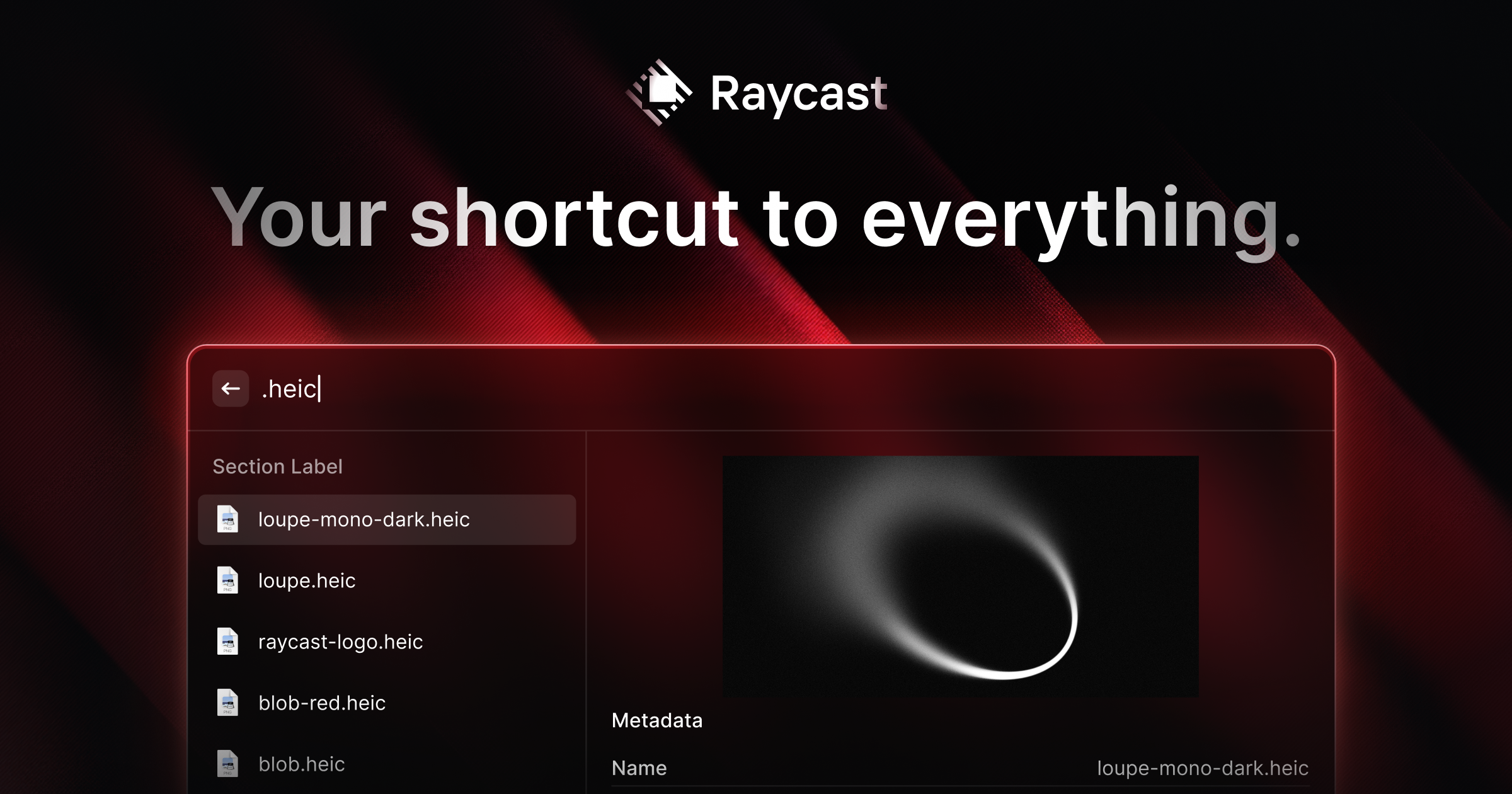
Raycast is a native macOS launcher designed to replace Spotlight with a faster, more powerful command palette. We rate it 92/100 — an exceptional productivity tool that combines blazing-fast performance with an extensible ecosystem, AI integration, and a polished UI.
Raycast launched in October 2020 as an alternative to macOS Spotlight, built on the premise that a launcher should be fast, keyboard-first, and extensible. The team designed it from the ground up as a native application (not Electron), prioritizing performance with a 99.8% crash-free rate. Today it has 7.3K GitHub stars for its extensions repository, 5.1K dependent packages, and a thriving community of 5K+ developers building extensions.
Unlike Spotlight, which indexes all files on your Mac, Raycast focuses on being a command palette for apps, tools, and integrations you actually use. It integrates with Linear, Jira, Slack, Notion, Spotify, 1Password, Google Translate, and hundreds of community-built extensions. In 2024, Raycast launched Raycast Notes (which won a Golden Kitty Award), expanded to iOS and Windows, and introduced deep AI integration.

1. Performance is Obsessive: Built natively (Swift/Rust), not Electron. The team benchmarks every release against Spotlight and previous versions. This matters when you use your launcher 100+ times per day.
2. Ecosystem is Developer-Friendly: The TypeScript/React SDK, comprehensive documentation at developers.raycast.com, and active Slack community (5K+ developers) make building extensions approachable. The barrier to publishing is low but quality standards are high.
3. AI Integration Without Friction: Quick AI is built-in (ChatGPT-powered). You can generate code, summarize text, or create custom AI commands without leaving the launcher. The free tier includes 50 AI messages; Pro adds unlimited AI for +$8/month.
4. Team-Centric Features: Unlike most launchers (which are single-user tools), Raycast has thoughtful team features: shared snippets, quicklinks, commands, and a free tier that doesn't expire. Team Pro ($12/user/month) adds SSO and org controls.
Raycast vs. Spotlight: Spotlight indexes everything on your Mac; Raycast is a command palette for tools you use. Raycast is faster, extensible, and team-aware. Spotlight is built-in.
Raycast vs. Alfred: Alfred is older, more powerful for advanced automation (Workflows). Raycast is faster, more beautiful, better for team collaboration, and has a thriving extension ecosystem. Alfred is one-time purchase ($49); Raycast is subscription.
Raycast vs. LaunchBar: LaunchBar is more feature-rich for power users. Raycast is faster, simpler, and has better integrations and team features.
Raycast is the best modern launcher for macOS. It's faster than Spotlight, simpler than Alfred, better for teams than LaunchBar, and has an ecosystem of extensions that keeps growing. The free tier is generous. Pro ($10/month) is worth it for unlimited notes, cloud sync, and custom themes. Team pricing ($12/user/month) is reasonable for organizations that want shared commands and SSO.
The main catch: you're paying a subscription for a tool that used to be one-time ($49 for Alfred) or built-in (Spotlight). But the speed, extensibility, and team collaboration are genuinely superior. If you use your launcher 100+ times per day (most engineers do), Raycast pays for itself in productivity within weeks.
Rating: 92/100 — An exceptional tool that deserves to be your new launcher.
ProductivityOpen-source AirDrop alternative for any device — 80k GitHub stars, end-to-end encrypted, zero internet required.
 Productivity
Local-first, Markdown-native note-taking with a graph view and 2,000+ community plugins
 Productivity
Self-hosted document management with OCR, auto-tagging and full-text search in 100+ languages
 Productivity
The fastest open-source team knowledge base — markdown, realtime collab, and 20+ integrations.
ServiceNow and Accenture Launch Forward Deployed Engineering Program to Scale Agentic AI in the Enterprise (May 6, 2026)
At Knowledge 2026, ServiceNow and Accenture announced a joint forward deployed engineering program that drops co-located engineer pods into customer environments to ship agentic AI workflows natively on the ServiceNow AI Platform — with access to 300+ pre-built agent skills and the AI Control Tower as the governance backbone.
May 7, 2026
ReFiBuy Raises $13.6M Seed to Help Brands Get Recommended by AI Shopping Agents (May 5, 2026)
ReFiBuy, the Raleigh-based agentic commerce platform from ChannelAdvisor founder Scot Wingo, closed an oversubscribed $13.6M seed led by NewRoad Capital Partners on May 5, 2026 — betting that the next billion-dollar e-commerce moat is being chosen by ChatGPT, Claude and Perplexity.
May 7, 2026
OpenAI Replaces ChatGPT's Default Model With GPT-5.5 Instant — 52.5% Fewer Hallucinations, 30% Shorter Answers (May 5, 2026)
OpenAI on May 5 swapped GPT-5.3 Instant for the new GPT-5.5 Instant as ChatGPT's default model, claiming 52.5% fewer hallucinated claims on high-stakes prompts and 30% more concise answers. The model also rolls into the API as chat-latest and adds personalization from Gmail and past chats for Plus and Pro web users.
May 7, 2026
Is this product worth it?
Compare with other tools
Open Comparison Tool →