 Design
Screen Studio
Professional macOS screen recorder with automatic zoom and cursor smoothing
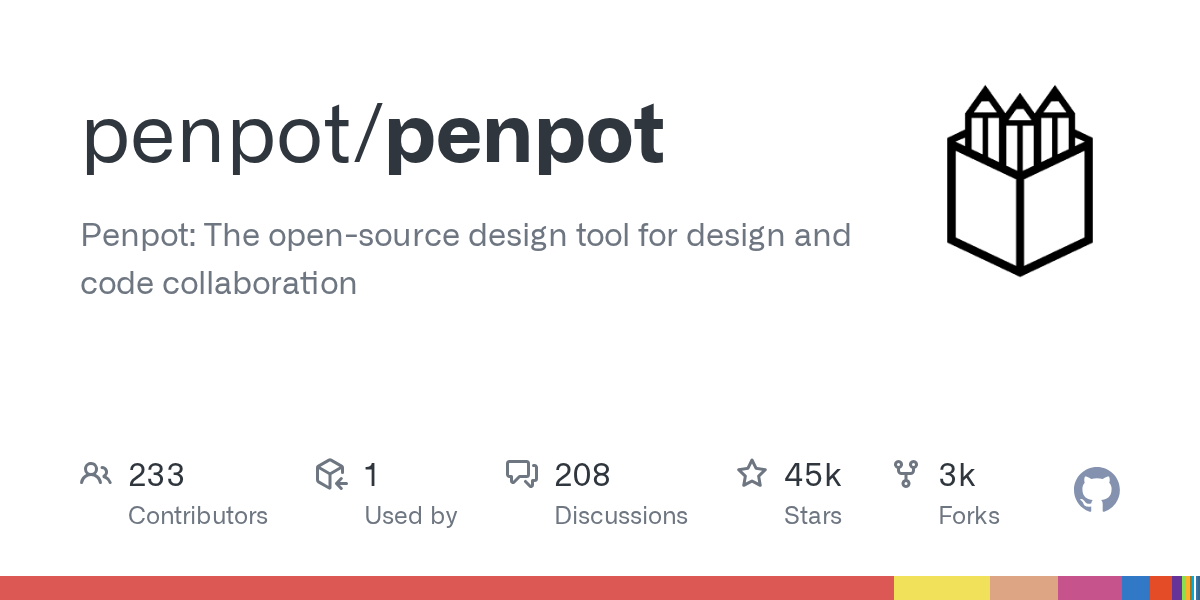
Penpot is the first open-source design tool for design and code collaboration — free for unlimited teams, self-hostable, and built on SVG/CSS open standards with native CSS Grid and free Developer Mode.
Penpot is the first open-source, web-based design and prototyping platform built on open standards (SVG, CSS) that lets designers and developers collaborate in a single app — no vendor lock-in, no handoff drama. We rate it 82/100: the best free Figma alternative for privacy-conscious teams, open-source advocates, and organizations that must self-host their design stack.
Penpot was created by Kaleidos, a Spanish open-source software company, and launched publicly in . By , the project reached 45,100+ GitHub stars and shipped version 2.14.1. Unlike Figma (owned by Adobe) or Sketch (Mac-only), Penpot runs in any modern browser and is 100% self-hostable via Docker with MPL-2.0 licensing.
The core problem Penpot solves is the design-developer gap: designers produce mockups, then developers manually re-implement measurements. Penpot eliminates this by natively generating SVG, CSS, and HTML code from any design element — for free, in the built-in Developer Mode — without a paid tier.
Community sentiment is broadly positive but honest about trade-offs. On Reddit's r/webdev and r/design, the most common praise covers open-source nature (especially post-Adobe/Figma deal), the generous free plan, and free Developer Mode. The recurring criticism: the interface feels slightly less polished than Figma — some panels feel modern, others like afterthoughts. G2 reviewers in 2025–2026 highlight native CSS Grid support as a breakout feature ("I can design the exact grid I'll build without using a plugin"), while noting that performance on very large files can lag. Product Hunt commenters at Penpot 2.0's launch praised the redesigned UI and CSS Grid, with the main complaint being a smaller plugin ecosystem versus Figma's mature marketplace.
Penpot's pricing is unusually transparent — and genuinely free for most professional use cases.
| Plan | Price | Key Details |
|---|---|---|
| Free | $0/month | Unlimited projects, files, and collaborators on Penpot Cloud. No seat limit, no feature walls. |
| Professional | Capped at $175/month | No matter how large your team, you never pay more than $175/month. Includes 25GB storage and advanced sharing controls. |
| Enterprise | Capped at $950/month | SSO, audit logs, SLA, dedicated support. Flat price regardless of team size — designed for large orgs. |
| Self-Hosted | Free (Open Source) | Run it on your own infrastructure. MPL-2.0 licensed. Full feature parity with Penpot Cloud. |
The capped pricing model is a direct shot at Figma's per-seat pricing, which can cost large teams thousands per month. A 200-person design org pays the same $175/month as a 20-person team on Penpot Professional.
Best for: Freelancers and startups on tight budgets, agencies that need to self-host client files for compliance, developers who want free code inspection, open-source advocates, and teams migrating from Figma after vendor-lock concerns intensified with the Adobe deal.
Not ideal for: Organizations deeply invested in Figma's plugin ecosystem (Penpot's plugin library is still maturing), teams that do heavy mobile app prototyping requiring platform-specific component libraries, or designers needing seamless Lottie/After Effects animation workflows.
Pros:
Cons:
Figma remains the industry standard — richer plugin ecosystem, smoother UX on large files, and stronger mobile prototyping. But paid Dev Mode and per-seat pricing make it expensive at scale. Lunacy (by Icons8) is a free native Windows/Mac app with AI features, but it's not open-source. Excalidraw is excellent for wireframes and diagrams but lacks the component systems and code export that Penpot delivers for full UI design work.
For any team where Figma's pricing feels punishing, or where data sovereignty is non-negotiable, Penpot is a clear recommendation. Free for unlimited seats, no paywalled Dev Mode, open-source file format, and a weekly release cadence — it earns its 82/100. Held back only by a maturing plugin ecosystem and occasionally rough UI edges, it's exceptional value at zero cost, and the $175/month Professional plan cap is genuinely disruptive pricing for larger teams.
ServiceNow and Accenture Launch Forward Deployed Engineering Program to Scale Agentic AI in the Enterprise (May 6, 2026)
At Knowledge 2026, ServiceNow and Accenture announced a joint forward deployed engineering program that drops co-located engineer pods into customer environments to ship agentic AI workflows natively on the ServiceNow AI Platform — with access to 300+ pre-built agent skills and the AI Control Tower as the governance backbone.
May 7, 2026
ReFiBuy Raises $13.6M Seed to Help Brands Get Recommended by AI Shopping Agents (May 5, 2026)
ReFiBuy, the Raleigh-based agentic commerce platform from ChannelAdvisor founder Scot Wingo, closed an oversubscribed $13.6M seed led by NewRoad Capital Partners on May 5, 2026 — betting that the next billion-dollar e-commerce moat is being chosen by ChatGPT, Claude and Perplexity.
May 7, 2026
OpenAI Replaces ChatGPT's Default Model With GPT-5.5 Instant — 52.5% Fewer Hallucinations, 30% Shorter Answers (May 5, 2026)
OpenAI on May 5 swapped GPT-5.3 Instant for the new GPT-5.5 Instant as ChatGPT's default model, claiming 52.5% fewer hallucinated claims on high-stakes prompts and 30% more concise answers. The model also rolls into the API as chat-latest and adds personalization from Gmail and past chats for Plus and Pro web users.
May 7, 2026
Is this product worth it?
Built With
Compare with other tools
Open Comparison Tool →