 Developer Tools
Templ
Type-safe HTML templating language for Go with compile-time safety
Payload is an open-source, TypeScript-first headless CMS and app framework that installs as a Next.js route. After Figma acquired it in June 2025, it has become the default pick for engineering teams who want a code-first CMS without losing Figma-grade polish.
Payload is an open-source, MIT-licensed, TypeScript-native headless CMS and application framework that installs directly into a Next.js /app folder. We rate it 88/100 — it is the best code-first CMS for teams already shipping on Next.js in 2026, and the Figma acquisition on has only accelerated its momentum. It is the wrong call only for non-technical content teams who want a point-and-click WYSIWYG out of the box.
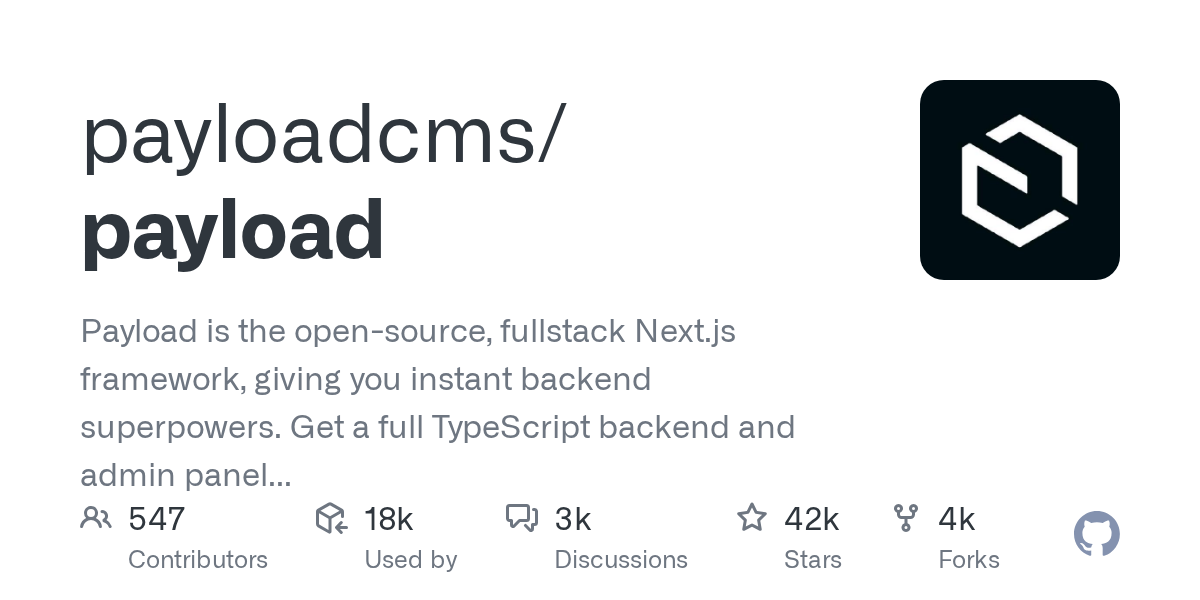
Payload was founded in 2018 by James Mikrut, Elliot DeNolf, and Dan Ribbens out of Grand Rapids, Michigan, shipped its first public beta in , hit 1.0 in 2022, and raised a $4.7M seed led by Matt Mullenweg and Y Combinator in . On the entire Payload team joined Figma; financial terms were not disclosed, and Payload remains MIT-licensed and fully self-hostable. The GitHub repository sits at roughly 41,900 stars, 96% TypeScript, with active weekly releases through April 2026.
The specific problem Payload solves is the headless-CMS tax: most headless CMSes force you to run a separate Node service, configure a SaaS dashboard remote from your code, and glue the two together with SDKs and webhooks. Payload collapses that stack — you install one npm package, drop a collections config into your existing Next.js app, and get a full admin panel, REST and GraphQL APIs, authentication, uploads, and a TypeScript-typed client on the same deployment. Unlike Sanity or Contentful, there is no external service to reach for at runtime — your database is yours, your server is yours, and your code owns the schema.

npx create-payload-app scaffolds a production-ready admin panel in under 2 minutes.Sentiment on the Payload 3.0 Show HN thread is strongly positive on developer experience. Top-voted commenters praise "actual types end-to-end" and call the local API "the feature other CMSes forgot." On r/nextjs the recurring theme is teams replacing Strapi or Directus with Payload and cutting their content backend from two deployments to one. On G2 Payload currently holds a 98% user-satisfaction rating across 123 reviews.
The honest complaints are consistent. First, Payload is unopinionated: there is no marketing-friendly page builder out of the box, so content teams coming from Webflow or WordPress feel the ramp. Second, several HN commenters noted that 2FA for admin users is not enforced by default and must be configured explicitly — a fair criticism the Payload team has acknowledged on their roadmap. Third, the ecosystem is smaller than Sanity's or Strapi's, so obscure integrations often mean writing a plugin rather than installing one.
Payload is MIT-licensed and free to self-host forever. Payload Cloud is a fully managed option with a free-for-development Sandbox tier, then usage-based production tiers.
| Plan | Price | Key Limits |
|---|---|---|
| Self-hosted | $0 | MIT-licensed, unlimited projects, unlimited seats, all features — bring your own infrastructure |
| Cloud Sandbox | $0/mo | 1 dev environment, MongoDB Atlas M0, Cloudflare R2, sleeps after inactivity — for dev only |
| Cloud Standard | From $35/mo | Production workloads, 10 GB DB + 20 GB storage, email included, automated daily backups |
| Cloud Pro | From $199/mo | Dedicated compute, 100 GB DB, 500 GB storage, point-in-time restore, SSO add-on |
| Enterprise | Up to ~$833/mo (custom) | Reserved capacity, priority support, custom SLAs, audit logs, HIPAA BAA option |
Best for: Next.js engineering teams who want a code-first CMS, TypeScript shops that prize type-safety from schema to frontend, agencies building client sites that need full white-labelling, any team whose marketing site already lives in a Next.js monorepo, and anyone replacing Strapi, Directus, or a bespoke Mongoose-plus-admin stack.
Not ideal for: Non-technical content teams who want a drag-and-drop page builder out of the box (look at Webflow or WordPress), teams with no Node.js or TypeScript expertise in-house, and sites with zero dynamic content where a static site generator is simpler.
Pros:
Cons:
Strapi — the older Node-based open-source CMS with a much bigger marketplace but a less polished TypeScript story. Sanity — SaaS-first, extremely polished editor, but your data lives in Sanity's cloud. Directus — database-first, attaches to an existing Postgres schema rather than defining one, the right pick when you already have tables. Contentful — enterprise staple with the deepest integration catalogue, but priced accordingly. See our developer-tools index for full head-to-head comparisons.
Yes — for any team shipping on Next.js in 2026, Payload is the fastest path to a typed, self-hostable CMS, and the MIT license plus Figma-backed runway make it a safer long-term bet than it was a year ago. The 88/100 rating reflects a category-leading developer experience offset by three honest gaps: the lack of a native page builder, the opt-in 2FA default, and a smaller plugin ecosystem than the incumbents. If you are already living in TypeScript and Next.js, you will ship faster with Payload than with any other headless CMS on the market today. If your content team is non-technical, pair Payload with a simpler front-end CMS or look at Webflow instead.
ServiceNow and Accenture Launch Forward Deployed Engineering Program to Scale Agentic AI in the Enterprise (May 6, 2026)
At Knowledge 2026, ServiceNow and Accenture announced a joint forward deployed engineering program that drops co-located engineer pods into customer environments to ship agentic AI workflows natively on the ServiceNow AI Platform — with access to 300+ pre-built agent skills and the AI Control Tower as the governance backbone.
May 7, 2026
ReFiBuy Raises $13.6M Seed to Help Brands Get Recommended by AI Shopping Agents (May 5, 2026)
ReFiBuy, the Raleigh-based agentic commerce platform from ChannelAdvisor founder Scot Wingo, closed an oversubscribed $13.6M seed led by NewRoad Capital Partners on May 5, 2026 — betting that the next billion-dollar e-commerce moat is being chosen by ChatGPT, Claude and Perplexity.
May 7, 2026
OpenAI Replaces ChatGPT's Default Model With GPT-5.5 Instant — 52.5% Fewer Hallucinations, 30% Shorter Answers (May 5, 2026)
OpenAI on May 5 swapped GPT-5.3 Instant for the new GPT-5.5 Instant as ChatGPT's default model, claiming 52.5% fewer hallucinated claims on high-stakes prompts and 30% more concise answers. The model also rolls into the API as chat-latest and adds personalization from Gmail and past chats for Plus and Pro web users.
May 7, 2026
Is this product worth it?
Built With
Compare with other tools
Open Comparison Tool →