

 Analytics
Rybbit
Open-source, cookieless Google Analytics replacement that's 10× more intuitive — built by an indie founder.
OpenReplay is the leading open-source alternative to LogRocket and FullStory — self-host the full session replay stack for free, or run it on a managed VM from $179/mo with no per-session limits.
OpenReplay is an open-source session replay and product analytics suite you can self-host on AWS, GCP, Azure, DigitalOcean or Kubernetes — making it the most credible privacy-first alternative to LogRocket, FullStory and Hotjar. We rate it 78/100 — the right choice for engineering teams that want to see exactly what their users did without shipping that data to a third party.
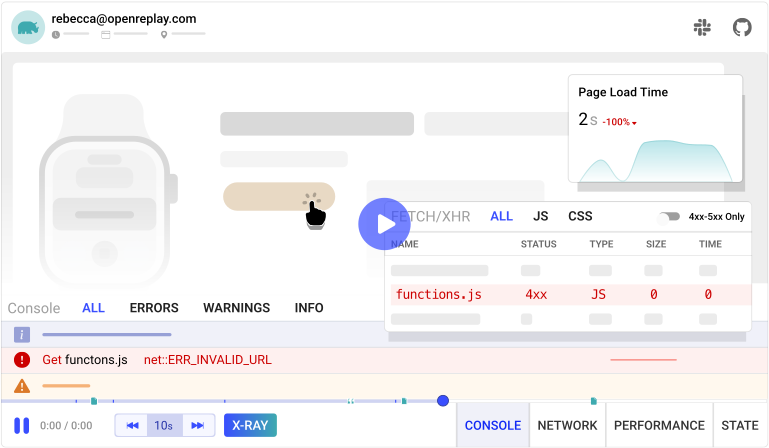
OpenReplay is a self-hostable session replay platform that captures everything a user does in your web or mobile app — clicks, scrolls, network calls, console logs, JavaScript errors, Redux/Vuex/Pinia state, GraphQL queries and 40+ performance metrics — and lets you replay the session as if you were sitting next to them. It was founded in by Mehdi Osman (CEO) under the company Asayer, Inc., went through Y Combinator's S19 batch, and pivoted from a closed-source SaaS to an open-source product in 2020. The company has raised $6M+ from Y Combinator, Runa Capital, Expa and Kima Ventures.
As of the GitHub repository sits at roughly 12,000 stars and 737 forks, with the latest stable release being v1.26.0 (shipped ). The pitch is simple: every commercial session replay tool charges per session and lives on someone else's servers — OpenReplay lets you replay every single session, keep raw recordings inside your own VPC, and pay nothing if you're willing to operate it yourself.


On Hacker News and Reddit's r/webdev, OpenReplay consistently surfaces as the recommended self-hosted replay tool whenever someone asks for a LogRocket alternative. The most cited praise is data ownership — teams in healthcare, fintech and EU regions repeatedly mention that being able to keep raw session data in their own AWS or GCP account simplified their compliance review. Independent comparisons from Better Stack, Statsig and PostHog's own blog all rank OpenReplay as the top open-source competitor in the category.
Recurring complaints, however, are equally consistent. The self-hosted stack ships with ClickHouse, Kafka, Redis and PostgreSQL — running it well at scale needs real DevOps experience, and several Reddit threads describe spinning up an O3 instance only to spend a weekend tuning storage. The free Cloud plan has tight session limits compared with LogRocket's Free tier, native mobile replay is still labelled preview and does not yet match the web experience, and the AI/analytics features — while improving — are less mature than dedicated tools like PostHog or Amplitude.
OpenReplay is one of the few category leaders that publishes a fully-free tier with no session cap — provided you host it yourself. The managed Dedicated tier moved away from the old per-session model in 2025 and now bills hourly per VM size, so cost is bounded by infrastructure rather than by traffic.
| Plan | Price | Key Limits |
|---|---|---|
| Open-Source | $0 | Self-hosted, all core features, community support, full data ownership |
| Dedicated | From $179/mo ($0.25/hr) | Managed VM in 50+ AWS/GCP/Azure regions, BYOC option, SSO, custom retention, 7-day free trial |
| Enterprise | Custom (multi-year) | SAML/SCIM, RBAC, audit trail, MCP server, dedicated support, on-prem at scale |
Best for: Engineering teams at SaaS, fintech, healthcare, govtech and EU companies that need full session replay and product analytics but cannot send raw user behavior to a US SaaS vendor. Solo developers and indie hackers who want unlimited sessions for free and don't mind running Docker Compose. Support and CX teams that want cobrowsing without buying a separate Pylon-style tool.
Not ideal for: Teams without any DevOps capacity who want a one-line install — LogRocket or FullStory will be smoother. Teams whose primary need is event analytics, feature flags, surveys and A/B testing under one roof — PostHog covers more of that surface. Mobile-first teams that need a fully GA native iOS/Android replay product today.
Pros:
Cons:
PostHog is the closest all-in-one alternative — also open source, with replay, analytics, feature flags and surveys, but without OpenReplay's cobrowsing and with a more analytics-first UX. Sentry added session replay in 2023 and is a better fit if your team already lives inside Sentry for error monitoring. LogRocket and FullStory remain the polished commercial options if data residency isn't a constraint and you want zero ops.
If you can run a managed Postgres and a small Kubernetes cluster — or pay $179/mo for the managed VM — OpenReplay is the obvious answer for self-hosted session replay in 2026. It is the most actively maintained open-source project in the category, the replay quality is competitive with the commercial leaders, and the per-VM Dedicated pricing makes it the cheapest credible option for high-traffic apps. The honest caveat is that this is a real distributed system: pick LogRocket if you want a one-line install and an account manager, pick PostHog if analytics matter more than replay, and pick OpenReplay if data ownership is non-negotiable. We rate it 78/100.
ServiceNow and Accenture Launch Forward Deployed Engineering Program to Scale Agentic AI in the Enterprise (May 6, 2026)
At Knowledge 2026, ServiceNow and Accenture announced a joint forward deployed engineering program that drops co-located engineer pods into customer environments to ship agentic AI workflows natively on the ServiceNow AI Platform — with access to 300+ pre-built agent skills and the AI Control Tower as the governance backbone.
May 7, 2026
ReFiBuy Raises $13.6M Seed to Help Brands Get Recommended by AI Shopping Agents (May 5, 2026)
ReFiBuy, the Raleigh-based agentic commerce platform from ChannelAdvisor founder Scot Wingo, closed an oversubscribed $13.6M seed led by NewRoad Capital Partners on May 5, 2026 — betting that the next billion-dollar e-commerce moat is being chosen by ChatGPT, Claude and Perplexity.
May 7, 2026
OpenAI Replaces ChatGPT's Default Model With GPT-5.5 Instant — 52.5% Fewer Hallucinations, 30% Shorter Answers (May 5, 2026)
OpenAI on May 5 swapped GPT-5.3 Instant for the new GPT-5.5 Instant as ChatGPT's default model, claiming 52.5% fewer hallucinated claims on high-stakes prompts and 30% more concise answers. The model also rolls into the API as chat-latest and adds personalization from Gmail and past chats for Plus and Pro web users.
May 7, 2026
Is this product worth it?
Built With
Compare with other tools
Open Comparison Tool →