
 Analytics
Umami
Simple, fast, privacy-focused analytics — the 36k-star open-source Google Analytics alternative
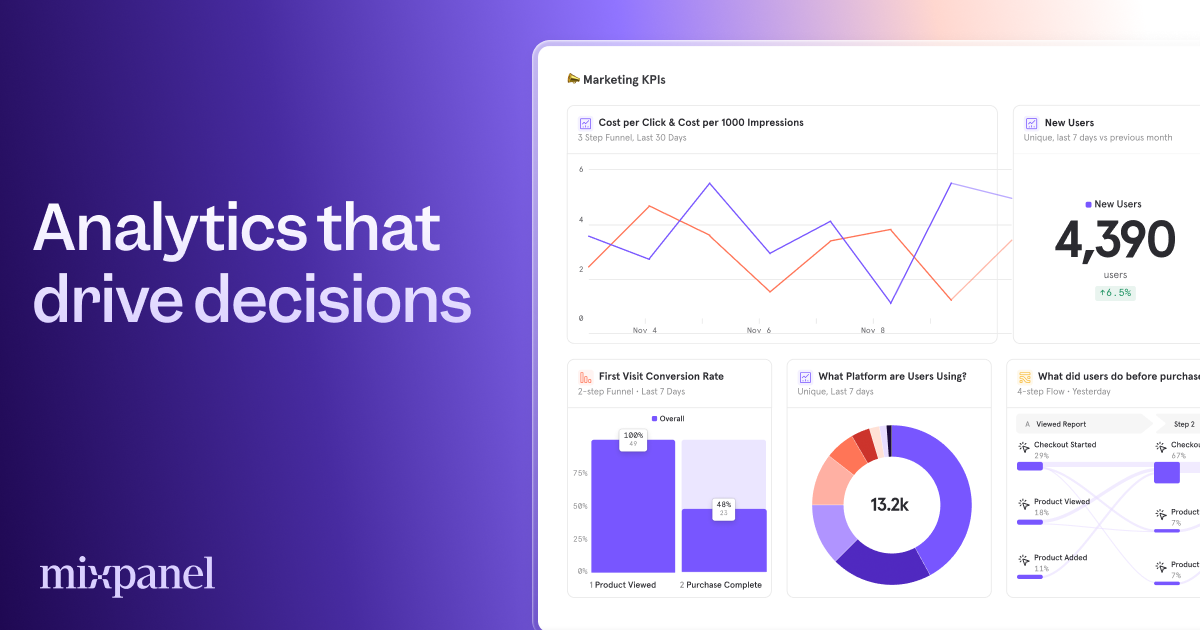
Mixpanel is event-based product analytics with the deepest funnels and retention reports in the category, now powered by Spark AI and a hosted MCP server. The new event-based pricing in 2026 is fairer than the old MTU model, but heavy event volume can still produce a steep bill.
Mixpanel is event-based product analytics that turns user behaviour — clicks, signups, feature usage — into funnels, retention curves, and cohorts your product team can actually act on. We rate it 82/100 — for product-led teams that want best-in-class analysis depth and an AI layer that finally makes the platform usable without SQL, Mixpanel is one of the strongest picks in 2026, but the move to event-based pricing in February 2026 still punishes fast-growing startups.
Mixpanel is a product analytics platform that tracks user actions instead of pageviews and turns them into funnels, retention reports, cohorts, and dashboards. The company was founded on in San Francisco by Suhail Doshi and Tim Trefren, classmates from Arizona State who met in a discrete math course. After joining Y Combinator's Summer 2009 batch, Mixpanel grew into one of the defining tools of the SaaS analytics era — today it processes hundreds of billions of events per month for companies including Uber, Netflix, Yelp, Expedia, and Pinterest.
The pitch in 2026 is sharper than it was a decade ago: instead of staring at GA pageviews, instrument the actions that actually matter — onboarding completed, plan upgraded, feature used — and let Mixpanel slice them into the answers a product manager actually asks. Where Mixpanel pulls ahead in 2026 is its AI layer: Spark, an in-app generative AI query builder, plus an MCP server that lets Claude, Cursor, and ChatGPT query your event data in plain English.

Sentiment on Mixpanel in 2026 has improved noticeably since the Spark AI launch and the February 2026 switch to event-based pricing. G2 reviewers and posts on Reddit's r/SaaS and r/ProductManagement repeatedly praise the analytical depth — funnels, retention, and flows are still the gold standard — and the polished UI that makes it usable for non-technical PMs. Hacker News commenters call out the MCP server as a "killer integration" because it pipes Mixpanel data straight into the AI tools their teams already use.
The criticism is real, however, and it always comes back to one thing: the bill. Even after the 2026 switch from MTU to event-based pricing, Reddit threads and the PostHog comparison page document teams paying $2,500+/month at 10M events, with several users reporting 2–3x cost overruns versus their original budget when their app grows. The complaint is structural — every new tracked interaction adds to the bill — and it is the single biggest reason teams shop for alternatives.
Pricing was overhauled in : Mixpanel moved from MTU (monthly tracked users) to a pure event-based model, with a much more generous free tier than the old plan.
| Plan | Price | Key Limits |
|---|---|---|
| Free | $0/month | Up to 1M events/month, core reports, unlimited data history, no credit card required |
| Growth | Starts at $0; $0.28 per 1,000 events above 1M (volume discounts apply) | ~$280/month at 2M events, ~$2,520/month at 10M events; full feature set including Spark AI |
| Enterprise | Contact sales | Custom volume pricing, SSO, SOC 2, dedicated support, advanced data governance |
Best for: Product-led B2C and B2B SaaS teams (10–500 people) who instrument specific user actions and want first-class funnels, retention, and AI-driven querying without standing up a data warehouse pipeline. Particularly strong for product managers who don't write SQL but need to answer activation, retention, and feature-adoption questions daily.
Not ideal for: Hobbyists or pre-launch startups scared of unpredictable bills (use PostHog self-hosted), teams that mostly need pageview-style web analytics (Plausible or Umami are cheaper and simpler), or organisations with strict on-prem requirements (Mixpanel is cloud-only).
Pros:
Cons:
The most common 2026 alternatives are PostHog (open source, self-hostable, bundles analytics + replay + feature flags + experiments), Plausible Analytics (lightweight pageview-style web analytics with predictable pricing), and Amplitude (closest like-for-like with Mixpanel's analytical depth, plus experimentation and replay on one platform). Choose PostHog if you're cost-sensitive and want a single-vendor stack; choose Amplitude if you've outgrown Mixpanel's depth and want experimentation built in; choose Mixpanel if Spark AI and the MCP server fit how your PMs already work.
Mixpanel in 2026 is in its best shape in years. The Spark AI layer and MCP server have shifted the platform from "powerful tool only data engineers loved" to "powerful tool that PMs can actually drive themselves." The new event-based pricing is fairer than the old MTU model, and the 1M-event free tier is finally generous enough to start a project on. We rate it 82/100 — strong recommendation for product-led SaaS teams that prioritise analysis depth and AI ergonomics, with one persistent caveat: model your event volume carefully, because that bill scales fast.
AnalyticsSimple, fast, privacy-focused analytics — the 36k-star open-source Google Analytics alternative
 Analytics
Open-source, cookieless Google Analytics replacement that's 10× more intuitive — built by an indie founder.
 Analytics
Open-source Mixpanel alternative — funnels, session replay & cookieless web analytics. Self-host free or $2.50/mo cloud.
 Analytics
Open-source business intelligence everyone on the team can actually use — 47k GitHub stars and a self-hosted core under AGPL-3.0.
ServiceNow and Accenture Launch Forward Deployed Engineering Program to Scale Agentic AI in the Enterprise (May 6, 2026)
At Knowledge 2026, ServiceNow and Accenture announced a joint forward deployed engineering program that drops co-located engineer pods into customer environments to ship agentic AI workflows natively on the ServiceNow AI Platform — with access to 300+ pre-built agent skills and the AI Control Tower as the governance backbone.
May 7, 2026
ReFiBuy Raises $13.6M Seed to Help Brands Get Recommended by AI Shopping Agents (May 5, 2026)
ReFiBuy, the Raleigh-based agentic commerce platform from ChannelAdvisor founder Scot Wingo, closed an oversubscribed $13.6M seed led by NewRoad Capital Partners on May 5, 2026 — betting that the next billion-dollar e-commerce moat is being chosen by ChatGPT, Claude and Perplexity.
May 7, 2026
OpenAI Replaces ChatGPT's Default Model With GPT-5.5 Instant — 52.5% Fewer Hallucinations, 30% Shorter Answers (May 5, 2026)
OpenAI on May 5 swapped GPT-5.3 Instant for the new GPT-5.5 Instant as ChatGPT's default model, claiming 52.5% fewer hallucinated claims on high-stakes prompts and 30% more concise answers. The model also rolls into the API as chat-latest and adds personalization from Gmail and past chats for Plus and Pro web users.
May 7, 2026
Is this product worth it?
Built With
Compare with other tools
Open Comparison Tool →