 Developer Tools
Templ
Type-safe HTML templating language for Go with compile-time safety
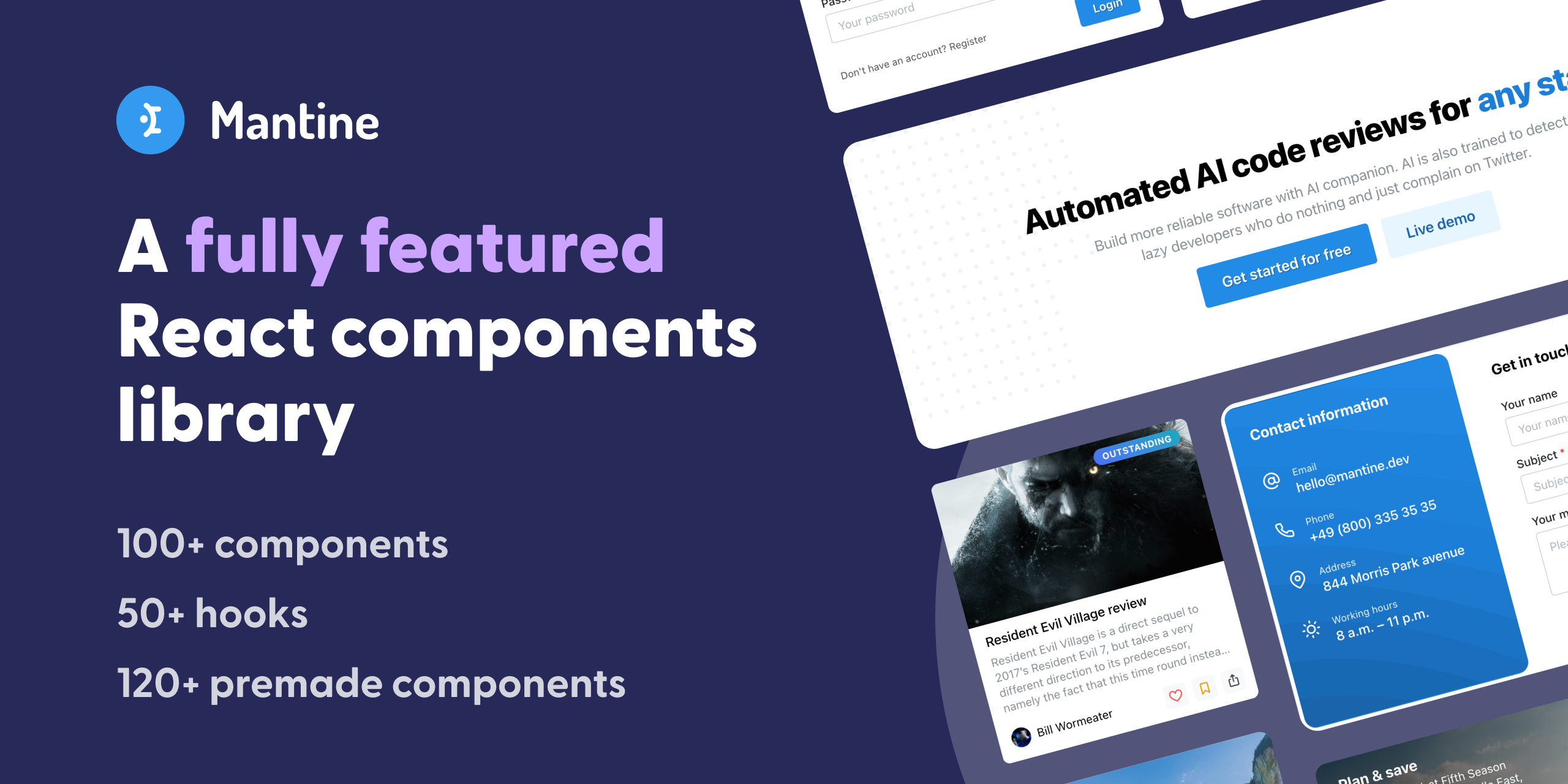
Mantine is a free, open-source React UI library with 120+ components and 100+ hooks built on CSS Modules. It is a top developer-experience pick for new React 19 projects in 2026.
Mantine is a free, open-source React UI library that ships 120+ accessible components and 100+ hooks in a single MIT-licensed package. We rate it 92/100 — for any new React 19 project in 2026 where you want best-in-class developer experience without paying for an enterprise component suite, Mantine is the strongest all-around pick.
Mantine is a React component library originally built by Vitaly Rtishchev and first released on . It has grown to 31,000+ GitHub stars and roughly 1.35 million weekly npm downloads by mid-2026 — up from around 900K just six months earlier. The current stable release is 9.1.1, published on .
Where libraries like MUI ship a heavy theme engine and Chakra UI focuses on style props, Mantine bets on raw component coverage and built-in primitives. You get rich text editing (Tiptap), date pickers, notifications, a Spotlight command palette, charts, drag-and-drop, code highlighting, carousel, modals, and even a brand-new scheduler package — all from the same vendor, with the same API conventions.
Button and TextInput to specialized widgets like RichTextEditor, Spotlight, Carousel, and the new FloatingWindow, OverflowList, Marquee, Scroller, and BarsList shipped in v9.0.useEffectEvent in five core hooks (useHotkeys, useClickOutside, useWindowEvent, useCollapse, usePageLeave). The Activity component preserves state in hidden subtrees of Tabs.Panel, Stepper, and Collapse when keepMounted is set.@mantine/form handles validation, dirty tracking, and async validators with no external dependency — no Formik, no React Hook Form needed unless you want them.useVirtualizedCombobox hook integrates with any virtualization library (TanStack Virtual recommended) so dropdowns of 10,000+ items stay smooth.On Reddit's r/reactjs and r/webdev, Mantine threads consistently rank among the most upvoted in the "what's your favorite component library" debates. A frequently quoted comment from a developer with 20 years of front-end experience calls it "hands-down the best component library I've ever used." On Hacker News, the most discussed praise points are the documentation quality and the breadth of hooks — many shops drop their react-use dependency entirely after adopting Mantine.
Criticism is real but narrow. Two recurring complaints surface across Reddit and Discord: (1) heavy visual customization is harder than MUI because Mantine doesn't expose a deeply token-driven theme tree — you reach for CSS overrides faster, and (2) the third-party ecosystem (templates, admin dashboards, premium themes) is meaningfully smaller than MUI's. A vocal minority also miss the old v6 styling API and prefer Emotion's runtime flexibility over the v7+ CSS Modules approach.
Mantine is 100% free and open source under the MIT license. There are no paid tiers, no enterprise upsells, and no usage limits. The project is funded through Open Collective sponsorships rather than commercial licensing.
| Plan | Price | What's Included |
|---|---|---|
| Open Source (only tier) | $0 forever | All 120+ components, all 100+ hooks, every @mantine/* package, commercial use, no attribution required |
For teams that want pre-built layouts, Mantine UI (ui.mantine.dev) ships free copy-paste responsive blocks. There is no paid Pro tier — unlike Tailwind UI or shadcn/ui Premium.
Best for: Solo developers, indie hackers, and small-to-mid teams shipping React 19 + Next.js or Vite apps who want a comprehensive component set without paying for MUI X Pro. It is especially strong for SaaS dashboards, internal tools, and content-heavy sites that need rich text and forms out of the box.
Not ideal for: Enterprise teams that already standardize on Material Design (use MUI), projects that need a radically custom design system from scratch (use Radix or shadcn/ui with Tailwind), or React 18-only codebases that cannot upgrade to React 19.2 yet.
Pros:
Cons:
Three named competitors worth comparing:
Yes — for almost any new React 19 project in 2026 we'd start with Mantine. The combination of breadth, free-forever MIT licensing, mature documentation, and the v7+ runtime-free architecture is genuinely hard to beat. The 92/100 score reflects two real caveats: heavy custom theming still takes work, and the third-party template ecosystem lags MUI. If those tradeoffs don't apply to you, this is the React component library to default to.
@mantine/* packages are free for commercial and personal use.@mantine/schedule calendar package, adds five components (FloatingWindow, OverflowList, Marquee, Scroller, BarsList), brings async validation to @mantine/form, and adopts React 19's useEffectEvent across core hooks.Developer ToolsType-safe HTML templating language for Go with compile-time safety
 Developer Tools
Open-source API key management and rate limiting platform for modern developers
 Developer Tools
Open-source low-code platform for building internal business applications
 Developer Tools
Git-friendly open-source API client for REST, GraphQL, and gRPC
ServiceNow and Accenture Launch Forward Deployed Engineering Program to Scale Agentic AI in the Enterprise (May 6, 2026)
At Knowledge 2026, ServiceNow and Accenture announced a joint forward deployed engineering program that drops co-located engineer pods into customer environments to ship agentic AI workflows natively on the ServiceNow AI Platform — with access to 300+ pre-built agent skills and the AI Control Tower as the governance backbone.
May 7, 2026
ReFiBuy Raises $13.6M Seed to Help Brands Get Recommended by AI Shopping Agents (May 5, 2026)
ReFiBuy, the Raleigh-based agentic commerce platform from ChannelAdvisor founder Scot Wingo, closed an oversubscribed $13.6M seed led by NewRoad Capital Partners on May 5, 2026 — betting that the next billion-dollar e-commerce moat is being chosen by ChatGPT, Claude and Perplexity.
May 7, 2026
OpenAI Replaces ChatGPT's Default Model With GPT-5.5 Instant — 52.5% Fewer Hallucinations, 30% Shorter Answers (May 5, 2026)
OpenAI on May 5 swapped GPT-5.3 Instant for the new GPT-5.5 Instant as ChatGPT's default model, claiming 52.5% fewer hallucinated claims on high-stakes prompts and 30% more concise answers. The model also rolls into the API as chat-latest and adds personalization from Gmail and past chats for Plus and Pro web users.
May 7, 2026
Is this product worth it?
Built With
Compare with other tools
Open Comparison Tool →