 Productivity
Linear
The issue tracker for modern software teams
Loom is the leading async video messaging platform, trusted by over 22 million people to record their screen, camera, or both and share videos instantly. Acquired by Atlassian for $975M in 2023, it helps remote teams communicate faster and cut meeting time.
Loom is an asynchronous video messaging platform that lets you record your screen, webcam, or both, then share a link instantly without file uploads or email attachments. We rate it 87/100 — the most polished async video tool on the market, though free tier limits may push growing teams to paid plans sooner than expected.
Loom was founded in 2015 by Shahed Khan, Vinay Hiremath, and Joe Thomas. The company grew explosively during the pandemic as remote work normalized async communication, reaching 14 million users by 2021 and 22 million by 2024. In October 2023, Atlassian — the company behind Jira, Confluence, and Trello — acquired Loom for $975 million, integrating it deeply into the Atlassian ecosystem.
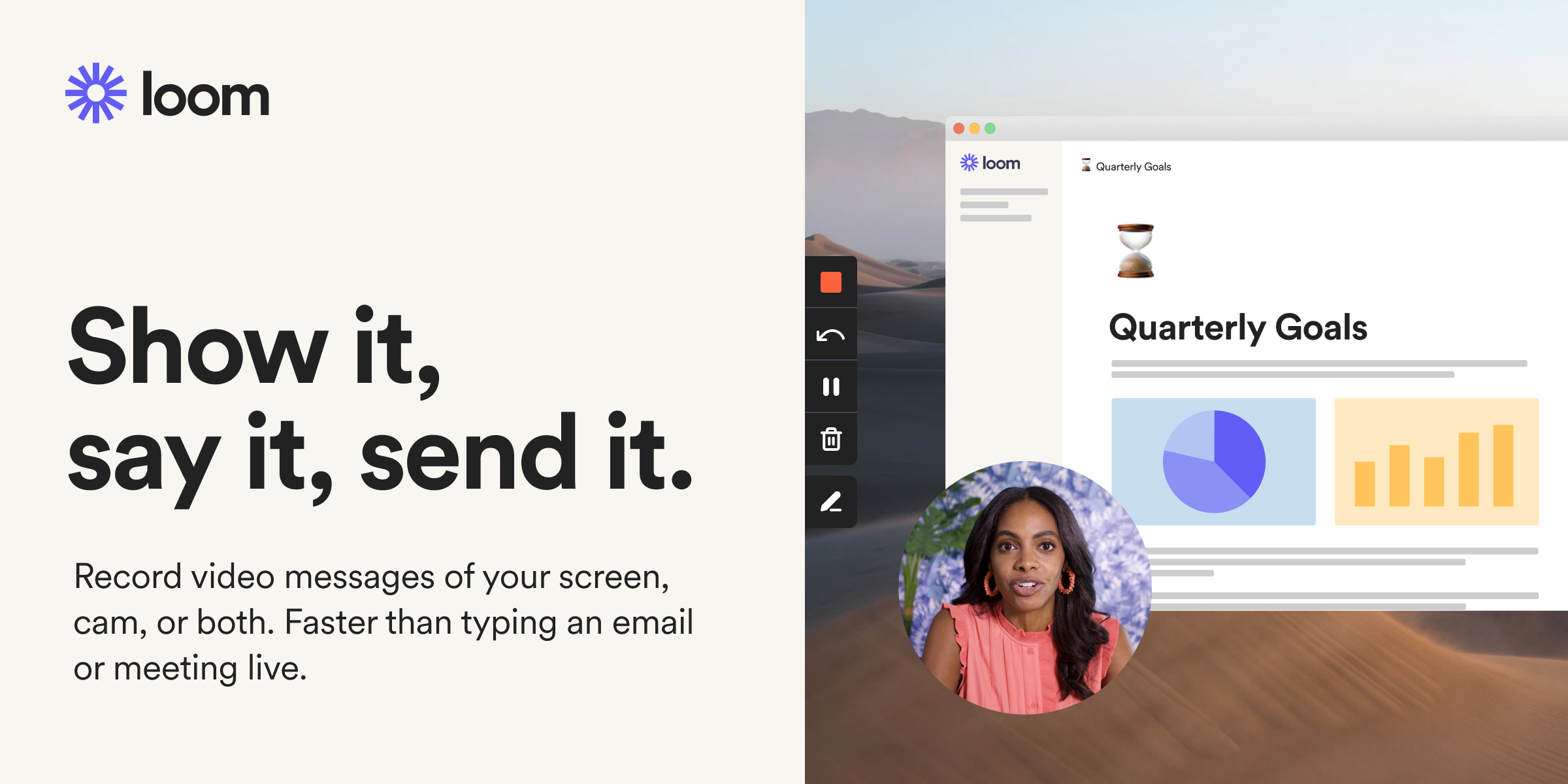
The core problem Loom solves: most workplace communication requires either a synchronous meeting (expensive, schedule-dependent) or a wall of text that loses tone and nuance. Loom threads the needle — you record a 2-minute video walkthrough of a bug, design feedback, or sales pitch, paste the link in Slack, and the recipient watches on their own time. Reactions, comments, and timestamps can be left directly on the video.
Loom has a strong NPS and frequent praise on Reddit (r/remotework, r/productivity) and Product Hunt. The most common compliment: "It replaced 80% of my sync meetings." Engineering managers and customer success teams are its most vocal advocates, pointing to how quickly a Loom can replace a long Slack thread when explaining a complex bug or walking a customer through a feature.
Recurring criticisms include the free plan's 25-video cap — teams hit this ceiling quickly and feel forced to upgrade. Several users on Reddit report frustration with Loom's AI editing features feeling like "half-baked" additions compared to dedicated video editors like Descript. Post-Atlassian acquisition, some long-time users have noted a slowdown in product innovation and expressed concern about deep Jira/Confluence lock-in. Others report occasional upload lag on longer recordings. On the positive side, most reviewers agree that for its core use case — quick async video — nothing comes close for ease of use.
| Plan | Price | Key Limits |
|---|---|---|
| Starter (Free) | $0/user/month | 25 videos/person, 5-min recording limit, up to 50 members |
| Business | $18/user/month (billed monthly) — $15/user/month (annual) | Unlimited videos, unlimited recording length, AI editing, no Loom branding |
| Enterprise | Custom (contact sales) | SSO/SCIM, custom data retention, Salesforce integration, 99.95% uptime SLA |
Best for: Remote-first teams communicating across time zones, engineering teams doing async code reviews and bug walkthroughs, customer success reps creating personalized video support responses, sales teams sending custom demo videos to prospects, and managers giving performance feedback without scheduling calls.
Not ideal for: Teams that need heavy video editing capabilities (use Descript or ScreenFlow instead), individuals who only need occasional screen recording (the free 25-video cap will frustrate power users without a Business plan), and organizations with strict data residency requirements outside Loom's current Enterprise offerings.
Pros:
Cons:
Descript — Better for teams needing professional-grade video editing, transcript-based cutting, and podcast production. More complex and expensive, but far more powerful for edited content. Screencastify — A simpler, cheaper browser-based screen recorder aimed at educators and individuals; lacks Loom's team features and analytics. Tella — A newer competitor with prettier templates and a stronger focus on polished video presentations; good alternative if Loom's aesthetic feels dated.
Loom is genuinely excellent at what it does: making async video communication frictionless. For any remote or hybrid team, the Business plan at $15/user/month (annual) pays for itself almost immediately in reduced meeting overhead. The free Starter plan works well for occasional use, but the 25-video cap means most regular users will hit the paywall within a few weeks. At 87/100, Loom earns its reputation as the default async video tool — the Atlassian integration is a real advantage for Jira/Confluence shops, and transcription in 50+ languages is a standout. Just go in knowing that AI editing is a secondary feature, not a strength.
ProductivityThe issue tracker for modern software teams
 Productivity
A macOS launcher that replaced Spotlight, Alfred, and half my browser tabs.
 Productivity
The private and flexible writing app that adapts to the way you think
 Productivity
Open-source scheduling infrastructure that gives you Calendly's features without Calendly's lock-in.
ServiceNow and Accenture Launch Forward Deployed Engineering Program to Scale Agentic AI in the Enterprise (May 6, 2026)
At Knowledge 2026, ServiceNow and Accenture announced a joint forward deployed engineering program that drops co-located engineer pods into customer environments to ship agentic AI workflows natively on the ServiceNow AI Platform — with access to 300+ pre-built agent skills and the AI Control Tower as the governance backbone.
May 7, 2026
ReFiBuy Raises $13.6M Seed to Help Brands Get Recommended by AI Shopping Agents (May 5, 2026)
ReFiBuy, the Raleigh-based agentic commerce platform from ChannelAdvisor founder Scot Wingo, closed an oversubscribed $13.6M seed led by NewRoad Capital Partners on May 5, 2026 — betting that the next billion-dollar e-commerce moat is being chosen by ChatGPT, Claude and Perplexity.
May 7, 2026
OpenAI Replaces ChatGPT's Default Model With GPT-5.5 Instant — 52.5% Fewer Hallucinations, 30% Shorter Answers (May 5, 2026)
OpenAI on May 5 swapped GPT-5.3 Instant for the new GPT-5.5 Instant as ChatGPT's default model, claiming 52.5% fewer hallucinated claims on high-stakes prompts and 30% more concise answers. The model also rolls into the API as chat-latest and adds personalization from Gmail and past chats for Plus and Pro web users.
May 7, 2026