 Marketing
Ghost
The open-source publishing platform with built-in newsletters and paid memberships
Listmonk is a free, AGPL-licensed self-hosted newsletter and mailing list manager that runs as a single Go binary backed by Postgres. It is the most credible open-source alternative to Mailchimp for technical teams who want to send campaigns at near-zero per-email cost.
Listmonk is a free, AGPL-licensed, self-hosted newsletter and mailing list manager that runs as a single Go binary backed by PostgreSQL. We rate it 89/100 — for technical teams, indie creators, and bootstrapped SaaS founders who can run a server and connect an SMTP relay, it is the strongest open-source alternative to Mailchimp, Brevo, and ConvertKit on the market in 2026.
Listmonk is an email and messaging campaign platform built by Kailash Nadh (CTO of Zerodha) that you self-host on your own server. The first public commit landed on , and as of the project sits at 19,621 GitHub stars, 2,008 forks, and version v6.1.0 (released ). The repository is officially listed under the topics newsletter, mailing-list, email-marketing, and self-hosted.
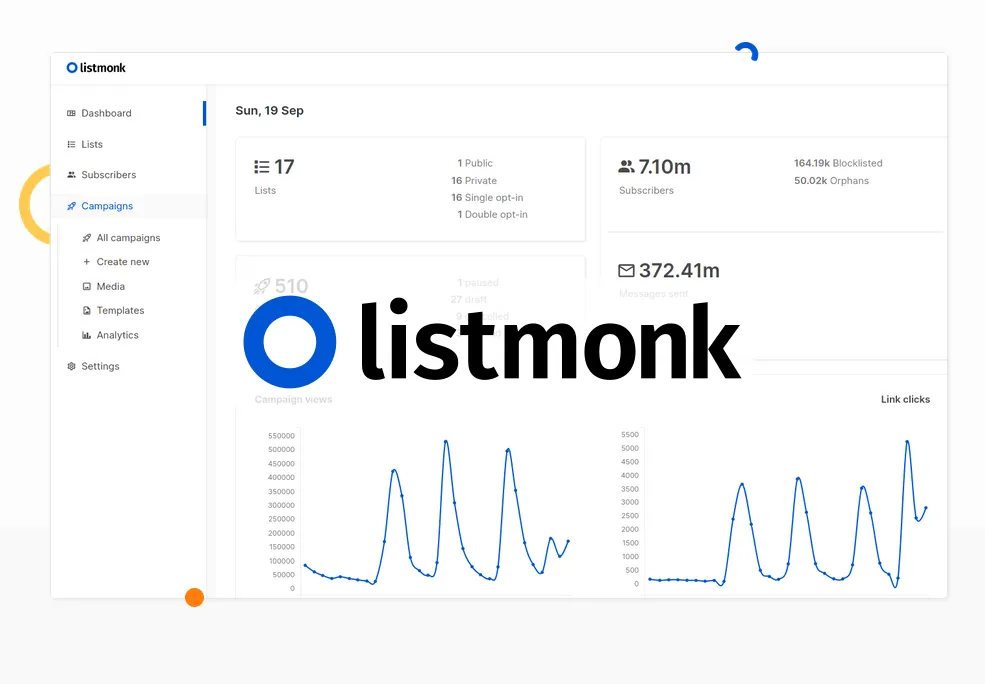
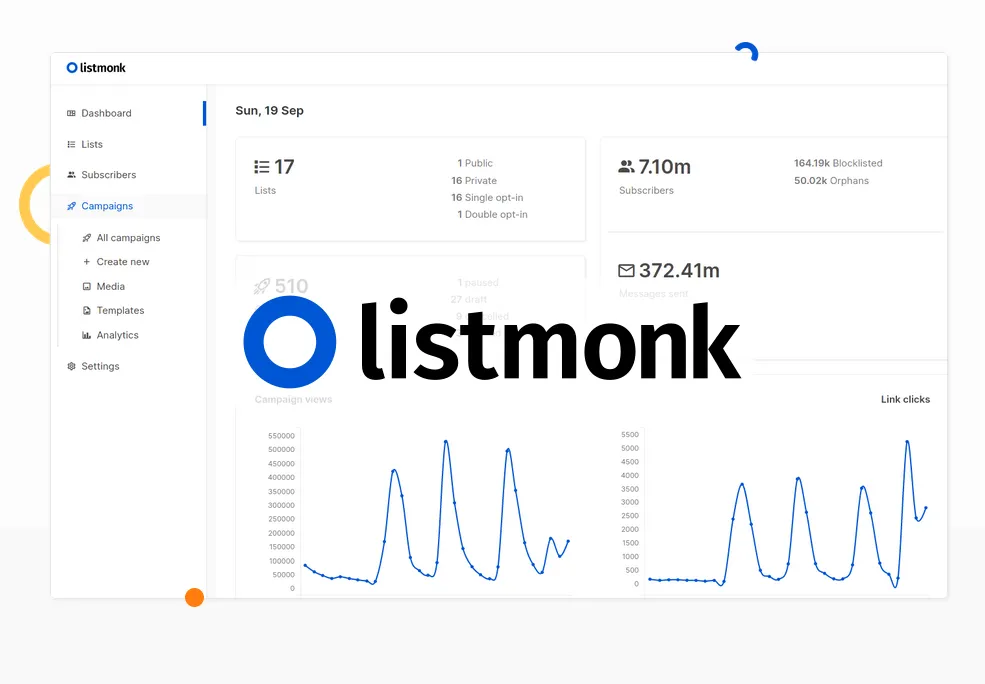
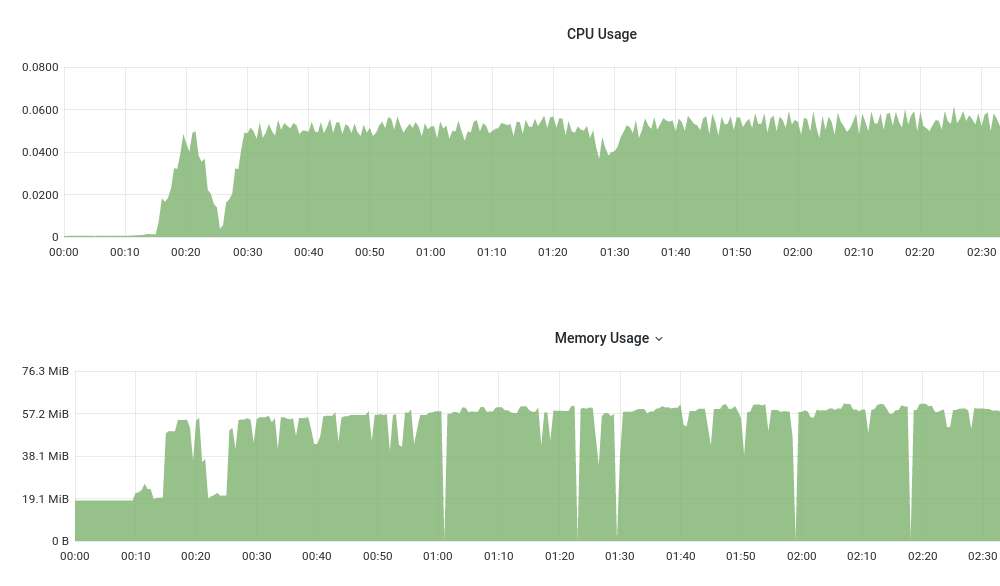
Architecturally, Listmonk is one Go binary that bundles the admin dashboard, REST API, campaign engine, multi-SMTP queue, and a Vue + Buefy frontend. It pairs with a single PostgreSQL database — nothing else. There is no Redis, no separate worker process, no message broker. That is the entire point: you can run a production newsletter that handles millions of subscribers from one VPS, with the binary peaking at roughly 57 MB of RAM during a campaign send, according to the project's own benchmark of a 7+ million email production run.
--new-config then --install), and there are official builds for Linux, macOS, Windows, FreeBSD, NetBSD, and OpenBSD.subscribers schema. There is no point-and-click visual segment builder — the trade-off is that any segment Postgres can express, Listmonk can target.POST /api/tx endpoint sends arbitrary one-off messages to a subscriber using a saved template. The same Messengers abstraction can fan out to SMS, WhatsApp, FCM push, Slack, Discord, or any HTTP webhook — not just SMTP.
Sentiment in self-hosting communities is overwhelmingly positive. The most upvoted threads on r/selfhosted and r/sysadmin describe Listmonk as "the only open-source ESP I would actually trust at scale," and the original Hacker News launch thread drew specific praise for the lightweight resource footprint and the fact that the project ships a real REST API rather than treating the API as an afterthought. Bootstrapped indie hackers on Indie Hackers and X repeatedly cite per-email cost as the primary motivation — with Amazon SES at $0.10 per 1,000 emails, a list of 100,000 subscribers costs roughly $10 per send versus $300+ on Mailchimp.
The most common complaints, repeated across GitHub issues and review sites: (1) deliverability is your problem, not Listmonk's — the software does not handle SPF, DKIM, DMARC, IP warming, or reputation management, and several users report bounce-handling edge cases (issue #1928) where non-existent addresses fail to register as bounces; (2) the setup curve is steep for non-technical users — a YunoHost forum thread notes the official install docs assume working knowledge of Postgres, systemd, and reverse proxies; (3) the SQL-first segmentation is powerful but unfriendly for marketing operators used to drag-and-drop builders. Maintainer Kailash Nadh is known for fast issue triage but is also explicit that the scope stays tight — no built-in MTA, no marketing automation flows.
Listmonk itself is free and open source under the AGPL-3.0 license. There is no paid tier, no hosted SaaS run by the maintainer, no per-subscriber fee, and no telemetry. Your real costs are the server you self-host on plus whatever your SMTP provider charges per email.
| Plan | Price | Key Limits |
|---|---|---|
| Self-hosted (only option) | $0 | Unlimited subscribers, lists, campaigns, and templates. AGPLv3 — you must publish source modifications if you offer Listmonk as a network service. |
| Typical VPS hosting | $5 – $20 / month | A 1 GB RAM Hetzner CX11 or DigitalOcean basic droplet handles 100k+ subscribers comfortably. |
| SMTP cost (Amazon SES) | $0.10 per 1,000 emails | The cheapest reliable option. SendGrid, Mailgun, and Postmark are 5–10× more expensive at scale. |
For a 50,000-subscriber list sending one campaign per week, total cost is roughly $5 server + $20 SES = $25/month. The same list on Mailchimp's Standard plan is $350/month at the time of writing.
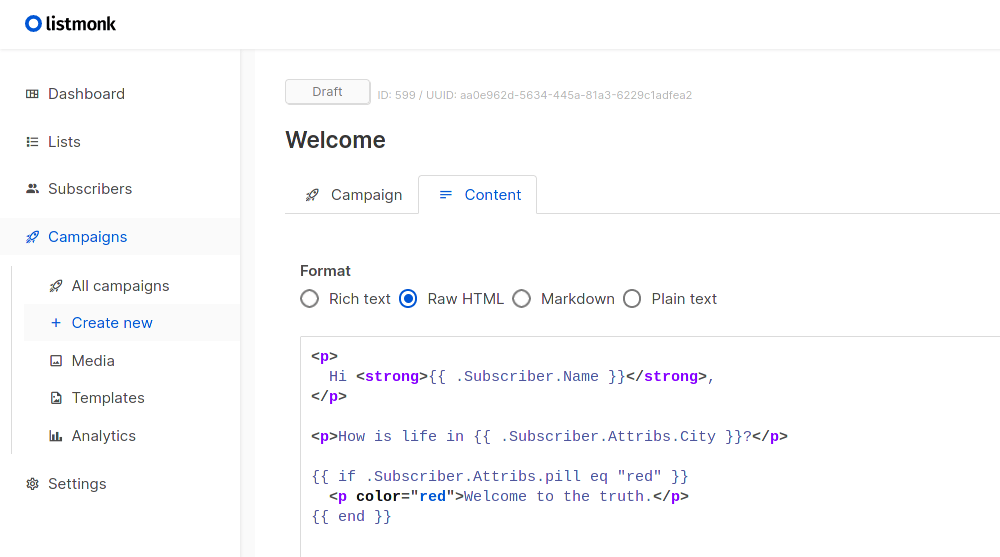
Best for: Bootstrapped SaaS founders, indie newsletter writers, agencies running campaigns for multiple clients, technical content creators with 10k–500k subscribers, and privacy-focused organisations that cannot send subscriber data to a US-based ESP. If you can SSH into a VPS and configure DKIM records, Listmonk will save you four figures a year.
Not ideal for: Marketing teams that need drag-and-drop automation flows, A/B test orchestration, CRM integrations, or visual customer journeys — those are out of scope by design. Also skip Listmonk if you do not want responsibility for IP reputation, deliverability monitoring, or PostgreSQL backups; a managed ESP is genuinely the better answer for that use case.
Pros:
Cons:
Mautic is the heavier, marketing-automation-first OSS option — visual journey builder, deeper CRM integrations, and a much larger PHP/Symfony stack to operate. Pick Mautic when you need automation flows; pick Listmonk when you need raw send performance. Postal is a self-hosted MTA, not a campaign tool — useful as Listmonk's downstream SMTP layer if you want to run the entire pipeline yourself. Mailchimp and Brevo are the obvious managed alternatives; both will cost an order of magnitude more once you cross 10,000 subscribers but require zero infrastructure on your end.
If you have technical staff, send to more than a few thousand subscribers, and want to own your subscriber data, Listmonk is the obvious choice in 2026. The code is mature, the maintainer is responsive, and the cost arbitrage versus Mailchimp is brutal at scale. We rate it 89/100 — it loses points only for the steep learning curve for non-developers and for the deliverability burden it leaves with the operator. For everyone else who can write a SQL query and read a DKIM record, this is the strongest open-source ESP available.
listmonk/listmonk:latest. The admin dashboard is a web app, so any modern browser works on the client side.ServiceNow and Accenture Launch Forward Deployed Engineering Program to Scale Agentic AI in the Enterprise (May 6, 2026)
At Knowledge 2026, ServiceNow and Accenture announced a joint forward deployed engineering program that drops co-located engineer pods into customer environments to ship agentic AI workflows natively on the ServiceNow AI Platform — with access to 300+ pre-built agent skills and the AI Control Tower as the governance backbone.
May 7, 2026
ReFiBuy Raises $13.6M Seed to Help Brands Get Recommended by AI Shopping Agents (May 5, 2026)
ReFiBuy, the Raleigh-based agentic commerce platform from ChannelAdvisor founder Scot Wingo, closed an oversubscribed $13.6M seed led by NewRoad Capital Partners on May 5, 2026 — betting that the next billion-dollar e-commerce moat is being chosen by ChatGPT, Claude and Perplexity.
May 7, 2026
OpenAI Replaces ChatGPT's Default Model With GPT-5.5 Instant — 52.5% Fewer Hallucinations, 30% Shorter Answers (May 5, 2026)
OpenAI on May 5 swapped GPT-5.3 Instant for the new GPT-5.5 Instant as ChatGPT's default model, claiming 52.5% fewer hallucinated claims on high-stakes prompts and 30% more concise answers. The model also rolls into the API as chat-latest and adds personalization from Gmail and past chats for Plus and Pro web users.
May 7, 2026
Is this product worth it?
Built With
Compare with other tools
Open Comparison Tool →