 AI Tools
Aider
AI pair programming in your terminal—free, open-source, any LLM
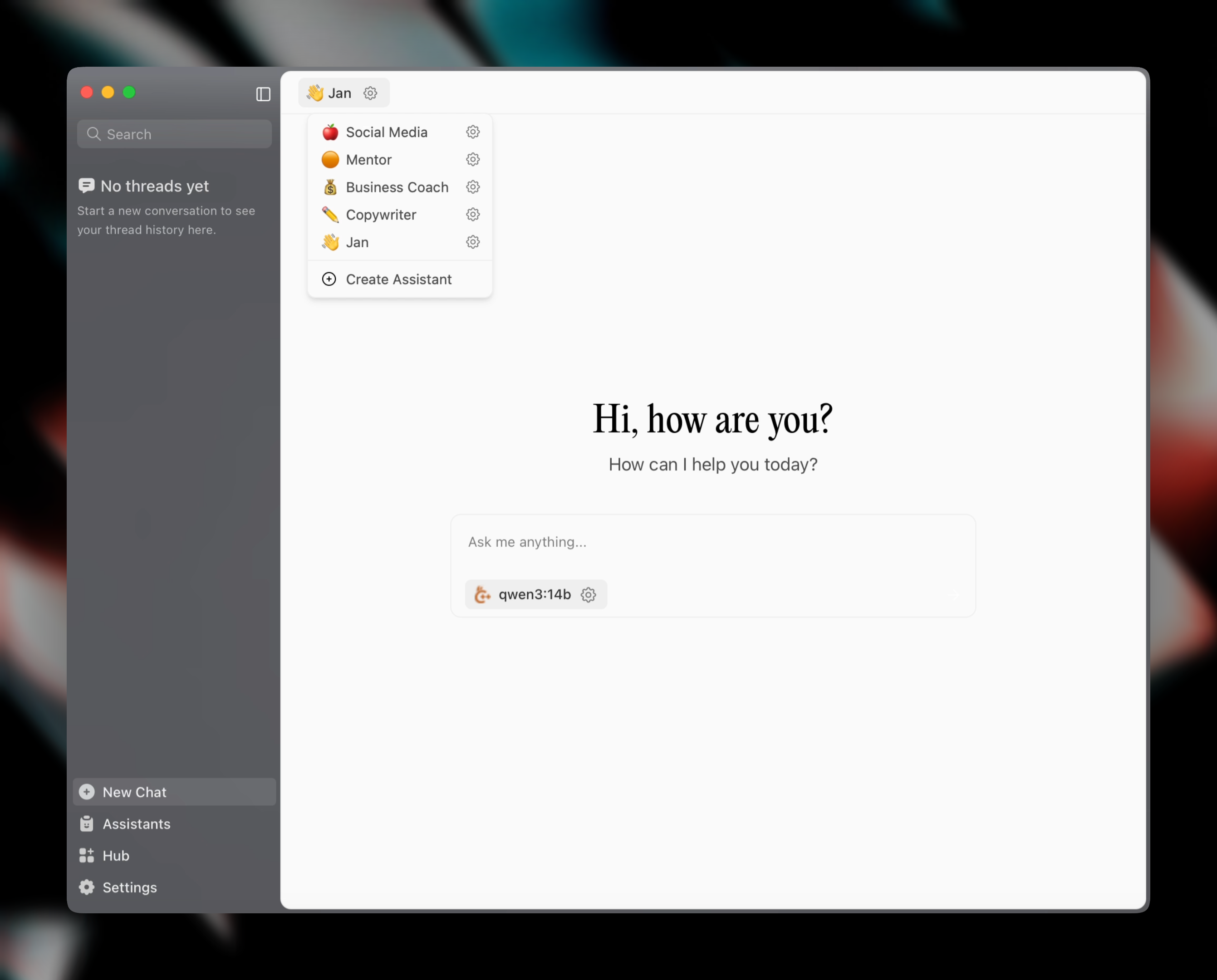
Jan is an open-source desktop app that runs Llama, Qwen, DeepSeek and other LLMs locally with full privacy — or routes them to cloud providers through a single ChatGPT-style UI. Free, self-hostable, Apache 2.0.
Jan is an open-source ChatGPT alternative that runs large language models 100% offline on your own computer, while letting you optionally connect to cloud models like GPT-5.5, Claude, Gemini, Mistral and DeepSeek from the same interface. We rate it 83/100 — the cleanest, most polished local LLM desktop app available right now, and a serious contender against LM Studio for anyone who values open source and privacy.
Jan is a privacy-first desktop application built by Menlo Research that ships under an Apache 2.0 license. The project first appeared on GitHub in and has grown to 42,000+ GitHub stars and over 5 million downloads across macOS, Windows and Linux as of . It uses llama.cpp and Apple MLX as its inference backends, wrapped in a Tauri-based UI that feels closer to ChatGPT than the developer-tool aesthetic of Ollama or Text Generation WebUI.
The pitch is simple: download the app, pick a model from a curated list (or paste any HuggingFace GGUF link), and start chatting. Nothing leaves the device unless you explicitly add a cloud provider. For developers, Jan also exposes an OpenAI-compatible REST API at localhost:1337, which means you can drop it in as a private replacement for the OpenAI SDK in any existing project.
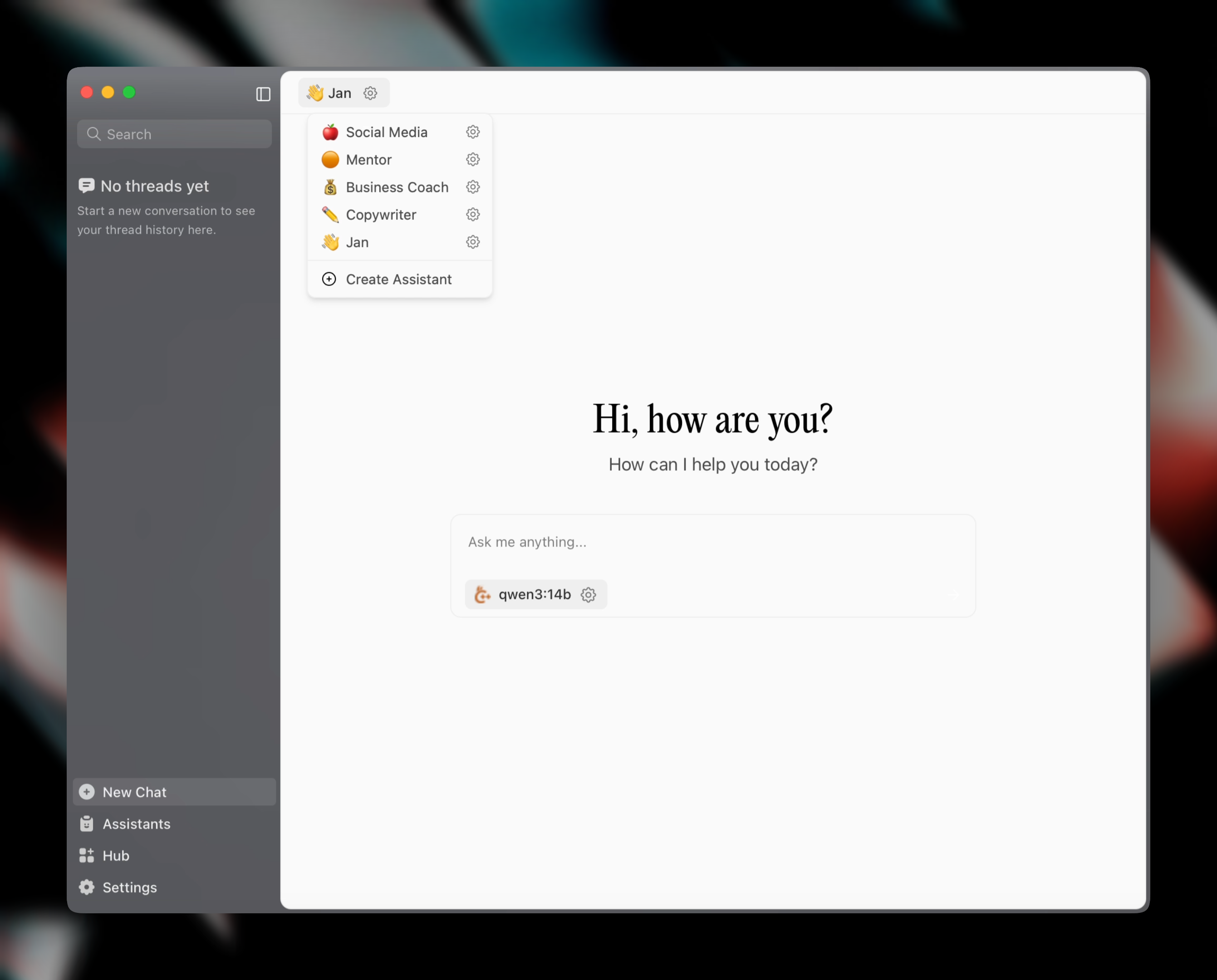
http://localhost:1337/v1 exposes the same chat-completions, models and embeddings endpoints as OpenAI. Drop-in replacement in code that already uses the OpenAI SDK.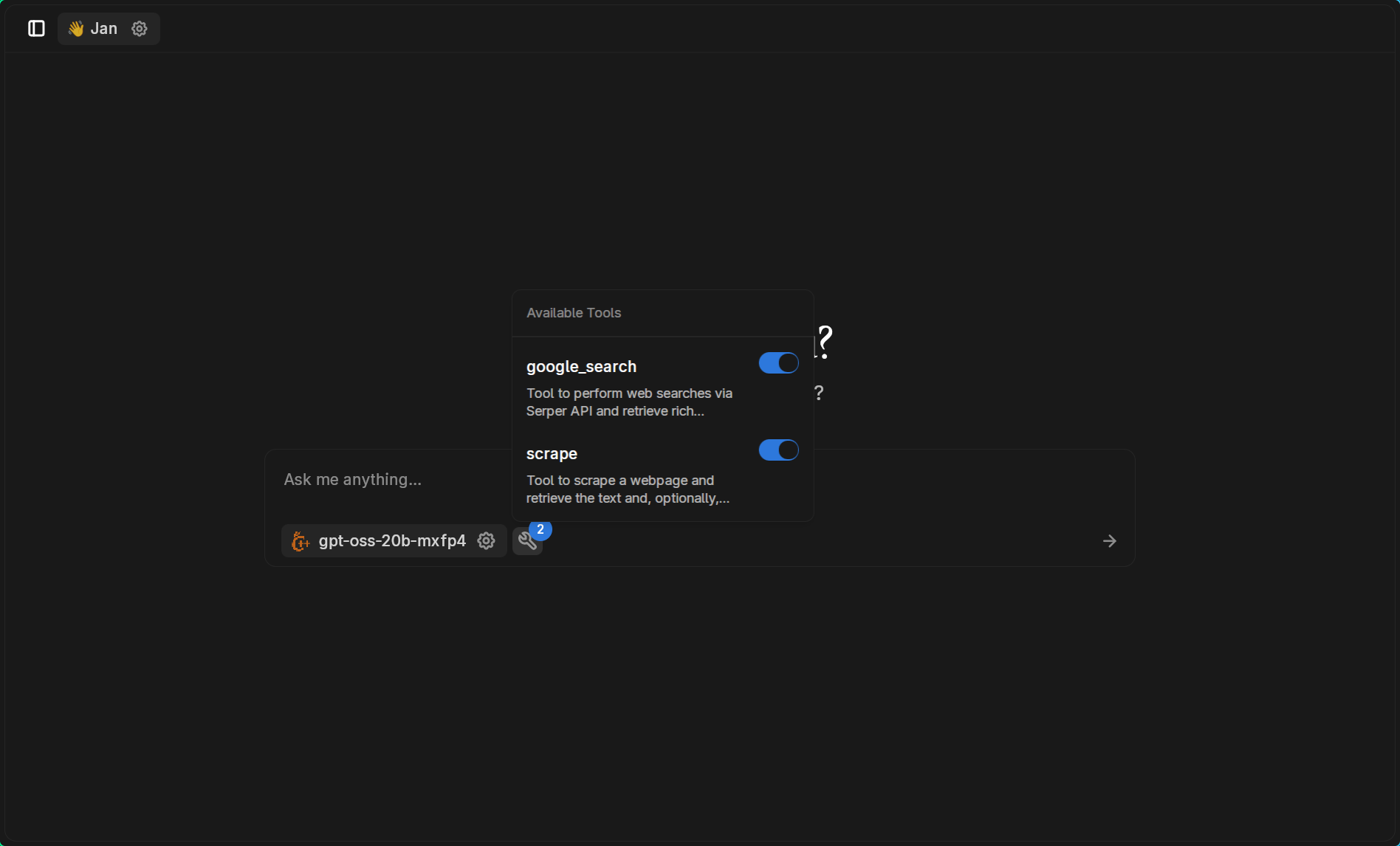
On Reddit's r/LocalLLaMA, the most upvoted Jan threads consistently praise it as the best open-source choice for non-technical users — one user puts it as "my pick over LM Studio because it's actually open source." Reviewers on independent comparison sites like neurocanvas.net and promptquorum.com repeatedly call out the UI polish, the plugin system, and the cleaner model-management experience versus Ollama's CLI-first workflow.
The complaints are also consistent and worth knowing. Several Reddit threads report higher idle memory usage than LM Studio, occasional slowdowns when switching between very large models, and a documentation site that lags behind feature releases — the v0.6 UI revamp shipped weeks before the docs caught up. Apple Silicon users on M1/M2 with 8 GB RAM report Jan struggling with anything past a 7B-parameter model, which is a hardware reality more than a Jan-specific issue.
Jan is fully free and Apache 2.0 licensed. There is no Pro tier, no usage cap, no telemetry-driven plan upsell. The only money you'll spend is on cloud API usage if you choose to connect a paid provider — and those keys go directly to the provider, not to Jan.
| Plan | Price | Key Limits |
|---|---|---|
| Jan Desktop App | $0 | Unlimited local models, unlimited messages, no account required |
| Cloud Models (BYO Key) | Pay provider directly | Routed through your own OpenAI / Anthropic / Mistral / Groq keys |
| Source Code | Free (Apache 2.0) | Self-build, fork, redistribute — commercial use allowed |
The catch: you provide the hardware. A reasonable local experience needs at least 8 GB of RAM for 3B models, 16 GB for 7B, and 32 GB for anything in the 13B+ range. Apple Silicon delivers the best price-per-token by a wide margin in 2026.
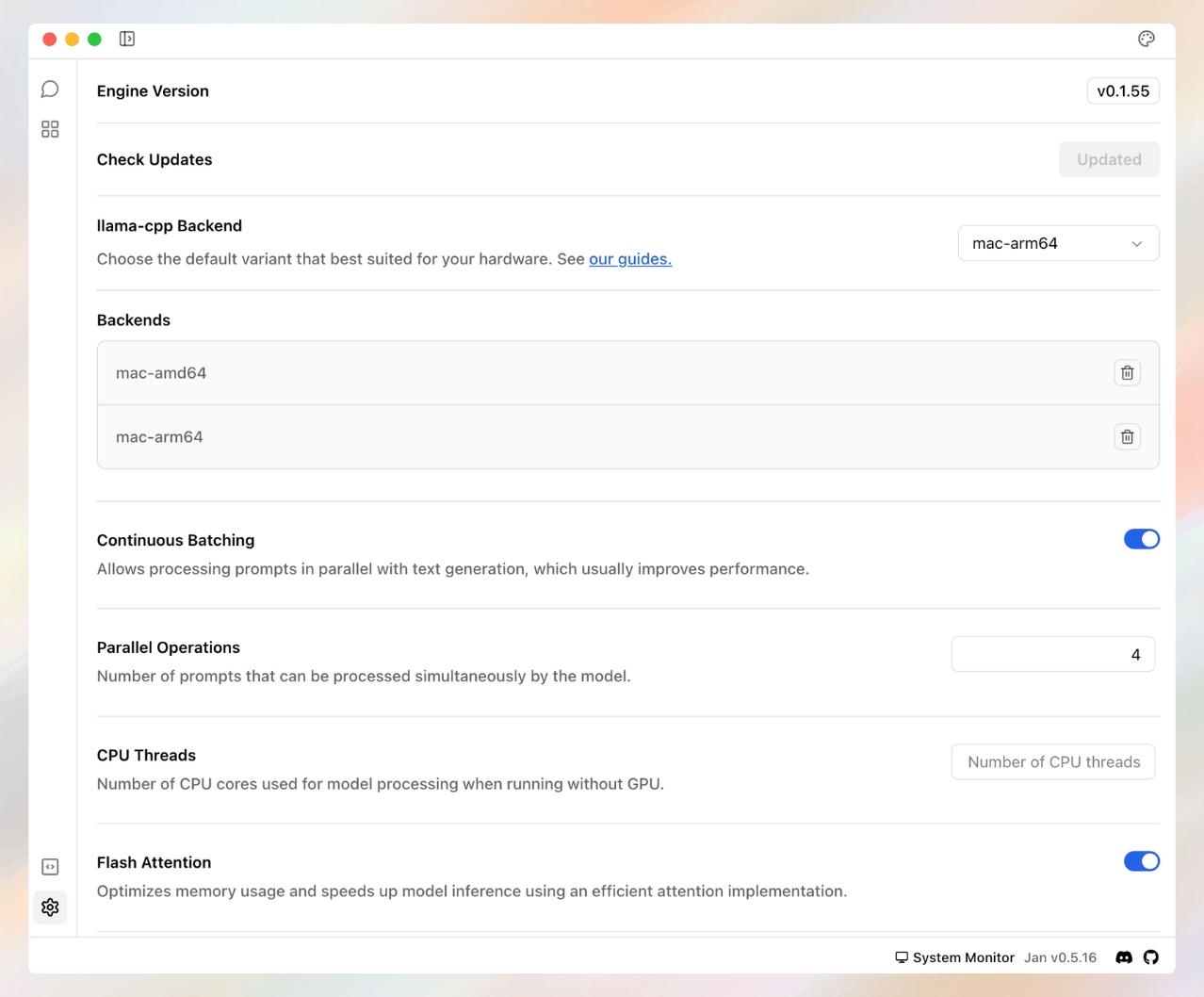
Best for: Privacy-conscious users who want a ChatGPT-style experience without sending data to a cloud, developers building OpenAI-compatible apps that need an offline fallback, and teams in regulated industries (legal, healthcare, finance) where the model has to stay on-device. Apple Silicon owners get the most out of Jan thanks to MLX acceleration.
Not ideal for: Casual users on a base-model laptop with 8 GB RAM (the cloud version of ChatGPT will feel snappier), and developers who only want a CLI — Ollama or llamafile fit that use case better. If you need image generation, Jan supports image inputs but does not run diffusion models locally.
Pros:
Cons:
Ollama is the CLI-first counterpart — lighter footprint, no GUI by default, and the most popular pick for power users who want scripting. LM Studio has the most polished UI of any local LLM app and slightly better memory efficiency, but it is closed source — Jan's main differentiator. Open WebUI is the self-hosted browser-based alternative that pairs well with Ollama on a home server. llamafile is the easiest single-binary option but lacks Jan's plugin and MCP ecosystem.
If you want a ChatGPT-shaped app on your own laptop without sending data to OpenAI, Jan is the easiest way to get there in 2026. It has earned its 42k stars by being the best-balanced option between LM Studio's polish and Ollama's openness — and the Apache 2.0 license means it stays that way. Power users with strong CLI habits will still prefer Ollama, and 8 GB-RAM laptops will still struggle with 13B+ models, but for everyone else, Jan is the local LLM client to install first. We rate it 83/100.
AI ToolsAI pair programming in your terminal—free, open-source, any LLM
 AI Tools
Open-source Python web crawler for LLMs, RAG and AI agents
 AI Tools
Open-source, extensible AI agent that goes beyond code suggestions — desktop app, CLI, and API for any LLM
 AI Tools
All-in-one open-source AI app to chat with your docs, run agents, and connect any LLM — local-first.
ServiceNow and Accenture Launch Forward Deployed Engineering Program to Scale Agentic AI in the Enterprise (May 6, 2026)
At Knowledge 2026, ServiceNow and Accenture announced a joint forward deployed engineering program that drops co-located engineer pods into customer environments to ship agentic AI workflows natively on the ServiceNow AI Platform — with access to 300+ pre-built agent skills and the AI Control Tower as the governance backbone.
May 7, 2026
ReFiBuy Raises $13.6M Seed to Help Brands Get Recommended by AI Shopping Agents (May 5, 2026)
ReFiBuy, the Raleigh-based agentic commerce platform from ChannelAdvisor founder Scot Wingo, closed an oversubscribed $13.6M seed led by NewRoad Capital Partners on May 5, 2026 — betting that the next billion-dollar e-commerce moat is being chosen by ChatGPT, Claude and Perplexity.
May 7, 2026
OpenAI Replaces ChatGPT's Default Model With GPT-5.5 Instant — 52.5% Fewer Hallucinations, 30% Shorter Answers (May 5, 2026)
OpenAI on May 5 swapped GPT-5.3 Instant for the new GPT-5.5 Instant as ChatGPT's default model, claiming 52.5% fewer hallucinated claims on high-stakes prompts and 30% more concise answers. The model also rolls into the API as chat-latest and adds personalization from Gmail and past chats for Plus and Pro web users.
May 7, 2026
Is this product worth it?
Built With
Compare with other tools
Open Comparison Tool →