
 Developer Tools
Templ
Type-safe HTML templating language for Go with compile-time safety
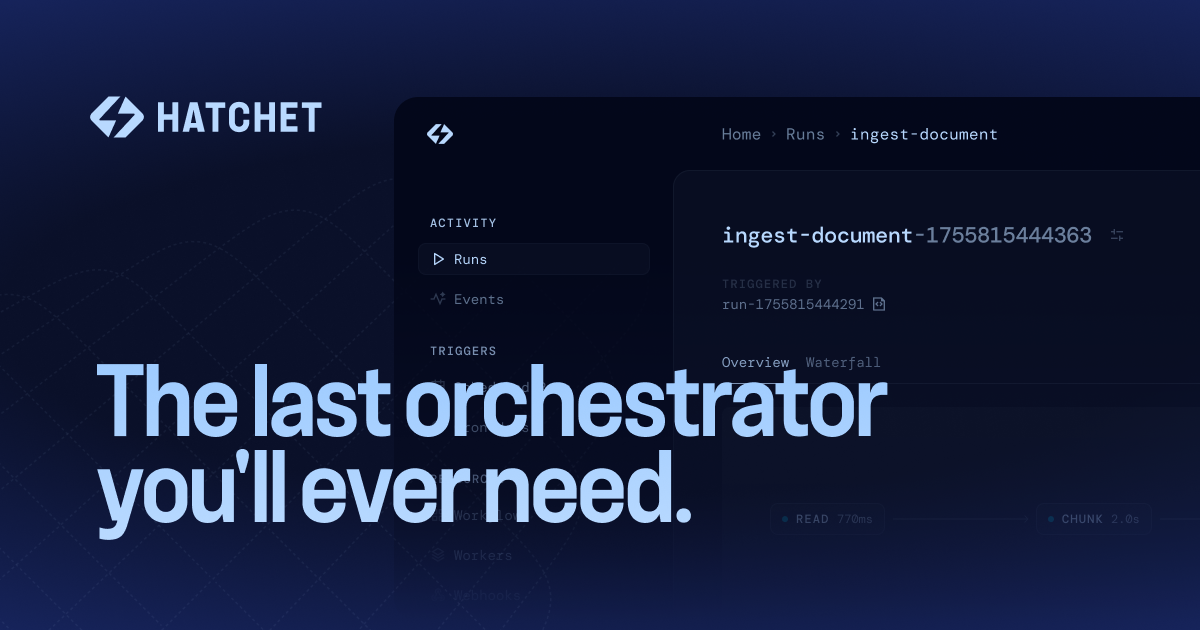
Hatchet is a Postgres-backed, MIT-licensed task queue and durable-execution engine that has become the go-to alternative to Temporal, Inngest, and Celery for AI-heavy backends. Free runner, predictable cloud pricing, and a 7,000+ star repo make it one of the most pragmatic ways to ship reliable background jobs in 2026.
Hatchet is an open-source, Postgres-backed orchestration engine that combines a distributed task queue, a DAG runner, and a durable-execution engine into one platform with SDKs for Python, TypeScript, Go, and Ruby. We rate it 83/100 — one of the most pragmatic durable workflow tools you can adopt in 2026, especially if you’re building AI agents, RAG pipelines, or any background job system that has outgrown Celery and BullMQ but doesn’t want the operational weight of Temporal.
Hatchet was founded in late 2023 by Alexander Belanger (CEO, formerly co-founder/CTO at Porter, S20) and Gabe Ruttner, and went through Y Combinator’s Winter 2024 batch. The first public commit on the hatchet-dev/hatchet repo lands on , and the company raised a $500K seed round from YC in April 2024. As of , the repo has crossed 7,087 GitHub stars, 369 forks, and is MIT-licensed end-to-end.
The product solves a very specific problem better than its predecessors: keeping a task queue durable — persisting the full execution history, intermediate state, and event timeline of every run — without forcing you onto a separate Redis or RabbitMQ broker, and without the workflow-DSL friction of Temporal. Hatchet uses Postgres as the durability layer for both the runtime and the observability system, which is why teams who already operate Postgres can self-host the entire control plane in a single docker-compose.
The Show HN and Launch HN threads (item 39643136 and item 40810986) are the most useful primary sources of developer sentiment. The most upvoted comments praise three things: the Postgres-only architecture ("finally, a queue I can run in the same database as my app"), the speed of the Python SDK, and the fact that the OSS runner is genuinely usable without ever touching the cloud product. Recurring complaints in 2024–2025 were around early-stage UI bugs and Postgres tuning under load — both of which the team explicitly addressed in the v1 rewrite shipped in late 2024.
On Reddit’s r/Python and r/golang, Hatchet is usually recommended over Celery for new Python projects that need workflows, and over BullMQ for TypeScript teams that want durability. The 2026 PkgPulse comparison concludes that Inngest wins for fastest cloud onboarding, Trigger.dev v3 wins for self-hosted DX, and Hatchet wins for complex AI orchestration with fine-grained concurrency control — matching what most users on Discord report.
Hatchet’s open-source runner is MIT-licensed and free to self-host forever. Hatchet Cloud, the managed offering, follows usage-based pricing across four tiers as of :
| Plan | Price | Key Limits |
|---|---|---|
| Developer | Free + $10 per 1M task runs | First 100,000 task runs included, SOC 2 Type II, no credit card required. |
| Team | $500/mo + usage | 10 users & 5 tenants, 3-day retention, 500 RPS sustained throughput. |
| Scale | $1,000/mo + usage | Unlimited users & tenants, 7-day retention, audit logs, HIPAA. |
| Enterprise | Contact sales | 300M+ runs/month, latency guarantees, SSO/SAML, bring-your-own-cloud, self-host support. |
Yearly billing is 20% cheaper. The free Developer tier alone covers most prototypes and many small production apps — 100k runs/month is plenty for typical RAG, notification, or webhook fan-out workloads.
Best for: Backend and AI engineering teams shipping Python, TypeScript, or Go services that need durable execution, retries, fan-out, and observability without standing up a Temporal cluster. Especially strong for RAG pipelines, agentic LLM workflows, scheduled GPU jobs, and per-user notification fan-out. Great for teams already running Postgres who want to avoid adding Redis or Kafka.
Not ideal for: Pure data-engineering shops who need rich source/sink connectors out of the box (Airflow, Prefect, and Dagster are still better). Extremely throughput-bound systems above 10k tasks/second on a single Postgres instance — at that scale, a Redis-backed BullMQ or Celery cluster will be cheaper to run, even if less durable.
Pros:
Cons:
The natural shortlist is Temporal (more mature, heavier ops, better for very long-lived workflows), Inngest (HTTP-based, fastest cloud setup, less control), and Trigger.dev v3 (best self-host DX in TypeScript, but TS-only). For pure data pipelines, Airflow, Prefect, and Dagster remain the right choice. For lightweight Python jobs without durability needs, Celery is still hard to beat on raw throughput.
For a backend or AI team in 2026 that needs durable background work and is already comfortable operating Postgres, Hatchet is the most pragmatic choice on the market. The free Developer tier is generous enough to ship a real product on, the OSS path is honest and self-hostable, and the cloud pricing scales linearly without surprise. We rate it 83/100 — held back from a higher score only by single-node throughput limits and a still-maturing self-hosted UI. If you’re evaluating Temporal, Inngest, or Trigger.dev for AI agent orchestration, Hatchet deserves to be on the spreadsheet.
Developer ToolsType-safe HTML templating language for Go with compile-time safety
 Developer Tools
Open-source API key management and rate limiting platform for modern developers
 Developer Tools
Open-source low-code platform for building internal business applications
 Developer Tools
Git-friendly open-source API client for REST, GraphQL, and gRPC
ServiceNow and Accenture Launch Forward Deployed Engineering Program to Scale Agentic AI in the Enterprise (May 6, 2026)
At Knowledge 2026, ServiceNow and Accenture announced a joint forward deployed engineering program that drops co-located engineer pods into customer environments to ship agentic AI workflows natively on the ServiceNow AI Platform — with access to 300+ pre-built agent skills and the AI Control Tower as the governance backbone.
May 7, 2026
ReFiBuy Raises $13.6M Seed to Help Brands Get Recommended by AI Shopping Agents (May 5, 2026)
ReFiBuy, the Raleigh-based agentic commerce platform from ChannelAdvisor founder Scot Wingo, closed an oversubscribed $13.6M seed led by NewRoad Capital Partners on May 5, 2026 — betting that the next billion-dollar e-commerce moat is being chosen by ChatGPT, Claude and Perplexity.
May 7, 2026
OpenAI Replaces ChatGPT's Default Model With GPT-5.5 Instant — 52.5% Fewer Hallucinations, 30% Shorter Answers (May 5, 2026)
OpenAI on May 5 swapped GPT-5.3 Instant for the new GPT-5.5 Instant as ChatGPT's default model, claiming 52.5% fewer hallucinated claims on high-stakes prompts and 30% more concise answers. The model also rolls into the API as chat-latest and adds personalization from Gmail and past chats for Plus and Pro web users.
May 7, 2026
Is this product worth it?
Built With
Compare with other tools
Open Comparison Tool →