
 Developer Tools
Templ
Type-safe HTML templating language for Go with compile-time safety
Hasura turns any database into a production-ready GraphQL or REST API in minutes — with built-in row-level authorization, real-time subscriptions, and a federated Data Delivery Network (DDN) for AI-era data access.
Hasura is an open-source data API platform — point it at Postgres, MongoDB, ClickHouse or SQL Server and it generates a production-grade GraphQL (or REST) API with row-level authorization in minutes. We rate it 78/100 — still the fastest path from database to API for most teams, but the v3/DDN pricing pivot and the new PromptQL focus mean it’s no longer the obvious zero-friction choice it once was.
Hasura is a data API platform founded in by Tanmai Gopal and Rajoshi Ghosh, headquartered in San Francisco with engineering in Bangalore. The company has raised over $136M across Seed through Series C (Series C in 2022, led by Greenoaks Capital), and customers include Atlassian, NASA, Airbus, Hitachi, Philips, General Mills and Fanatics. The flagship open-source GraphQL Engine launched on GitHub on and now sits at 32,000+ stars, making it one of the most starred backend projects in the language ecosystem.
What Hasura actually does is unusual: instead of writing a backend, you give it a connection string and a metadata file, and it compiles your authorization rules and joins down into a single optimized SQL query per GraphQL request. The v3 engine — branded Hasura DDN (Data Delivery Network) — was rewritten from Haskell to Rust and shipped GA in 2024, adding federation across multiple databases (a single supergraph spanning Postgres + MongoDB + ClickHouse), and in late 2024 the team launched PromptQL, a layer that lets LLMs query your data through Hasura’s authorization model without hallucinating rows it shouldn’t see.
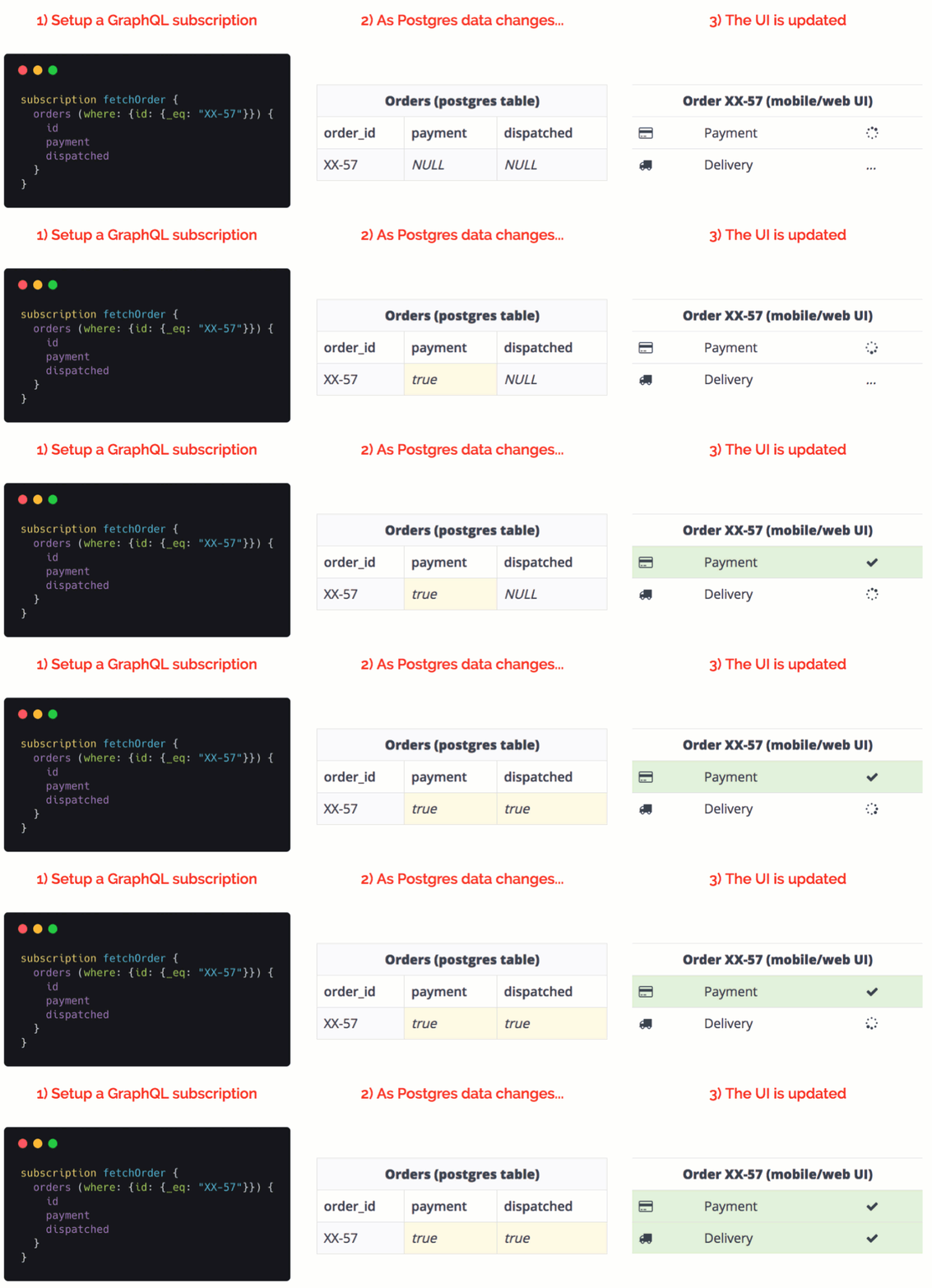
x-hasura-user-id. Hasura compiles them into a SQL WHERE clause on every query, so a multi-tenant app gets airtight isolation without an N+1 middleware layer.subscription. Hasura piggybacks on Postgres’s logical replication to push updates to thousands of concurrent clients without a separate websocket service.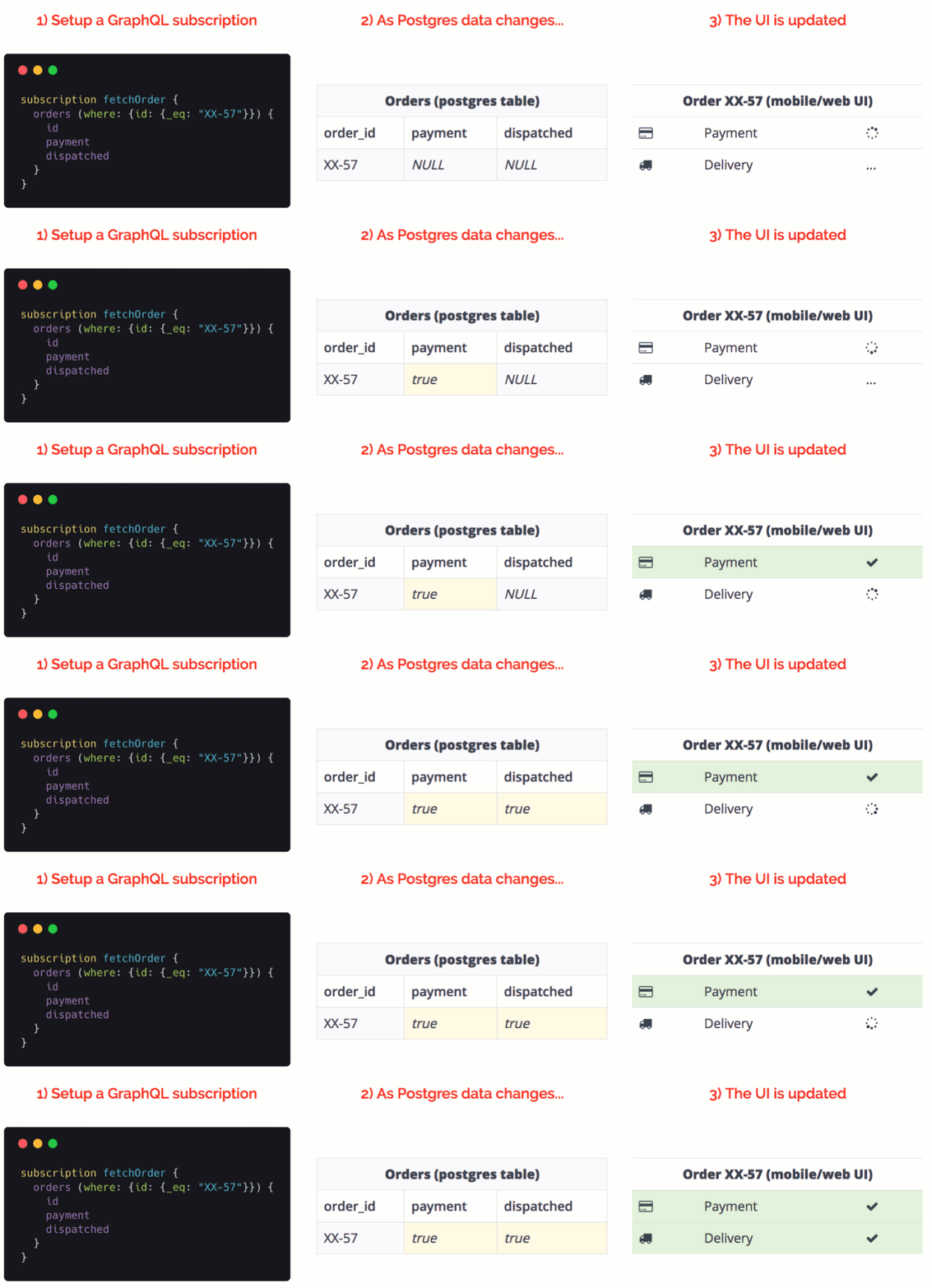
On Hacker News, the recurring sentiment is split along version lines. The v2 engine (still Apache 2.0, still self-hostable) is widely praised — comments like “Hasura is the fastest way I’ve ever gone from idea to working API” appear under almost every “backend in 2026” thread. On G2 and TrustRadius the headline pros are “ridiculous productivity” and “permission system that actually works,” with reviewers consistently rating it 4.5/5+.
The criticism is consistent and worth taking seriously. The 2023 pricing change — from a $99/month Standard plan to enterprise tiers starting much higher — generated a real backlash; Hasura ultimately grandfathered every pre-2023 user onto the legacy plan, but trust took a hit. Indie Hackers and Reddit’s r/graphql still flag two recurring pains: the Cloud experience requires bringing your own Postgres (so you’re managing two providers and a firewall), and the “dashboard-driven” metadata workflow makes multi-environment Git workflows clunky compared to a code-first ORM. PromptQL is too new to have stable production reviews — the early Show HN thread is enthusiastic but cautious about cost.
Hasura sells two products in 2026: the Apache 2.0 self-hosted v2 engine (free forever) and Hasura DDN, the managed v3 platform billed per active model.
| Plan | Price | Best For |
|---|---|---|
| DDN Free | $0 forever | 1 developer, unlimited models, 30-day observability — solo projects and prototypes |
| DDN Base | From $5/active model/month | Single team, business-critical workloads, unlimited developers |
| DDN Advanced | From $30/active model/month | Multi-team federated supergraphs, multi-repo CI/CD, HIPAA* |
| Self-hosted v2 | Free (Apache 2.0) | Anyone who wants to run their own GraphQL engine on their own infra |
Connector hosting on DDN is metered separately at $0.075/vCPU-hour and $0.0075/GiB-hour, which is fair but worth modeling before you commit — a busy connector can quietly outrun the per-model fee.
Best for: Backend and full-stack engineers building data-heavy CRUD applications on Postgres or MongoDB who want a production-grade API in days instead of months — internal tools, B2B SaaS, real-time dashboards, and multi-tenant apps where row-level authorization is the hard part. PromptQL also makes Hasura compelling for teams shipping LLM agents that need to read internal data accurately.
Not ideal for: Teams whose API surface is mostly write-heavy custom business logic (you’ll end up writing most of it as Actions and the value proposition shrinks), tiny side projects that don’t need RBAC (Supabase or PocketBase will be simpler), or shops on a strict GraphQL-Apollo-Federation roadmap who don’t want to learn DDN’s metadata model.
Pros:
Cons:
The closest peer is PostGraphile — also instant GraphQL on Postgres, MIT-licensed, but smaller community and Postgres-only. Supabase ships an auto-generated PostgREST API plus auth, storage and realtime, and is a better choice if you want one platform for everything. Appwrite is the open-source BaaS analogue. For pure GraphQL federation across services, Apollo Federation is the incumbent, but you write the subgraphs yourself.
Yes — if you have a relational database with non-trivial relationships and authorization, Hasura is still the fastest, cleanest way to expose it as a real API. The 78/100 reflects that the open-source v2 engine is excellent and DDN’s technical bones are strong, but the 2023 pricing memory lingers and DDN’s active-model billing requires careful modeling before you commit. Try the free tier or self-host v2 first; only graduate to DDN once you’ve confirmed the federation features actually pay for themselves.
Developer ToolsType-safe HTML templating language for Go with compile-time safety
 Developer Tools
Open-source API key management and rate limiting platform for modern developers
 Developer Tools
Open-source low-code platform for building internal business applications
 Developer Tools
Git-friendly open-source API client for REST, GraphQL, and gRPC
ServiceNow and Accenture Launch Forward Deployed Engineering Program to Scale Agentic AI in the Enterprise (May 6, 2026)
At Knowledge 2026, ServiceNow and Accenture announced a joint forward deployed engineering program that drops co-located engineer pods into customer environments to ship agentic AI workflows natively on the ServiceNow AI Platform — with access to 300+ pre-built agent skills and the AI Control Tower as the governance backbone.
May 7, 2026
ReFiBuy Raises $13.6M Seed to Help Brands Get Recommended by AI Shopping Agents (May 5, 2026)
ReFiBuy, the Raleigh-based agentic commerce platform from ChannelAdvisor founder Scot Wingo, closed an oversubscribed $13.6M seed led by NewRoad Capital Partners on May 5, 2026 — betting that the next billion-dollar e-commerce moat is being chosen by ChatGPT, Claude and Perplexity.
May 7, 2026
OpenAI Replaces ChatGPT's Default Model With GPT-5.5 Instant — 52.5% Fewer Hallucinations, 30% Shorter Answers (May 5, 2026)
OpenAI on May 5 swapped GPT-5.3 Instant for the new GPT-5.5 Instant as ChatGPT's default model, claiming 52.5% fewer hallucinated claims on high-stakes prompts and 30% more concise answers. The model also rolls into the API as chat-latest and adds personalization from Gmail and past chats for Plus and Pro web users.
May 7, 2026
Is this product worth it?
Built With
Compare with other tools
Open Comparison Tool →