 Developer Tools
Templ
Type-safe HTML templating language for Go with compile-time safety
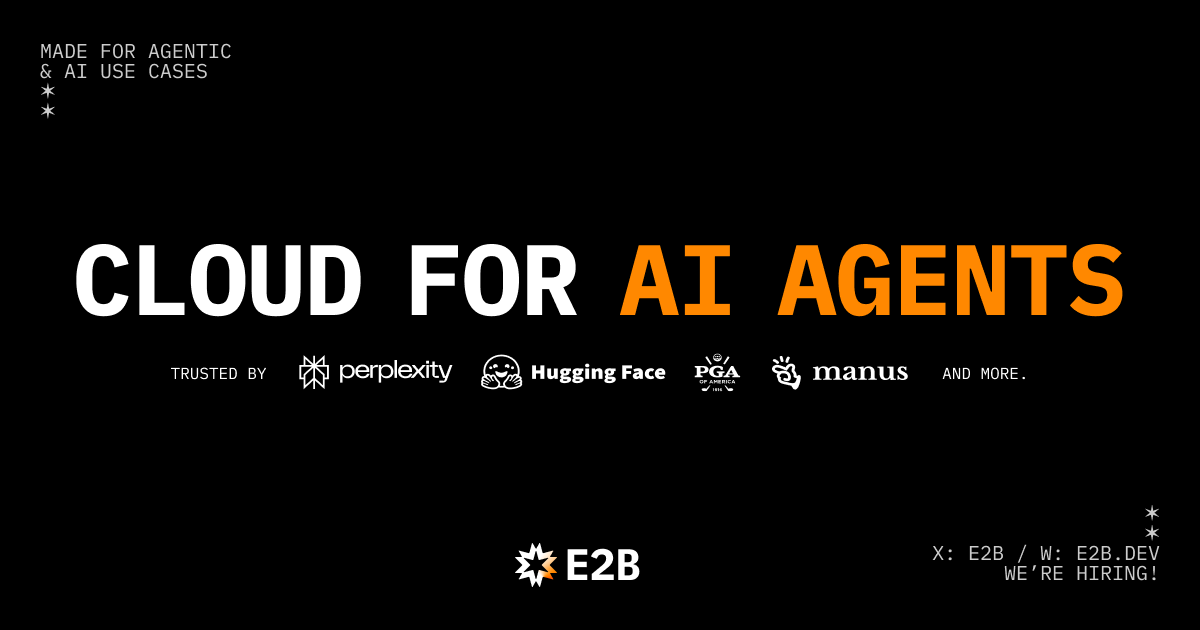
E2B is an open-source cloud that gives AI agents secure Firecracker microVMs to execute code, browse the web, and use computers. Used by Perplexity, Manus and 88% of Fortune 100 companies, it boots in ~150ms and runs sessions up to 24 hours.
E2B is the open-source cloud that gives AI agents secure, real computers — Firecracker microVM sandboxes that boot in ~150 ms, run for up to 24 hours, and let an LLM execute code, browse the web, or click through a desktop without you ever trusting it on your own machine. We rate it 88/100 — the clear category leader for agentic code execution today, with the only meaningful caveats being that it is still a young company and the runtime cost adds up at scale.
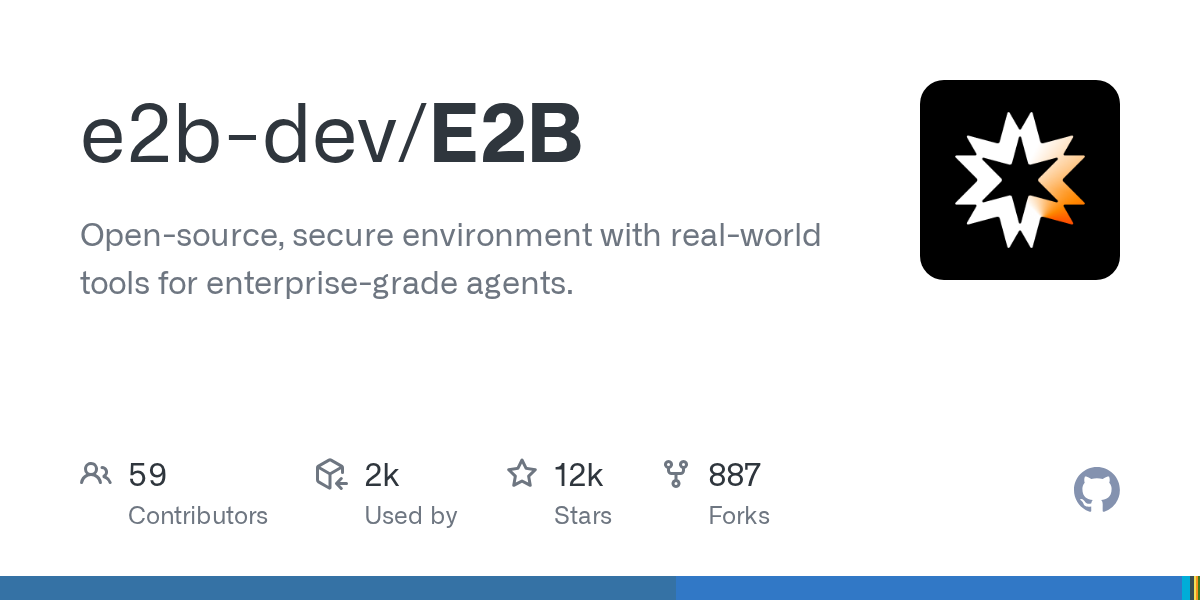
E2B (which stands for "Environments to Build" agents) was founded in by Czech founders Vasek Mlejnsky (CEO) and Tomas Valenta (CTO). The company has raised $32.5M to date — an $11.5M seed in September 2023 led by Decibel Partners and a $21M Series A in July 2025 led by Insight Partners with participation from Decibel, Sunflower Capital, Kaya, and angels including former Docker CEO Scott Johnston. The open-source e2b-dev/E2B repository on GitHub has crossed 12,000 stars and 880+ forks, and the company's homepage claims usage by 88% of Fortune 100 companies, with public case studies from Perplexity (advanced data analysis shipped in one week), Manus (virtual computers for autonomous agents), Hugging Face, Notion, and Y Combinator portfolio companies.
The problem E2B solves is simple to state and brutal to solve: when an LLM writes code, you do not want to exec() it on your laptop or in your production VPC. You want a disposable, fully isolated machine that boots fast enough to feel synchronous, exposes a real filesystem, network, and shell, and tears down cleanly when the agent is done. E2B is the platform that turns that requirement into a one-line SDK call: Sandbox.create() in Python or TypeScript and you have a Linux box your agent can do anything in.
Sentiment across Hacker News, r/LocalLLaMA, and developer Twitter is unusually positive for an early infrastructure company. The most consistent praise: the SDKs "actually feel good to use," documentation is dense and accurate, and support resolves issues "in minutes" — a recurring quote from enterprise testimonials. On the Insight Partners and VentureBeat coverage of the Series A, developers from Perplexity and Manus publicly credited E2B for shipping features in days that would have taken months on a custom orchestration layer.
The honest complaints are also consistent. Reddit threads in r/LangChain and r/AI_Agents flag two real concerns: per-second runtime billing (~$0.000168/sec per sandbox) gets expensive for high-volume workloads — at 100K runs/month at 30 seconds each, you are paying around $504/month in sandbox time before LLM costs — and the dashboard offers more configuration than a solo developer needs for a quick Python script. Some commenters on the open-source repo have asked for longer free-tier sessions and a clearer migration path to self-hosting; both are roadmap items the company has acknowledged.
E2B's pricing has three tiers, all on top of per-second usage costs. The Hobby tier is genuinely usable thanks to the $100 of free credits, and the Pro tier is priced for teams already shipping agents in production.
| Plan | Price | Key Limits |
|---|---|---|
| Hobby | Free + $100 one-time credit | 1-hour max sessions, 20 concurrent sandboxes, community support, no credit card |
| Pro | $150/month + usage | 24-hour sessions, customizable Sandbox CPU & RAM, higher concurrency, priority support |
| Enterprise | Custom | BYOC, on-prem, or self-hosted; SOC 2; dedicated support; volume discounts on runtime |
Sandbox runtime is billed at roughly $0.000168 per CPU-second. For mental math: a sandbox running for one minute costs ~$0.01. The free $100 credit translates to about 165 hours of single-CPU sandbox time, which is more than enough to ship a real product to MVP.
Best for: Teams shipping AI agents that need to execute code, run browser automation, or perform data analysis on user-supplied inputs. SaaS products adding a "ChatGPT-style code interpreter" feature. Anyone building a coding agent, a data analyst agent, or a "computer use" agent on top of Claude, GPT, or Gemini. Open-source projects that want a turnkey sandbox layer without writing their own Firecracker orchestrator.
Not ideal for: Hobbyists running one-off Python scripts where a local Jupyter notebook is fine. Workloads that need persistent state across long-running sessions — sandboxes are meant to be ephemeral. Cost-sensitive use cases that run code for hours at extreme concurrency without negotiating an Enterprise rate.
Pros:
Cons:
Modal is the closest competitor — it is more general-purpose serverless compute, not agent-specific, but you can build a sandbox layer on top. Daytona ships Firecracker-based developer environments and recently added an AI sandbox SDK, so it is increasingly a head-to-head choice. Cloudflare's Workers Sandbox API is cheaper for very short-lived JS workloads but lacks E2B's full Linux environment. For self-hosted options, beam.cloud, Sprites.dev, and rolling your own Firecracker setup are all on the table — none have E2B's polish out of the box.
If you are building an AI agent in 2026 that needs to execute untrusted code or operate a real computer, E2B is the default answer and probably the right one. The 150 ms cold start, the SDK quality, and the production references from Perplexity and Manus all justify the price. Hobbyists with the $100 free credit get a free runway long enough to ship a working product. The case to look elsewhere only really applies if you are running massive concurrent workloads where the per-second cost compounds, or if you have a hard regulatory requirement that pushes you toward self-hosted from day one — and even then, E2B's Apache-2.0 license and Enterprise self-hosted plan keep them in the conversation. We rate it 88/100: very good, market-leading where it matters, with honest room to grow on long-running sessions and price for high-volume use.
ServiceNow and Accenture Launch Forward Deployed Engineering Program to Scale Agentic AI in the Enterprise (May 6, 2026)
At Knowledge 2026, ServiceNow and Accenture announced a joint forward deployed engineering program that drops co-located engineer pods into customer environments to ship agentic AI workflows natively on the ServiceNow AI Platform — with access to 300+ pre-built agent skills and the AI Control Tower as the governance backbone.
May 7, 2026
ReFiBuy Raises $13.6M Seed to Help Brands Get Recommended by AI Shopping Agents (May 5, 2026)
ReFiBuy, the Raleigh-based agentic commerce platform from ChannelAdvisor founder Scot Wingo, closed an oversubscribed $13.6M seed led by NewRoad Capital Partners on May 5, 2026 — betting that the next billion-dollar e-commerce moat is being chosen by ChatGPT, Claude and Perplexity.
May 7, 2026
OpenAI Replaces ChatGPT's Default Model With GPT-5.5 Instant — 52.5% Fewer Hallucinations, 30% Shorter Answers (May 5, 2026)
OpenAI on May 5 swapped GPT-5.3 Instant for the new GPT-5.5 Instant as ChatGPT's default model, claiming 52.5% fewer hallucinated claims on high-stakes prompts and 30% more concise answers. The model also rolls into the API as chat-latest and adds personalization from Gmail and past chats for Plus and Pro web users.
May 7, 2026
Is this product worth it?
Built With
Compare with other tools
Open Comparison Tool →