 Developer Tools
Templ
Type-safe HTML templating language for Go with compile-time safety
Crawlee is the open-source scraping framework from Apify that pairs Cheerio, Puppeteer and Playwright with built-in proxy rotation, browser fingerprinting and a persistent request queue. Free, Apache-2.0, and arguably the most production-ready crawling toolkit shipping today.
Crawlee is the open-source web-scraping and browser-automation framework built by Apify, available for Node.js (TypeScript) and Python, with first-class support for Cheerio, Puppeteer and Playwright behind a single, autoscaling crawler runtime. We rate it 90/100 — the most production-ready open-source scraping toolkit shipping today, and the right default for any team building serious crawlers in 2026.
Crawlee is the in-house framework that powers Apify's own commercial scraping platform, open-sourced under Apache 2.0 in as a successor to the older Apify SDK. It abstracts the messy parts of crawling — request queues, retries, browser fingerprints, proxy rotation, session pools, autoscaling, error recovery — behind one consistent API, and it lets you swap between an HTTP-only crawler (Cheerio / BeautifulSoup) and a full browser crawler (Puppeteer or Playwright) without rewriting your scraping logic.
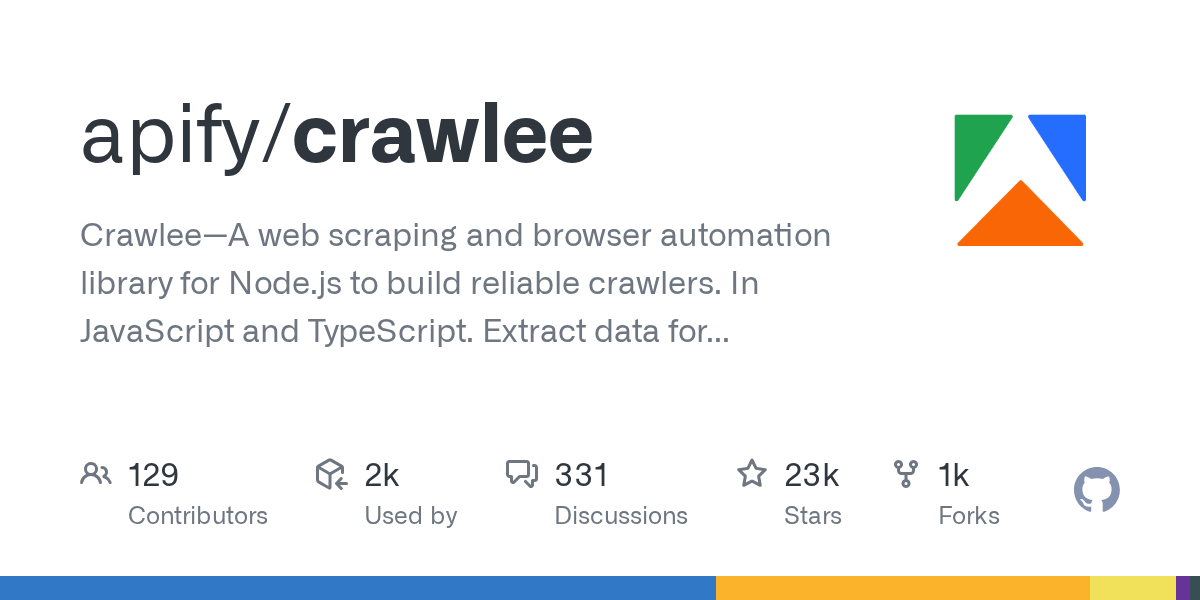
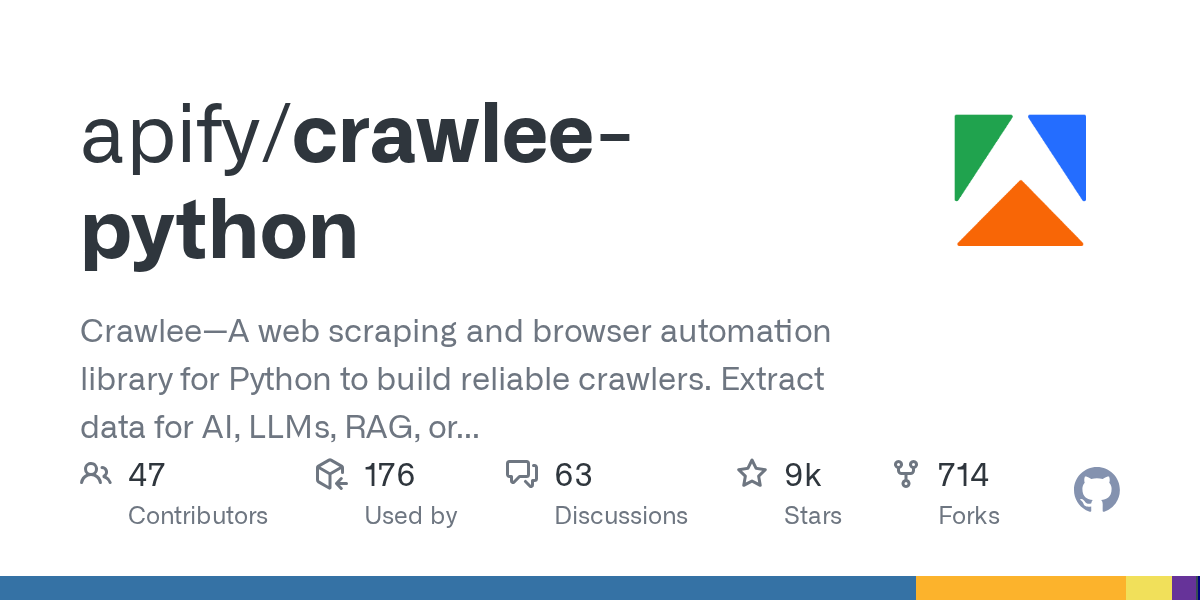
The library is maintained by Prague-based Apify, the same team that runs the Apify cloud platform and Actor marketplace. Crawlee for JavaScript currently sits at 23,000+ GitHub stars, 1,340 forks and shipped v3.16.0 in . Crawlee for Python — launched in — has crossed 8,800 stars and pushed v1.6.3 on , putting both ports on weekly to fortnightly release cadences.
CheerioCrawler, PuppeteerCrawler and PlaywrightCrawler share the same router, queue and storage APIs — switch from a fast HTML-only crawl to a full headless browser by changing a single import.fingerprint-suite, which generates human-like TLS, header and Canvas/WebGL fingerprints from real browsers, so headless Playwright runs aren't trivially blocked by the major anti-bot vendors.ProxyConfiguration rotates proxies based on success rate and per-session stickiness, with first-class hooks for Apify Proxy, Bright Data, Smartproxy and any custom HTTP/SOCKS5 list.AutoscaledPool watches CPU, memory and event-loop lag and ramps concurrency up or down automatically — no manual maxConcurrency guessing.AdaptivePlaywrightCrawler tries each URL with cheap HTTP first and only falls back to a full browser when the page actually needs JavaScript — cutting compute by 5–10× on mixed sites.npx crawlee create spins up a Cheerio, Playwright or TypeScript starter project with Docker, ESLint and TypeScript wired up — under 30 seconds to first run.Sentiment is overwhelmingly positive among production scraping teams. On Hacker News, the recurring praise is that Crawlee is the only popular scraper that "feels like a real framework instead of a stitched-together tutorial" — the queue, retry and storage primitives are exactly what people end up reinventing if they roll their own. On Reddit's r/webscraping, the consensus across multiple 2025 and 2026 threads is that Crawlee + Playwright is the default recommendation for anyone past the toy stage, with Scrapy being the only serious Python alternative for veterans who want maximum control.
The honest complaints are mostly about scope and learning curve. The TypeScript types are dense, the docs assume you already know why you'd want a request queue, and the Python port still has a smaller plugin ecosystem than the JS port. A handful of users report that Crawlee's default fingerprints get caught by Cloudflare's stricter Turnstile rules — you still need a residential proxy and sometimes a stealth plugin for the hardest targets. None of those are dealbreakers, but they're worth knowing before you commit.
Crawlee the library is and will remain free and open-source under Apache 2.0 — you can run it on your laptop, on a $5 VPS or on Kubernetes without paying anyone. Pricing only enters the picture if you decide to host crawlers on Apify's managed cloud or use Apify Proxy. The Apify platform tiers as of 2026 are below.
| Plan | Price | Key Limits |
|---|---|---|
| Free (Apify cloud) | $0/month | $5 in monthly platform credits, 7-day data retention. Plenty for prototyping. |
| Starter | $29/month | $39 platform credits, 14-day retention, email support. |
| Scale | $199/month | $249 platform credits, 30-day retention, priority chat support. |
| Business | $999/month | $1,249 platform credits, premium support, account manager. |
| Self-hosted Crawlee | $0 | Free forever, Apache 2.0, run anywhere with no token-counting. |
| Enterprise | Custom | SSO, SOC 2, contractual SLA, dedicated infra. |
Best for: Engineering teams building production scrapers, RAG ingestion pipelines, price-monitoring crawlers or LLM training datasets — anyone who needs proxy rotation, fingerprinting and recoverable state but doesn't want to reinvent the queue. Solo developers also love it because npx crawlee create gets you to a running, dockerised crawler faster than rolling your own Playwright script.
Not ideal for: One-off five-minute scrapes where a 50-line Python script and requests would do the job, or for non-developers who want a no-code visual builder — for that, Apify Actors or Octoparse will fit better.
Pros:
Cons:
Scrapy is the long-standing Python alternative — battle-tested, plugin-rich, but built around a 2010-era async model and weaker on browser automation. Playwright alone gives you the browser layer but nothing above it — no queue, no retries, no fingerprint stack. Colly in Go is fast and minimal but ignores the browser problem entirely. For a hosted, no-code option, Bright Data and Octoparse are credible — at a very different price point.
Yes — emphatically. If you're writing more than a one-off scraper in 2026, Crawlee is the default starting point. It is one of the very few open-source frameworks that hits the right level of abstraction: high enough to delete a week of yak-shaving, low enough that you can still drop down to raw Playwright when you need to. The fact that it's free, Apache 2.0, dual-language and backed by a profitable parent company (Apify) makes the long-term bet about as safe as open source gets. The 90/100 reflects exactly that — a near-best-in-class tool whose only real frictions are the learning curve and a handful of edge-case anti-bot scenarios that no library can fully solve on its own.
Developer ToolsType-safe HTML templating language for Go with compile-time safety
 Developer Tools
Open-source API key management and rate limiting platform for modern developers
 Developer Tools
Open-source low-code platform for building internal business applications
 Developer Tools
Git-friendly open-source API client for REST, GraphQL, and gRPC
ServiceNow and Accenture Launch Forward Deployed Engineering Program to Scale Agentic AI in the Enterprise (May 6, 2026)
At Knowledge 2026, ServiceNow and Accenture announced a joint forward deployed engineering program that drops co-located engineer pods into customer environments to ship agentic AI workflows natively on the ServiceNow AI Platform — with access to 300+ pre-built agent skills and the AI Control Tower as the governance backbone.
May 7, 2026
ReFiBuy Raises $13.6M Seed to Help Brands Get Recommended by AI Shopping Agents (May 5, 2026)
ReFiBuy, the Raleigh-based agentic commerce platform from ChannelAdvisor founder Scot Wingo, closed an oversubscribed $13.6M seed led by NewRoad Capital Partners on May 5, 2026 — betting that the next billion-dollar e-commerce moat is being chosen by ChatGPT, Claude and Perplexity.
May 7, 2026
OpenAI Replaces ChatGPT's Default Model With GPT-5.5 Instant — 52.5% Fewer Hallucinations, 30% Shorter Answers (May 5, 2026)
OpenAI on May 5 swapped GPT-5.3 Instant for the new GPT-5.5 Instant as ChatGPT's default model, claiming 52.5% fewer hallucinated claims on high-stakes prompts and 30% more concise answers. The model also rolls into the API as chat-latest and adds personalization from Gmail and past chats for Plus and Pro web users.
May 7, 2026
Is this product worth it?
Built With
Compare with other tools
Open Comparison Tool →